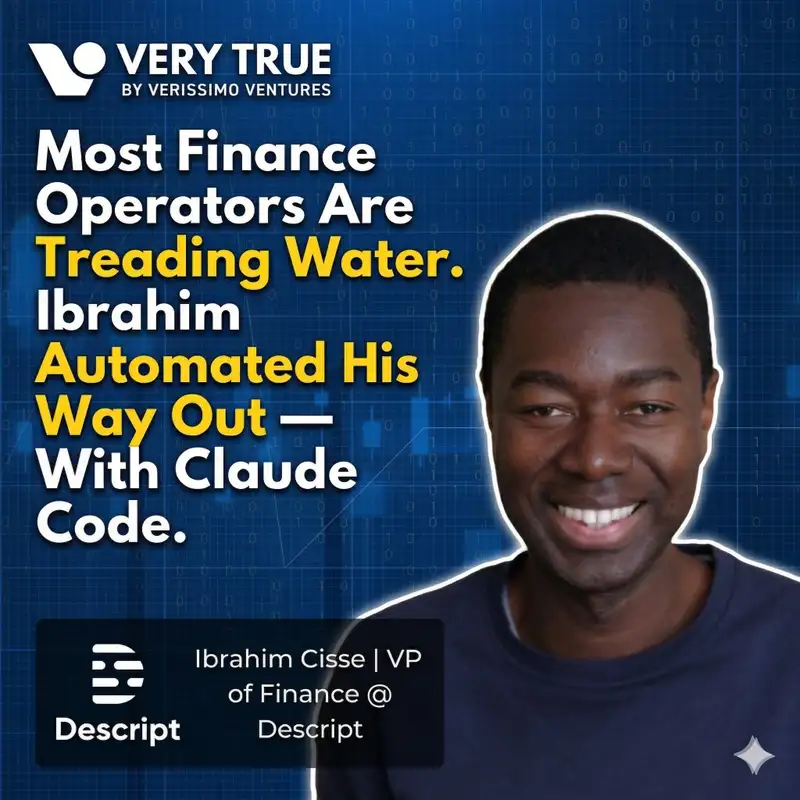
Most Finance Operators Are Treading Water. Ibrahim Automated His Way Out — With Claude Code.
Alex (00:00)
Welcome back to Very True. I'm Alex, and today I'm sitting down with my friend Ibrahim, VP of Finance and Operations at Descript, who I think is quietly one of the most interesting financial operators in the game right now. Here's why. Ibrahim has essentially rebuilt his entire workflow around AI, not as a gimmick, not as a party trick, but as a genuine operating system. We're talking about email triage, SQL queries, contract red lines, procurement approvals, all running out of a terminal and cloud code. No developers required.
But what makes this conversation worth your time isn't the tools. It's the mindset shift underneath them and the intelligent process designed to integrate AI into critical operating workflows. When you remove every bottleneck from a great operator, something interesting happens. They don't relax. They go deeper. We talk about what finance actually is, what gets unlocked when you stop treading water, and where all this is heading. Let's get into it.
Alex (01:42)
Welcome back to everybody to another episode of very true today. I am really excited to have my friend, Ibrahim on the podcast. He is currently the VP of finance at descript and is deep in the AI space right now as a financial operator, but also has spent a lot of time thinking and operating on how best to use AI tools in that finance seat.
This is something that I've personally been waiting for for a long time. I am the son of a CFO who's in his late sixties now. I have been a strategic finance consultant for a long time. I've seen the operational mess that happens inside companies. And I've been waiting for what I call the next generation of financial operators who instead of playing whack-a-mole can be more thoughtful about how to use modern tools to solve really old problems.
And we can talk about the history of that a little bit more. Ibrahim and I met, we were actually both kind of consulting in a different finance capacities for the same company, I think back in like 2018 or 19. And, we've stayed in touch. We've, ⁓ we've, I think we've actually met once in person and it was in Paris a few years ago. and you know, he's in now my hometown and I'm in, ⁓ I'm in Jerusalem, which is my new hometown.
Ibrahim Cisse (02:49)
Yeah, in Paris, yeah.
Alex (02:56)
And I'm excited to have him on today and to share this discussion with everyone. So I will kick it over to Ibrahim to share a little bit more of his background and we'll take it from there.
Ibrahim Cisse (03:07)
Sure. Thank
you, Alex. Happy to share a little bit about my background. As you said, I lead finance and operations at Descript. Descript is an AI video editing tool. And as you may know, at a startup, doing finance and operations means a lot of things. So at Descript, I lead the finance and operation team, so meaning that the finance team, the accounting team, I'm also owning RevOps.
Something that's slightly different than a lot of finance operators, I also oversee our customer support team and I'm fairly involved in internal tooling or IT also as well. Funny enough, I wear a lot of hats at the company. Last year, I was our interim head of sales and success for a year until we hired a VP of sales for obviously great reasons. But yeah, so a little bit about my background.
I'm from Paris, started my career at a very large retail marketing firm where I was part of the international team. So my job at the time was to kind of travel across Europe, work with a ton of different subsidiaries. And when a head of finance was MIA, they would just send me and I would have to handle that subsidiary. So I've that for a couple of years. I loved it. And then I decided to move to the US. I moved to San Francisco where I was
you know, head of finance and ops at a small kind of SaaS company, built the finance, accounting. I was also head of people there. I a small startup. I've done that for couple of years. Then I moved to consulting work where I met you, where I worked with a ton of like B2B SaaS companies. And there, like, I've done a ton of things. wearing multiple hats, a fair amount of a lot of modeling. I think that's kind of where we overlapped a little bit.
a fair amount of fundraising, working with a lot of head of sales, implementing a lot of data stacks, controllership activities, and all of these things. so yeah, I was doing a little bit of consulting work for this company, Descript, and I happened to join them full time a year later. So that's kind of my journey into the company.
Alex (04:53)
you
And we have to admit we are, we're recording this on Riverside. We're not on Descript, but I think maybe one day we'll graduate ⁓ to the real enterprise tour, make this happen. So that's very cool. Really what it, one of the things that it makes me think about that you've worn all these different hats is, and I just posted on LinkedIn about this, about how we just use this jargon and the term that I, you it's like finance. And I still remember when I stepped in to
Ibrahim Cisse (05:08)
Not yet, not yet.
Alex (05:28)
meet the founders of monday.com and they're like, what do you do? Like we've never met anyone who does what you do. And I was like, it's called finance. Like, well, we have a finance guy. I'm like, let me guess, he worked at EY or PWC before. And they're like, yeah, I'm like, yeah, he's probably an accountant or an auditor, you know? And they're like, huh, like what's the, like, what's like, what's the difference? And I, know, the way I cutely define it is like, I have this line, which I say, which is that if you're
a creative financier, you become a billionaire. And if you're a creative accountant, you go to jail. And that ethos completely changes the way you view the world. And the other thing is one's backwards looking, one's forwards looking. And especially in startup land, you want things to be geometric, not arithmetic. And again, you need to understand not how to make sure things check out, but how how calculus can drive businesses. So it's a very different philosophy.
Ibrahim Cisse (05:57)
You
Alex (06:20)
I found that there's very few people that understand both well enough to actually be useful. And again, I'm the son of a CFO and I've watched my dad try to figure this out and how, you know, he became effectively like, you're saying a really good manager. Like my dad was the CFO of Planet Labs and he became the head of launch. Like he flew to India for like 36 hours once to manage an actual launch. Now.
My dad worked in aerospace and as a trained mechanical engineer, so it wasn't like so insane, but like still he's the CFO of the company. And like, that's what happens. And it actually gets to another idea, which is, you know, people have been talking about how like data is the new oil. And I still remember when the term big data was invented back in like 2012. And I'm, pretty sure we kind of, I don't want to say we invented it at Morgan Stanley, but we really popularized it. And it was for the Splunk IPO.
So Splunk does logs, right? Which logs are just the accumulation of data and it's very raw. And I still remember, you know, visiting a very elite cybersecurity team and like, they just had Splunk logs like flowing on their big screens. But anyway, like people talk about like data's the new oil and like, yeah, if you want to just sell stuff online, then like, I guess data's oil. But I came up with this other thing and it's tied to like my recent kind of health binge.
Ibrahim Cisse (07:09)
Mm-hmm.
Alex (07:35)
which is that like data is actually blood. And you know, what blood does is it carries nutrients around our body and it's the circulatory system. And as a result, you can take a prick of your finger or from your arm and with a very small sample, you can actually learn a tremendous amount about what's going on in the organism. And to me, like that's what data is. And the original form of company data,
Is financial data. Like that's what companies run on. So the term I started using instead of finance is quantitative resource allocation. And so I know that we're kindred spirits in this, but I'd love to hear your take on like how. I don't know. Whatever you're thinking like on, this idea and like how this has developed and how we should be looking at what financial data and real all company operational data represents.
Ibrahim Cisse (08:01)
Yep.
for sure. Yeah,
I think I would agree. I'm pretty data minded as a finance operator, especially since working at Descript. I would say, I think the old way to look at it ⁓ was for me to mostly focus on just pure financial data. And so financial data is like, what is my revenue?
⁓ What is my COGS? I want to check my OPEX. And then I can just work on the cache forecast and your runway and all of these. So these are like OEC table stakes. And you need to have that information. But I will say a lot more finance operators are going to work across the entire data stack. And the entire data stack is the amount of instrumentation, especially at the top line level, is tremendous now. So we have a ton of data tables.
around traffic data, conversion data, signups data. We have a massive amount of segmentation of our AR metrics that we track on a daily basis when we do some aggregating table on a monthly basis. And we have a lot of reporting around those, especially when you work at a high scale or high volume environment, data is definitely key. And I would say data is a big part of how a finance person has to operate.
within the company. And then the goal for me is how can I glean all of the, because then there is also like a ton of data. Sometimes there's even too much data. And then the question is, how do you glean the key insight at the company so that you can just overall like improve the business model of your business, right? You want to help operators at your company to make better decisions. You want to challenge existing ⁓ operating practices. And so I've...
been really like spending a lot of time on data over the years, especially early at Descript. I'm a little bit biased where like also for my strategic finance team, I tend to really hire people that have data backgrounds. And I feel like having that mindset, that approach makes you like just a better operator.
Alex (10:25)
For sure. I think in this day and age, it's like, you can go on vibes, you can go on instincts, but you need to actually then have the skill to back up those vibes and instincts with the data. But that brings me to another thing where, you know, I'm like, I fancy myself like a pretty hardcore finance guy, but I do these like pre-seed inception stage investments. And people are like, I don't get it. Like, shouldn't you be doing like growth stage? And I'm like, well, I like the harder problem. Right. And I would say like,
Ibrahim Cisse (10:43)
You are.
Alex (10:51)
Let's solve a financial problem with our eyes closed and our hands tied behind our back. And people say, well, how do you build a model for a company when the company has no financials or no data? And I say, well, how do you know what data to collect if you don't know what model it's going to go into? And that gets people thinking. But that brings me to like a broader point, which is this interplay between structured data and unstructured data. And I'll give like a little bit of a...
hopefully accurate history lesson here, which is that the first ever software post the calculator, which is a piece of software, was basically accounting software, right? Like, because computers are really good at adding numbers, like really, really fast, and they're really accurate. So they're like, let's just add a bunch of numbers. like, so there's been this interplay between, I'm not going to get into the whole thing between like,
the regulatory angle and like what the tools are and how that defines the job. And it became like this vortex of things getting slower and slower and slower and further behind. But it was really good for structured data. Then it feels like over the last 20 years, we've been on this war path of like structuring unstructured data. I mean, a great example of that would just be performance marketing. Go to, know, John Ham's character in that,
mad men or whatever it's called and tell them like one day everything's going to be data. like, you're going to have a Google analytics dashboard and like a meta dashboard. And you're going to like, you just be able to measure everything and be like, that's not marketing. Like that's nerdy computer science stuff. And you're to be like, yeah, exactly. but that interplay between structured data and unstructured data and being able to turn things that were historically
Ibrahim Cisse (12:06)
My man, yeah.
Alex (12:28)
unstructured into things that are structured. Like humans are good at unstructured data. And that's again, where a lot of the leaders and instincts and those amazing people and what they can do. But I feel like now, and this kind of gets into the main meat of our conversation, which is like, I think AI has in a large way from an operational perspective allowed us to take unstructured data.
Ibrahim Cisse (12:35)
Yeah, intuition.
Alex (12:49)
That is at the management layer in language, in meetings, whatever it may be with customers and turn that into structured data on which we can apply much more objective, rigorous methods to get down to the truth. But at risk of kind of losing the thread or, you know, missing the forest for the trees or whatever, where you can still totally mess up if you don't have some instinctual thing going on. So.
Ibrahim Cisse (13:16)
yeah.
Alex (13:16)
I guess as you think about like that interplay between structured and unstructured, again, if you've done sales, you've done customer success, you've lived this, not just numbers to numbers to numbers, but interactions to numbers. How do you think about that going forward now that the AI tools, especially just over the last two months have like massively stepped up? And by the way, I have to plug this. I just got off a call with one of my best friends from high school who is now an AI professor at a pretty elite university.
And he told me last summer he switched to Gemini and in December he switched back to Claude. And I'm like, okay. And I literally basically did the same thing today. Today's the day. It's like back from Gemini, back to Claude. Because before I was on Gemini, was on Claude, OpenAI, Perplexity, Gemini 3.0 out, now it's Claude, Resonant, 4.6 or whatever. And then maybe we'll go back to OpenAI, whatever. Anyway, so I'll let you take it from there.
Ibrahim Cisse (13:59)
Yeah.
Sure, sure, There's a couple of interesting points. About unstructured data and structured data, ⁓ that's definitely something we're trying to work with on a daily basis, especially around there's two ⁓ areas where I spend some time on. There's obviously the sales and success part and the customer support part. And one of the challenges we have and where we're spending a lot of time at the company is how do we turn that unstructured data into structured data?
Right, so even last week as I was speaking with the team, and I was like, hey, so we use a couple data points of the company and a couple tools, especially on the customer support side. So we have an AI chatbot that is interacting with all our customers ⁓ if you have support tickets. And at same time, we use Zendesk for, let's say, a different channel of tickets. Let's say if you reach out directly by email or something like that. So we have two different channels. Data is fairly unstructured.
And what we're looking to get is, how can we move all these data to really structured BigQuery tables so that we have the details of the customer IDs, their plan, but also we want the context and the content of all these conversations? So that then we can now all these kind of tribal knowledge that we had that were like sitting in like the head of CS or some agents can just be fed into
or data pipelines. now, because we have, thanks to AI, we have a way to integrate that data at scale and then see trends in real time. We have metadata tagging that you can do automatically. it's just one thing we're doing right now. Same thing for Excel schools, right? So obviously, we use tools like Gong, or there's different tools out there, to record audio sales conversations. You can also try to get the emails and all of that.
The question is, how do you map all your customer journey into some sort of structured data table so that you can start asking, give me the type of customers that are expressing X amount of feedback or that specific type of feedback. And so that's kind of where I think the data team and my team are spending a lot of time on is data infrastructure around this. Because I think what we're looking to do is really leverage ⁓
insights at scale, because it's pretty easy now to just connect a specific data point and ask a specific question. But what we want to do is to really enable pretty much anyone in the company to interact with these tools and glean insights from those. So yeah, think that's kind of the... I would say now, everything is data, and I'm thinking a lot more about this on every part of the business.
⁓ You know, want or GL to be in a data set in that I can create on SQL I want to have access to all our contracts in some sort of database so that I can create that, you know at scale through AI same thing for all invoices like things like we're not think think that we're just reserved for like Data initially in the past like okay, maybe my my bidding data my customer like metrics now everything is data
And because now you have the tools to kind of start tapping into those and have high sense of interpretation. So that's what we spend a lot of time on.
Alex (17:15)
Nice. And so I guess one of the key things and I experienced this myself, like I've, as some people know, I built like a whole air table operating system for my business over the last six years. It's a, if you go to the VCOS.com, can see really actually it's already a couple of years old version of it. And to me, the value there is the structure, right? And the way that the pieces interact with each other of understanding like
Ibrahim Cisse (17:28)
Yeah.
Alex (17:39)
Here's a fund product. Here's an LP entity. Here's people. Here's a fun product that owns a holding in a company that is in a pipeline that is connected to meetings that is also connected to people and the companies and like the overlay and like the layout of that, which was clear in my head of like how all these things interrelate to each other. And then I spent hundreds of hours mechanically tying them into each other.
And so I just, I just did something interesting with Claude. I still need to review what it, what it popped out with. Cause I just put Claude into Excel today for the first time, which is what I did was I always tell people back, like what I said is that great business models start in PowerPoint. They don't start in Excel. If you can't first clearly lay out, here's what we sell to who and how.
Ibrahim Cisse (18:15)
⁓ okay.
Alex (18:28)
We have an SDR and like, here's our process. Like, let's just walk through the process and like at each point in that process, we can measure something. We can actually create the frameworks to build a rigorous process that will throw off the right data. like, frankly, I did quite well helping people just do this, right? Like sit down with the founder and be like, break down your sales process for me. And then like, let's try to simplify it. Like we don't need different AEs for every channel when you're a small company, like
Ibrahim Cisse (18:54)
yeah.
Alex (18:54)
Let's
consolidate that into one eight, for example. So I took one of my PowerPoint layouts, which again is let's clarify what we are trying to do as a business. And I took that PowerPoint layout and I put it into Claude and I told it what my kind of legend is of like what the different colors and shapes mean. And, and I said, turn this into a model. And I only had a few minutes to look at what it had done, but it's pretty good. Like.
Ibrahim Cisse (19:19)
Yeah, it's impressive
now.
Alex (19:20)
Because again, I feel like, okay, I did the heavy lifting. The other part is pretty mechanical, right? And so as someone who is pretty ADHD, but loves Excel and structuring kind of like flows and stuff like that, to me, it's just an accelerator. And so I guess I'm interested in hearing how you think about the necessity, I guess, in the future of understanding those frameworks or...
To what extent you can just be like, here's everything that's going on. Let me just talk at you. And like the AI can like then distill that, create the PowerPoint, teach you the PowerPoint of the flow chart, and then build the Excel model to match it. Like, are we there yet? Is that what people should be doing? Like, do they even know that they need to be asking AI to do that? And that's the requisite steps to do something useful. This is where I'm still trying to figure out like, where do humans fit into this? And like.
Ibrahim Cisse (20:10)
Yeah, for sure.
It's super interesting. I was thinking a little bit about this last week about AI for modeling. So I use AI fairly extensively for all my workflows. I would say if there is one maybe workflow where I'm not using it as much is on the modeling side. Obviously, I think when you're in finance for a while, you're a pretty advanced Excel user for most people.
And so you tend to start building fairly complex models. I think AI is at a point where if you want to make a fairly targeted change, update, or creation of a model, it can do that fairly well. But if you have a fairly open-ended PowerPoint and you say, go create me a model,
you may have to tweak that a ton, or you may come up with a fairly simplistic model that may not fit your point of view. I mean, it depends, especially if you're on the seed stage, early stage, it's fine. But when you're tens of millions of ARR, things like that, it starts to be maybe different. So I would say I still use it mostly as a copilot on the modeling side.
One use case that I used fairly recently on the modeling side is, so let's say on our self-serve model. So you know, you have two channels of this script. You can buy through the sales team or you can buy through self-serve. Most of our business comes from self-serve. then, so we have a fairly extensive cohort-based modeling. And what I asked the model to do and why I used to spend a bunch of time is to translate
all these kind of modal inputs into daily targets for the team. So what it did, it went to go check historical data about, hey, here's kind of the impact of what's happening on a holiday, what's happening on the weekend, listed all the kind of anticipated variation for 2026. It took all the inputs of data and do that translation automatically. And then you can start targeting that. So I think for that, it's extremely useful.
I think in terms of the conceptualization, you still need to have a good sense. I would say you need to have a mental model of how your model is going to look like. Otherwise, you may grow a little bit frustrated, or you need a way to go into plan mode very, very extensively. You need to really tell him exactly what you need in plan mode to get exactly what you need. Like vague prompts for non-finance experts is tricky. I think that's why you really unlock
a lot of value using AI is if you're like an expert in a domain and then you have AI, then that's kind of how you start. That's when you start seeing amazing, amazing leverage.
Alex (22:44)
So I'll give two examples. The first was like five years ago, advising a company. the second is like two weeks ago with one of my portfolio companies. ⁓ So five years ago, I remember I was working with a marketplace company and the COO wasn't really like a marketplace tech guy, whatever, very good guy. But he was like, I just want to know what one supply side person is worth, right? Like what's the LTV of like a supply side participant.
Ibrahim Cisse (22:51)
Yeah.
Alex (23:09)
And I was like, it depends, right? Like, you're like.
Ibrahim Cisse (23:13)
It's always the answer in finance. It always depends.
Alex (23:14)
I like because
marketplaces are about load balancing, right? It's like I tried to explain it and they're like, hey, remember when Uber was offering like $5,000 for drivers? And the reason why was that if you don't have enough drivers and people open the app and there's no drivers, they just close the app and then they don't open it again. And that is very, very expensive. And so it's all about load balancing. So you can't just isolate the value of a driver. And I've gone deep on like unit economics of a marketplace are like a really clever and like shout out to my friend.
Ibrahim Cisse (23:19)
Yeah.
Alex (23:42)
Amit Mukherjee, who I worked with at NEA, who was the first person to explain this to me of what are the unit economics of a marketplace and how to think about that from a load balancing perspective and the information that you need. I guess we maybe could ask the AI right now and see, but okay, I was able to explain to him that he was not asking the right question. And I've definitely experienced that with an AI prompt where I ask it something and to what extent can it push back and be like, that's not.
really the right question. could like tell you right now, but that's a point in time and this is the context that you need. so it's this broader trend of like meeting people where they're at. It's something I've been thinking about really for the last couple of days of like, can you meet someone where they're at? Like I was able to tell this guy, like, that's not really the right way to look at it, you know, and like, because if you go out and acquire a bunch of those, but you don't have demand side to fulfill
their supply, then it's not going to matter and same the other way. So that's one example where like, the question there is like, can the AI meet you halfway? Right? Like, or not halfway, right? Like let's say right now I can meet you halfway, but what feels halfway to us now might feel like only 5 % of the way six months from now where like he'll just ask like, what's it worth?
He might not even have to ask what's it worth. He'll just be like, what should I do? Right? Like some super vague thing and like it can capture the context it needs. Cause like that's really the key to prompting. Anyone who's used AI knows that like you've got to give it the information that you need. And I'm a data nerd. So like I have like my watch collection on an air table, my wine collection on an air table, my flights in a Google doc. And that's only because I've been tracking them since before air table existed. I've got obviously my huge air table of how I run my business.
Ibrahim Cisse (24:58)
You
Alex (25:22)
I just put together like a gear closet Google sheet of like my bikes and my like running gear so that I can like ask AI like what should I wear? Which bike should I run? What tire pressure? Like, and it already knows all the context and I give it the information that it needs because it doesn't always know to ask. But I guess as you just think about it, and this is almost more like a philosophical question, at what point can it just, it'll know what to ask.
Ibrahim Cisse (25:25)
Hehehehe
Alex (25:47)
Right now you have to tell it, like, if you're not sure, don't just infer, like, ask me to confirm. But like, where does it just get like smarter enough that it's just like, nah, I don't need you. Like, I got this. It could pull its own context. It's an open-ended, like, philosophical question.
Ibrahim Cisse (26:00)
Yeah. Yeah, it's an open, yeah,
yeah. I think it's definitely going to get there at some point. And the way I'm thinking about it right now is I think the first example you mentioned is really good in the sense that for now, anything that doesn't require a high level of judgment could be deferred to AI at a very high level right now.
No, there's no questions about this. So then your question is like the frontier question is, when is it going to have that judgment that we have right now through experience or through challenges that we've faced? I think it's going to probably, I have no idea to be honest, like it's a billion dollar question, but I feel like we're going to get to a point where
that is going to have a lot more nuance and judgment. And I would say, yeah, I think it's hard for me to answer, but I think it's probably coming. I think it's probably coming, yeah, for sure. Or at least we'll be really pleasantly surprised about the things we look at. The thing that I'm still trying to wrap my head around is how can it start to be proactive?
Alex (26:57)
Yeah.
It's hard to know where it's headed.
Ibrahim Cisse (27:12)
on the type of insights of problems. Because I think when we're pretty good at right now, mean like non-machines, is to look at specific patterns and ask the right questions and start asking people around the company or the AI to do a deep dive on specific topics because we have that questions and we kind of start asking the right questions for us. And so
When is it going to be able to do that? It's tricky also as well because I'm thinking like the way I'm thinking about it, it's so different from one company to another. The way to operate is so different from one company to another. The way I will ask a question will be so different based on what's a team, how do they...
Alex (27:53)
Does that make
sense though? I always felt like when I was consulting for a bunch of different companies, and I'm sure you felt this too, where things should not be as different as they are. Like, no, this is how we do this. I'm like, yeah, well, that's wrong. Or it's it's totally under optimized. Everyone should be doing this, this, and this. And this gets to the broader question of the financial workflows. It takes a really long time, as you've experienced.
Ibrahim Cisse (28:03)
⁓
Alex (28:16)
to learn enough about the various functions inside an operational finance organization to be able to own all of it. And even if you don't have to do all of it just to hire it, like to know enough about cash management and audit and like compliance and FP &A and accounting and taxes. And again, the list goes on and corp dev and like having to jump in and run CS and like HR, like my dad always ran HR and IT and like.
Ibrahim Cisse (28:36)
Yeah.
Alex (28:42)
build up that knowledge set to be able to run each one of those takes a really long time. I guess the, like, I guess to what extent do you think that that is like either can be massively accelerated and you could just put like any smart person and they'll just know what to do and learn it or like that's still going to be defensible that the person who's focused on it for a long time will own it.
and like will be the master. don't know. I guess I'm just like riffing on this right now, but.
Ibrahim Cisse (29:14)
Yeah.
Also, I think for me, there's two ways to look at it. ⁓ One is like, is that an existing company, a pre-AI company, or is it a company that you start now? A company that you start now, I believe you can build almost like, know, this AI is almost like, you know, a team member at this point, right? You know, they have full context. I think you have your AI set up in most conversations, decision-making process. You can start logging every single decisions at the company.
And so I think they can probably wrap up fairly quickly on all of that. When you have a company that have been around for a little bit where it's hard for you to come up, as a new person that joins the company, what you do is you start talking to people. You start to understand that. You start to understand what was done in the past, how the product works, the type of customer. You talk to a bunch of customers and all of that. And so there's a lot of
still a little bit of things that are influencing your judgment over time in these, I would say, pre-AI companies that you still need to learn. And so I think that's for the set of context. And the second thing is more like decision making is I'm using AI all the time. And when I used it this morning, I looked at some data. And I have like, hey, there is some gaps in data. Because I've been around the company for a while. When you've been around companies for a while.
you have this kind of nose for like, you know immediately when something is off, you you just need to glance at numbers and you have a feel for it. And so that is, think, something that is still tricky to build for the AI tool. And though like I'm building like a sub-agent auditor that's going to say, hey, if we tell me you return me some data, span this sub-agent auditor that's going to review and question if there is any gaps and all that. But still, even with that, I think you can.
think from a logical standpoint, like, why do you have a gap in this data? It can help you there. But sometimes even the overall process is not that great. Yeah.
Alex (31:08)
Yeah,
like if you can, if you can articulate the thought process that you're going through, where you say, saw this and that together or three or four things together, and that made me question something. And you teach that to the AI. And then you say, like, you do that a few times on different various compound anomalies. We'll call them. Can the AI discover a fifth one?
You know, like that, that marginal one that like you wouldn't have discovered. that's. Yeah. I mean, I, I always wonder about that because like it's in the world of like written word AI, there's nothing new under the sun. Like it's pulling something from everything. Like I'll use something that I thought was an obscure reference in some thing I'm using to edit. And it'll be like, yeah, you're referencing this specific. It's like, yeah, that's me for AI. But when it comes to like.
Ibrahim Cisse (31:53)
Yeah.
Alex (31:57)
deep compound inference, I guess it should be good at that too, right?
Ibrahim Cisse (32:00)
It should be good at it. I agree. mean, the first step that you mentioned is definitely something that I do and most people should be doing. Every time there is an issue on something, I say, hey, let's fix it together. And I do explain my thought process and why I think there's a problem. And now it has memory. We have an error log where every time there is an error, will log it so that it can learn from it from the next time and make sure.
Pretty much what you want to do is you don't want to fix the same thing over and over again. You want to fix it once and make sure it gets it. And so if you have a good system, yeah. Exactly.
Alex (32:31)
This was my entire ethos when I was in banking. was like, I never want to do anything twice. So I automated
things that I should not have wasted time automating because I built templates because I like, I don't want to have to do this again ever. yeah, it's an interesting approach.
Ibrahim Cisse (32:45)
Exactly.
Yeah, it is.
Alex (32:49)
So, so I guess what I'd love to jump in on is a couple of things. Like the first is I'd love to hear about a couple of examples of workflows that you've inside the operation, which I think a lot of our listeners would appreciate hearing and learning from because it's, it's, it's usually just mind expanding. then the second piece, which I think frankly is more interesting is how you've come upon them. Like,
Ibrahim Cisse (32:53)
you
Alex (33:13)
How have you decided, like, this is where I'm gonna insert the tool? Because again, it's this in-between layer of like, how do I apply the tool, which humans, by the way, have been dealing with for a really long time, like, since humans existed. Like, how do we use the tools in the best way possible that are given to us, and how does that develop over time? I think the timelines have gotten quicker, the tools have gotten more powerful, but that is where a lot of value accrues, especially for...
smart people, frankly, like what is the methodology in discovering the next use case for that tool? So, yeah.
Ibrahim Cisse (33:45)
Yeah, for sure. ⁓
So some of the key workflows. I have a ton of workflows. ⁓ OK, so ⁓ maybe let's start with the genesis of it. The genesis of it for me was there is one thing that I'm not great at, and there is one thing I've wanted. The one thing that I'm not great at is I'm not the best at email management.
Alex (33:52)
I imagine.
Ibrahim Cisse (34:08)
⁓ So, you know, I've never believed in zero inbox. You will like come open my inbox. People will be shocked because I have thousands of unread emails and all of that. I never missed an important email. I would just glance at them all the time, but it always felt for me like just wasted time to just, you know, classifying my emails. Every time I'm seeing people who's like zero inbox, I'm like, how do you guys do that? Like, you know, I'm just, I'm like, I'm like, I'm not going to spend my time labeling everything.
Alex (34:31)
It's fake.
Ibrahim Cisse (34:35)
know, drag and dropping every single email. Even if you use tools like Superhuman and stuff like that, that can really accelerate the workflow. I still couldn't quite get to it. So that was one thing that I wasn't great at. And the second thing is I kept trying a bunch of like to-do lists and tasks management tool. And I really wanted something that would auto update by following me daily. So there's a lot of ways that I'm getting tasks at the company that I need to do. So it's one.
Obviously, it's like, OK, you have an idea. You want to log it as a task. Two, you're in a meeting. We talk about stuff. And then you have a task from the meeting. Three, you receive an email. Four, there's a bunch of Slack messages. And that turns into tasks. So I just wanted to tackle these two things. I want an amazing task management system. And I also want to get rid of the email management stuff that I'm not great at. So one of the first workflows that I had was
plug my Gmail into Cloud Code and have it review all my emails. So I have what we call a Quant jobs. It's just an automation that is checking my emails. I would say three to four times a day. It will list every, it will, and I will receive a recap of that in Slack. So I have a Slack channel between me and Cloud. And so it was my private Cloud bot.
And let's say at 9 AM, it will check my emails. It will archive what needs to be archived. It will draft responses to all the emails that I need to reply to. It will update my to-do list and figure out a bunch of tasks for me to do. So that's kind of how I started to do it. And so that's kind of the genesis of it. And so just to email management and task management, because I had a bunch of those.
After that, it expanded to everything. So I have a bunch of data requests and ad hoc requests at the company. So we plugged on BigQuery, a bunch of data is in BigQuery. And now can ask it to do anything. Let's say if I received a request from an investor and say, hey, I want the Customer Cube for AR for your enterprise customers for the last 24 months. I can just.
First, I don't even have to ask it to do it. I will most likely receive an email. The AI will see that as an email. It is going to be on my to-do list. And then I will say, hey, let's work on this. So it will capture the data, do all the SQL queries, and then return the data. I have also the Excel MCP. Or I can use Google Sheets or whatever. So it will create Excel docs automatically with all that request. So these are the type of workflows I'm working on.
Mostly, I have a ton of those. This morning, actually, at 6 AM, I was finalizing two additional MCPs that I added. We use Zip as a procurement tool. So I do a fair amount of legal review at the company. And I was like, man, I wish I could just do everything from Cloud. I barely want to log into a platform anymore. I want to use, I mean, my OS is Cloud. So a Cloud code on the terminal is my OS. So as
I want to open as little software companies, tools that I want. So pretty much I want to open my terminal and I should be able to do the max amount of things there. And so I just connected zip as read only, read only, because I think it's pretty important. read only. So now when I have a request, when I need to approve whatever procurement, it can go there, find all the agreements and review the agreements and then tell me what, you know, if it's okay, not okay.
according to some data rules that I give it. So I can do that. I can go on and on. I also have one that I like a lot about red lines on contracts.
Alex (38:08)
So.
So I'll abstract this a bit, because what I'm hearing is that your genesis in your first use case was like pain point, painkiller, right? Everyone talks about like vitamin versus painkillers. It's this thing that bothers me that I don't like. And so like, let me spend some time thinking about how do I remove this pain point from my life and how can AI do that for me? It seems like the second step was here's some other stuff that like doesn't bother me that much, but it's time consuming. And how can I leverage the power of AI
to collapse the repetitive tasks and just surface what I need. And in some cases, again, with like a query request of someone looking for a piece of information, like you can automate the whole workflow. And I think that most people are, they don't even have that framework of like, okay, let's go after the things that I don't like that I'm not good at that annoy me, that spike my cortisol, like whatever. Like when I look at my inbox, I have two inboxes, right? And it's just like, and people are like, superhuman.
make your inboxes going like, it will not review the legal contract in my inbox. It will not approve the PWC audit form that I need to like, you know, these are like detailed things that I need to handle ⁓ that require like approval and judgment and all these things. So that's one. The second thing again, is the time consuming stuff where it's like, this is repetitive or again, I'm feeling personally like super enabled by this because like I had a boss.
Ibrahim Cisse (39:08)
Exactly.
Exactly.
Alex (39:30)
many years ago, a wonderful guy named Harry Weller, and he couldn't even sit through a meeting. He was 45 years old and he couldn't sit through a meeting. Like the ADHD was off the walls. But what I saw was a guy who was effectively the lead board member on 17 companies. You can't do that without being ADHD. Like that's a prerequisite for the job. And I saw how he was able to harness that and
Unfortunately, Harry passed away almost 10 years ago. This guy would have taken over the world with AI because what I find is like, I've got ideas like flying all the time and I try to give myself the space to do that. And AI really like empowers that right? Where like, I just have a spark of an idea. I could throw it in. I'd like, okay, you run with it while I do this other thing and then bring it back to me or like, and I didn't give the second example before of what I did with this company.
Ibrahim Cisse (40:10)
Yeah.
Alex (40:21)
I did an exercise 11 years ago with the company and then I did an exercise two weeks ago. I can explain that maybe after we finished this little part, but yeah, it's like, so I guess the next question is like, what's the next step, right? What are the things that, cause I think emotionally we hang on to things that we enjoy doing, right? Like I, for many years, like I just enjoyed like,
updating my software comps in this five megabyte Excel file connected to capital IQ. I just enjoy doing that and like resorting them and studying them and being involved in it. I don't want AI to do that for me. I need to see it and enjoy it and update it and add stuff and delete stuff and update the IPOs and da-da-da. At a certain point, I just lost interest in doing that, but I don't need to do that anymore.
But I enjoyed doing it for a long time, so I wouldn't have thought to get AI to do that. So I guess the question is like, probably the next step is, okay, let's take, we've got the pain points as one, we've got the time savers as two. Step three is the things that we enjoy doing that maybe we shouldn't be spending a lot of time doing, but like we just enjoy it. It's dopamine, it's fine, because we're nerds or whatever. The next step after that, I think that's where there's a lot of really interesting stuff, which is that.
Stuff we really physically didn't even think of being possible before. I guess to what extent have you taken it there?
Ibrahim Cisse (41:42)
Yeah, for sure. I think I'm fairly close. So first, I'm at a point I don't hang on anything. So everything, I'm using AI literally for 100 % of my workflows. It's very rare that I will do something without leveraging AI in some forms. And I think that's kind of the point of view right now, is it's just a copilot.
Right. So I feel like I have, I'm working with, you as I said, like most of my workflows will start from the, from the terminal. So.
Alex (42:11)
Well, so I
have to ask, I just have to interrupt you and ask then, are you working less or are you accomplishing more or both?
Ibrahim Cisse (42:17)
Oh yeah.
I feel like I'm working more, definitely. yeah, think you start to unlock bunch of projects that you wanted to do, right? And you never looked at it. especially when you are a startup, the amount of things you have on the back burner, that is, and it doesn't mean these things are not important. That means sometimes they felt like too time consuming, or you need to leverage so many people to get there, or you're missing that insight, is massive.
And so I think now you can do a ton of things at the company. And so it's just a massive accelerator. So you all can accomplish.
Alex (42:53)
a shout out to Cal Newport's book, Slow Productivity, which I am slowly working my way through. If you haven't checked it out or any of Cal Newport's stuff, highly, highly recommend. Yeah, I'll leave it there. There's a lot of good stuff in Slow Productivity that I think, again, Cal Newport's a computer science professor. Nothing in there talks about how AI ties so well with Slow Productivity because it allows us to be so uniquely in
Ibrahim Cisse (42:58)
Yeah? No.
Alex (43:18)
authentically human instead of being a cog in the machine. And the more we can kind of decog ourselves, I don't know what the right term is and pass off so much of it to AI, it really opens up to us up to do more interesting things that are aspirational that there were blocks on before. So what, I mean, what are some examples that you've, you felt like, okay, I now I've
Ibrahim Cisse (43:33)
Exactly
No, definitely.
Alex (43:41)
I've handled ABCD, which were all pain points that were like, again, a lot of people that are in the VP of finance seat in startups are like, I cannot stay afloat. They're like, forget automation. just, like, I haven't thought about that at all. I just need a procurement tool. Like just tell me which procurement tool now. Like we just, you know, we need an AP tool. Okay, fine. Like, so.
Ibrahim Cisse (43:52)
Exactly.
Exactly.
Yeah, I mean, first, I mean, as you mentioned, I think it's really hard to stay afloat. And I think you use it for that. I think we have a team that's fairly lean. And everyone on the team is leveraging AI as much as we can. And for me, my job is to take as much as I can and have the biggest impact on the company. And AI is just a way for me to get there. So I'm definitely doing a lot of that. I think when you start to unlock, for me, like,
Alex (44:04)
So I guess.
Ibrahim Cisse (44:27)
a lot of me spending a lot more time on key insights on the business. For example, this morning, where I spent a little bit of time on something that I would have loved to do and I would have never done without AI is I did a pretty massive deep dive on retention cohorts for our customers. so typically, the thing that I always wanted to know is what are the segmentation bad channel? What are the type of
actions customers are doing in the product that are fairly well correlated with retention and the high amount of retention. And that just uncovered, like, there's something I'm going to bring to the team that there's a specific feature that we have. And when people are using that feature, what we've thought was a plus, actually, the retention of these customers is below average. So these are the type of insights I want to start bringing to the business.
I think when you're in finance and you're in this type of world of the startup, you just have a curiosity that is limitless curiosity. And I think that really allows me to get there and start tapping into all the questions that I have in my mind and so do a ton of exploration. So that is that. And again, we always, as you said, trying to stay afloat. There's a bunch of things we're supposed to do that we're not doing. And I think AI is just allowing us to do.
you know, to just punch above our weight, you know.
Alex (45:47)
I think that's the, and we talked about this a little bit earlier. The thing that gets me more excited, frankly, than AI products is AI operations. Like as an investor, when I see a company going after some legacy industry and they're four people and the rest of their employees are just AI, like different AI tools, I'm like, they don't stand a chance. mean, like the incumbents, like don't stand a chance. And I wrote about this recently in what I call margin inversion.
Ibrahim Cisse (46:12)
Yeah.
Alex (46:16)
where it used to be that like gross margins were low and like OPEX was high. And so like the risk was high. And now it's like, well, why does gross margin need to be low? And is it really that low? And like, if you can crush OPEX, now this, what wasn't an interesting business is now a really interesting business, but you can do it with four people instead of 80 people. like, I know there's been a lot of talk about that. It's not that interesting, but I'll tell the kind of the other example now. ⁓ I'll give a couple entrees into it.
Ibrahim Cisse (46:41)
Mm-hmm.
Alex (46:44)
When I started in investment banking, they put us in training and they had us do an exercise where we put together a whole like valuation deck on a company as a team of four.
And I'm pretty sure it took us longer to do it as a team of four than it would have taken any of each of us to do the whole thing ourselves. You lose so much efficiency in communication. And by the way, I'll quote Ben Gilbert from acquired, like he talked about lossy compression and that's what a form of like talking and writing is. It's just lossy compression and trying to unpack and repack and rezip like it was playing telephone. So that's one.
Ibrahim Cisse (47:16)
Yep.
Alex (47:18)
The second thing I experienced was like when I was at Morgan Stanley as a full-time analyst, you know, after I finished training, we would, I worked with some really talented people that could get in the room with founders and operators and really like understand the gist of like, what made this company special? And this is why when I was there in 2011 to 13, we like cleaned up the market. We did every IPO because we figured out how to get people excited about these technology companies. And that is an art.
There's a woman I worked with named Marcy Vu, who is like one of the best in the world at this. I remember her physically writing on slides, like how to position Facebook, which again, in hindsight, are like, oh yeah, it's Facebook. And there were huge questions on Facebook. And she was able to architect this. I mean, she did the same thing for Groupon. She did the same thing for LinkedIn twice, right? Like the list goes on and on. Zynga, like so many other companies, like what actually captures the value of what's going on? And then it runs through this nil.
up and down the chain of like Marcy up to like Michael Grimes and then down to Ali who we worked with and then me and Cindy and like that was the workflow up and down and up and down and every once in a while I had Michael Grimes over my shoulder running helping run like in the weeds like the Facebook valuation model that we invented and it was like dozens and hundreds of hours of work of how do we position this company.
And every layer of the communication back and forth into the company and everything is just massively inefficient. Fine. Fast forward three years, I'm sitting at NEA. One of my partners says, hey, we got this company. They want some valuation work done. Who wants to do it? And I'm like, I love this stuff. Sign me up. Right. I fly to Chicago. I sit with the founder. Turns out he already has an LOI for an inbound &A. And I'm like, maybe we should hire a banker. He's like, no, we got this. I put together a full management presentation.
came up with like the cleverest comp selection, used every trick in the book of discounted equity valuations and DCFs and comps and M &A and how do we do with some of the parts on these other companies and split out with just like the whole kitchen sink of valuation methods of how this company is going to be worth a lot. Oh, the CEOs, oh, this is great. This is great. See, I told you we don't need a banker. I know where the company is. I can pitch it. You just give me the numbers and the math and we'll run with it.
Ibrahim Cisse (49:10)
I'm sure.
Alex (49:29)
It took me like, I don't know, 15 hours to like do the first draft of that, which like, if I was the analyst on it, it would have taken me like 200 hours, you know, just to get that. Um, because it's so inefficient going up and down. Then I had this realization, which again, I did all of a sudden it gave me the space to do Marcy's job, which is to have the, the revelation of like, ah, this is why this is valuable. And for that company, I had realized that
Ibrahim Cisse (49:39)
Yeah. ⁓
Alex (49:56)
another company started doing their own, some of the parts publicly and disclosing one of their subsidiaries, financials, and all the equity research analysts started valuing that subsidiary. And that is what our technology actually could do for the acquiring company was to build that. Now I'm like, okay, now we have a synergy model we can actually build based on, we can stand on firm ground. And yeah, I had like iterated another 12 hours on the deck and tuned all the numbers. And then that came into my mind. When the CEO saw that,
He was like, this is going to make me a lot of money. We ended up selling the company for double what the initial LOI came in for. It's the single most valuable thing I've ever done in my career. I generated almost a billion dollars of equity value by figuring this out. I doubled the &A price. Fine. Fast forward to two weeks ago, I'm sitting with one of my portfolio companies, early stage company, still small. I don't know that much about their market. I know it's like a big market.
great, there's a lot of potential, but it's also a slow sales cycle and fine. And they've been talking to a company that's much bigger, been in this space for a long time. And I was like, we need to create that same magic. And so I did that entire exercise, which I just described, which at that point I could, I'm at a point in my career where I can unpack what were the steps and what was the progression from that hyper inefficient, you know, four of us doing the same low level job to like,
Ibrahim Cisse (50:52)
Yeah, yeah.
Alex (51:13)
four of us doing a stack of jobs, which was also very inefficient to me doing the whole thing, which was efficient. And then going to the CEO to then me sitting on zoom live with the CEO and in 45 minutes, developing the same thing for this company, having the realization of, this is the key. This is how we create that magical and a dynamic that makes us so valuable to the acquirer.
I didn't know what it was going to be, but I was like, I know that's what we need to figure out that special moment. And I was able to create that. And it went from like, again, this mega inefficient exercise to like the day in day out of being an investment banking analyst, which I don't even, I would love to like, I kind of want to have an investment banking analyst on here now to be like, what's your day to day like compared to what mine was like. And then because we were, I caught like the worst moment in investment banking, I would argue where we, we had all the data, but we didn't have any way to automate.
Ibrahim Cisse (51:56)
yeah.
But none of the tools, yeah. All of the day none of the tools, it's like a ton of work.
Alex (52:05)
using it. remember like, Ablo was used for the first time. Massively
inefficient. So my desire to automate everything was helpful. Then doing it quickly just with the CEO at the vision, then doing it live in 45 minutes. So anyway, that's like my own experience. I guess as you look forward and like things have obviously changed a lot in the last six months. I'll, we can kind of finish off here with like, what gets you excited?
Where do you think the future, know, what's next on your list? What's the next thing that gets automated? What's the higher level thing? Like, where do we go from here? And I guess what's your advice to other financial operators, most of whom are treading water, you know, to get above that? do you have a, I guess, so we'll, two questions. What are the quick tips and tricks for financial operators that you would share? And what are you excited about that comes next?
Ibrahim Cisse (52:57)
Sure. I'll start with a quick tips. Tips that I have, I would say, I think you need to invest the time in building these systems. And you need to go through the initial hurdle of like, hey, it's faster for me to do it manually. Every time you set up a new system, there's a learning curve on that system. You need to prompt it really well. You need to write down.
pretty much all of processing documentation. I use Obsidian as whatever is the second brain. ⁓ It's a bunch of like MD files. And in all my MD files, I have all my processes. And you need to spend the time. You don't need to write them down yourself. You can ask the AI to do it. But you need to spend the time to set up your system. And it's going to feel painful at the beginning. At the beginning, you'll feel like, hey, I'm so busy. And I'm working extra to set up that system. But yeah, I think you have to do it. The second thing that I have is do not
try to fully automate fairly quickly. So initially, what you want to do is to leverage AI as much as you can. But you can use it as a one-type workflow. So let's say you don't want to say, hey, everything is automated. I'm not even looking at it every time, because it's going to break, and you're going to lose confidence. You want to be sure that you feel really comfortable about the output every time, that you have this sort of learning loop and all the tweaks. And when you feel pretty good about
something as an output, then start doing like full automation. Cause I see so many people wanting to jump too quickly at the automation and then like they get frustrated or it doesn't work as much because they did not refine the process. You know, it's like a, it's like a factory, right? You're not going to buy a machine to automate your whole kind of, you know, assembly line. If you haven't done it, if you don't have a sense of like, what's the best or efficient way to do it or what great looks like once you have that, then you start to be
kind of really build the assembly machine. So I think that's kind of the tip that I have. And I would say anything that does not require a high level of judgment for me at the first step should be through some sort of AI workflows as much as I can. So every time I'm doing something, I'm asking myself, how can I better use AI for that? So I would say that's the tips.
What gets, what excites me? There's a ton of things. mean, first, just the ability to build is what I feel like is super exciting. There is no limit, right? And I think I've always been like, obviously like a finance person, but I at heart, I'm like some sort of a generalist. I love, you know, talking with product or, you know, doing sales stuff or things like that. And I think the, the ability for like,
really high level generalists to do everything in the company and have massive impact. I'm really excited about that. I'm really excited about just the progression of the models. Over the last nearly three months, the progress of the models is just like, you know, insane. I think, and seeing how this thing is going to be even like three to six months from now, I'm super, super excited about it.
And the goal is to, again, more than a game, it's more like how can you help the company achieve its goal, right? And I think for me, it's helping me a lot when it comes to even like mutual allocation. There's a bunch of software that I don't need to buy or like we're replacing with AI. But also, I think it really helps us to kind of guide us making better decisions in terms of growth. And I'm really excited about the prospect.
of ubiquity around the company. So what I'm trying to do as much as I can is how can every single person at the company can use it and not just, you know, the fringe, you know, the one who is really into it, the nerd people. And I think if you get as a small organization, a group of like a hundred people or 150 people and everyone is using it the best way possible, that's where you really unlock, you know, productivity gains. You go through your roadmap.
10x faster, you can ship better value to customers, you can extract better value also as well. You can be more efficient in your go-to-market process. You can serve your customers better. It's just limitless possibilities when you start using it as a group and collectively. And these are the things I'm really excited about, about seeing that collective adoption and that impact at scale at the company.
Alex (57:14)
Amazing. I'm wondering if there's anything else we should discuss today. This has been super, super interesting. I mean, I've enjoyed it. This stuff just gets me excited. And it's great to catch up as well. Hoping to come back to San Francisco soon. Yeah, trying to think if there's anything else we should cover or should we just wrap up? Is there anything else you want to share or throw out there?
Ibrahim Cisse (57:25)
That was great.
Let's see. No, no, I think that's it.
Alex (57:39)
Okay, cool. Well, Ibrahim, great to catch up. Great to see you. Thanks so much for joining and sharing what you've done. think at least I've experienced some fear and that blockage, even though you mentioned it'll take longer to build the automation than it will just do it manually, but then you'll be done. And I said, like I said, I've always been that guy. I spent three hours doing something, so I would never have to do it again, even though it only taken an hour to do it once. And by the way, sometimes I never had to do it again.
Ibrahim Cisse (58:05)
Exactly.
Alex (58:06)
Waste of two
hours, but you know, maybe help someone else down the road. Actually, I know for a fact, sometimes it did when I was thinking, but, I think getting over that hump and finding, there's one key thing there. It's like, how do you find and define what's the, what's that one piece of your workflow? Like you got to think about it. Like what's the one thing that I feel like, ⁓ AI should be good at this and like, just put it there.
And then you start building the blocks around that one step at a time and you get comfortable with it and you repeat it and that motion becomes what drives a ton of value. there's a lot to be excited about right now, I think. ⁓ Yeah, amazing. Well, great to see you and thanks again.
Ibrahim Cisse (58:31)
Exactly.
It is, what a time.
Thank you. soon. Bye.