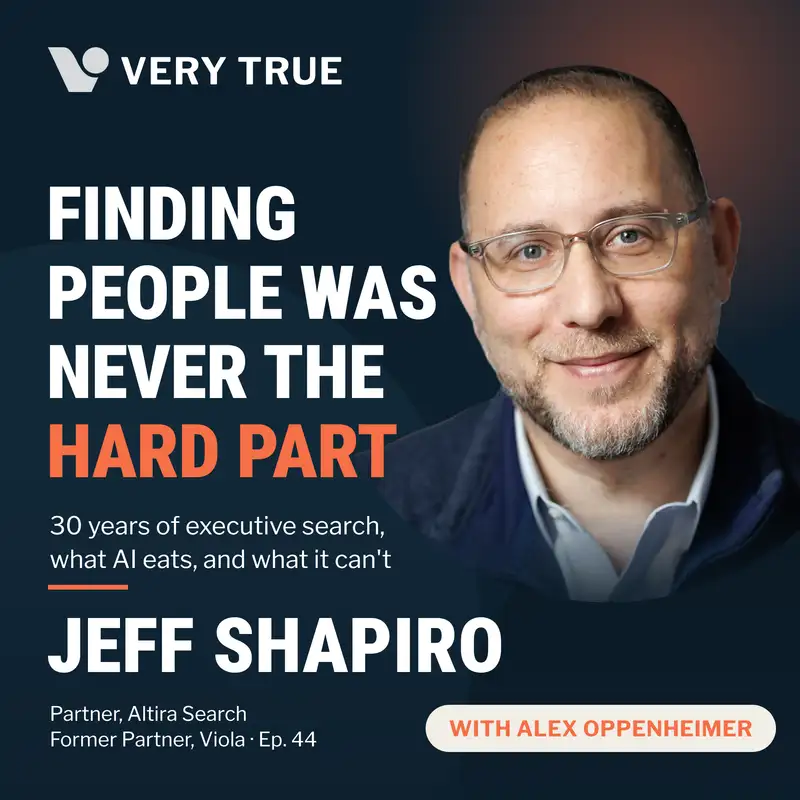
Finding People Was Never the Hard Part. Jeff Shapiro on 30 years of Executive Search, What AI Eats, and What it Can't
Jeff (00:00)
send an email to Eric Schmidt, Tell him I said he needs to do this. it was like Eric Schmidt saying, Hey Jeff, thanks for reaching out. Tell Vinod I appreciate it, but it's not for me. And then he joined Google like six months later.
there's no secret to finding people. The secret is in influence, the secret is in getting them over the line.
if you consistently make bad decisions that way, even if it's quote unquote not your fault, it's your fault.
Alex (00:20)
When was the last time a great executive recruit applied to a job posting? Think about it. The people you actually want are not refreshing their LinkedIn all the time. So how do they end up on your team? My guest today has spent 30 years answering that exact question. Jeff Shapiro is an executive recruiter.
He started at Egon Zender and Korn Ferry. And the very first search he ever ran was a CEO search for Vinod Kosla at Kleiner Perkins. He moved to Israel in 2005, built Everest search with Noam Eisenberg over 11 years, sold it to Kingsley Gate about five minutes before COVID, and then spent three years as a partner at Viola, focused on human capital across the entire operation. Now he's back on the search side working directly with founders. He's one of my closest friends here in Israel, which is why I keep calling him Yitzi.
And we get to what a headhunter actually does, which part of it AI has already eaten, why the CRO you're asking for might not be the right hire for what you actually need, why culture is the only moat you control, but is never as simple as people make it sound, leaders versus managers, what three years inside of VC taught him, and a rapid fire round at the end. Let's get into it.
Alex (02:15)
Welcome back, everybody, to another episode of Very True. Today I have my good friend Yitsi, aka Jeff Shapiro, joining me today. Uh,
Jeff (02:23)
Morning everyone.
Alex (02:25)
we have been friends for about 10 years. I think we met right after I made Aliyah in 2016.
Jeff (02:31)
Seems sounds about right.
Alex (02:32)
I vaguely remember getting recruited away from the Ashiva Minion to joining your secret seminary minion back 10 years ago.
Jeff (02:39)
That's
how we get you. We we starts off with some innocuous invitation to a minion somewhere and then look at you now.
Alex (02:45)
Funny enough, I think that I don't know if my wife was at that minion, but she went to that seminary. So
Jeff (02:51)
We bonded over wine.
Alex (02:53)
Wine, whisky.
Jeff (02:54)
Well, yeah, the things that we bond over, but yeah.
Alex (02:57)
Yeah,
traveling. So today we're gonna talk about a bunch of different things as we always do. This is a conversation. and this is our first podcast in a studio, which has already been an interesting experience. We
Jeff (03:09)
Live studio audience. Yeah.
Alex (03:10)
have hundreds of people, hundreds uh
Jeff (03:13)
Cue the laugh track
Alex (03:15)
sitting here with us. So do you want me to call you Yitz or Jeff for this podcast? Jeff.
Jeff (03:23)
Let's go with Jeff for now.
Alex (03:24)
So
let's just start with the story of the Jeff thing.
Jeff (03:27)
hi my name is Jeff.
Alex (03:28)
So I met our friend here as Yitzi ten years ago and we became good friends. And then all of a sudden we start interacting professionally and he's Jeff. And he told me, I don't know if it's true, that they start calling him Jeff when he went to Yeshiva University.
Jeff (03:41)
Funny enough. No, I thought I mean my my name actually is Jeff. I mean, let's let's be clear. My parents, like any good set of baby boomers, you know, was certain that you couldn't get ahead in this world unless you had a proper American sounding English name. So, you know, I was named Yitzchak Isaac for my great grandfather. And interestingly enough, his name in English was George, George Israel. And so they felt compelled to give me a name that sounded like George but wasn't George. Hence I am now Jeff Shapiro. So
Alex (04:09)
So every time I introduce Yitsi to somebody in Tel Aviv or New York or San Francisco who's like also a frum Jew, I introduce him as Yitz or Yitzi, and then he says, My name is Jeff. And
Jeff (04:23)
It's a little confusing. And
Alex (04:25)
to anyone who's seen the movie Twenty Two Jump Street, there's an amazing monologue that Jonah Hill does that is followed up by a very famous line from Channing Tatum saying
My name is Jeff. And he didn't know that that's what I was making him do every time he did that until I showed him the video. And
Jeff (04:40)
Now every time I walk into a room I just think, My name is Jeff.
Alex (04:42)
My name is Jeff. so here we are. We have Jeff Shapiro, who's had an amazing career and continues to have an amazing career as a headhunter, which is not to be confused with head shrinker. these are different jobs.
Jeff (04:54)
I'm an executive recruiter, let's be clear, okay?
Alex (04:57)
Head shrinking executive recruiter. Yes, that's that is the job title, head shrinking executive recruiter. And I just could never get that out of my head if someone's a headhunter and it's like, are you head shrinking or are you headhunter?
Jeff (05:10)
Well, I mean the image that you immediately think of is just like a bunch of little heads like on the edge of a spear or something with like, you know, kind of pygmies, you running around you know the Amazon or something. But but listen, that's what I thought when I first heard the when I first heard the word headhunter. So
Alex (05:26)
Let's just jump right in. what does an executive searcher do?
Jeff (05:32)
Great question. I've
Alex (05:34)
Ten seconds to describe it.
Jeff (05:36)
Yeah, I'll give you my elevator pitch. So I've been an executive recruiter for about 30 years. And in short, the whole industry was spun out of management consulting for the interest of helping companies, big and small, very specifically recruit senior executives, which is different than building engineering teams, building sales teams.
But idea being if you're a board, you're an investor, you're a founder of a company, and now you have to hire what might become one of the most critical members of your management team, it's not like just throw out a job posting somewhere and see who applies for it. It's more like, how do we find the one who's quite right for us? You know, company DNA, personality DNA, company builder, a startup person, a corporate person, et cetera, et cetera. I had the good fortune of beginning my career right around the time.
Alex (06:18)
pause you there because that sounds very AIable.
Jeff (06:21)
yeah. no, it's not at all. there are elements. No, I mean look, there are elements of what the recruiting world does that are incredibly AIable. applying the the the executive search world, the retained executive search world, which is what I've been in for the last thirty years, save for the three years I took sabbatical in venture capital. We'll get to that.
but you know, the the executive search world is an incredibly research intensive business. It's it's about understanding markets, it's about understanding companies, it's about researching people. All of that is incredibly, you know, is is ripe for automation. so every executive search firm in the world, and and look, recruiting at large, everybody's doing AI, but executive search in particular is completely supported by.
Agents that are in essence building, you know, all of the company background information you as an executive recruiter needs to know. They're building the lists of executives, all of which is public information at this point. There was a time, by the way, pre-internet, where the only way you'd find executives was to get on the phones and to source basically that was what you did. You you would get on the phones, you'd call somebody, you'd
Reach out to, you know, a a friend of yours, you'd reach out to someone else adjacent to the industry. You'd call up somebody's executive assistant and say, Hey, I I'd like to send so and so some some mail. Can I get his exact title and so on and so forth? And that's how you would, in essence, find people today, you know, thank you, LinkedIn. But like there's no secret to finding people. The secret is in influence, the secret is in getting them over the line.
Alex (07:53)
So if I put it in my terms, I would say that executive recruiters bring two main things to the table. The first is breadth, and the other thing which you haven't talked about is depth. And you just talked about the breadth piece, which has been automated and has gotten more and more efficient. Great. But without the depth, it kind of doesn't matter. And so for me, what that kind of reminds me of and points me towards is the fact that most people suck at interviewing.
Because it's not their job. Everyone's, everyone at the company's a recruiter. I saw some, you know, tweet recently from some hot company. And everyone on our team spends 25% of their time recruiting because it's all about the team. And like, okay, great. But, you know, I've worked in big financial service or organizations. I've worked with a bunch of startups. Nobody's really good at interviewing, even if they have people like training people at interviewing. And so there's there's always like the fit, and then there's like the really
Tactical stuff. Can you do this? Can you do that? But the stuff in between and the blending across those, to me, is like pretty hard to get to. And I think that most people in executive operating functions, even if they pride themselves as being great team builders, are not that good actually at interviewing for most of their career. They get to a point where, yes, maybe that it becomes like a true skill. But that what what is interviewing, right? You meet the candidates, you meet the team inside.
Jeff (09:19)
We we meet the I'm saying we in other words the that goes to the bigger question. We'll we'll get into the interviewing point, but look the interviewing doesn't begin with the candidate. The interviewing begins with the cut with with with clients, with our with the companies we work with. So in other words, being able to dive, let's just make this practical. Company X is looking to hire a chief revenue officer. Okay. So you're, you know, you've achieved a certain level, maybe you're 10, 15, 20 million dollars in revenue. The majority of the companies I tend to work with are tech-based companies, Israeli high-tech startups.
you know, from the earliest of stages, I've worked with Seed Stage Series A companies and I've worked Series C D and above and you know, help companies grow from zero to fifteen or from fifty to two hundred million. So figuring out exactly what you're looking for is the very beginning of determining who you're looking for, right? Because again, you could you see a lot of companies today, by the way. They will jump onto LinkedIn in today's day and age and they will put out a job post. We are looking for a CRO, which is fascinating to consider.
That it's possible that somebody might see this. Now, maybe the idea being is that someone will see it and say to their friend, Hey, this would be perfect for you. I think it's interesting to consider though that incredible candidates are searching for jobs, you know, on the internet.
Alex (10:31)
That is definitely true. but there's another aspect here which I'm interested to get your view on, which is how often do people come to you, boards, founders, exec teams, whatever, and say, We need an X, we need a COO, we need a CRO, we need a C H R O, we need whatever, we need a CTO. And you start talking to them and really getting a sense of how they're building their team. And you're like, Yeah, that's not really what you need.
Jeff (10:57)
It's not so much that it's company X is linked for CTO, and I say you don't need a CTO. It's company X says I need a CTO. And my answer to them or my response in the conversation is this isn't even a search, right? Maybe you're not large enough of a company. maybe it's not a CTO, but it is a VP of RD, or maybe it's a VP of product. In other words, the idea being is that even if it's experienced boards or even you know inexperienced or entrepreneurs,
But people have this idea of, this is what I'm looking for. So yeah, I mean, it is that many years of experience that helps you say to somebody, Well, what what if you think about it this way? And often, you know, I would tell you, often that that's that's a part of the conversation. Sometimes it's pretty binary. You know, we've achieved a certain level of growth, we need a CRO, right? VP sales got us to, you know, this point and we need to move forward, you know, further.
Alex (11:42)
So to foray that into kind of like the broader topic, which is that teams are changing, companies are changing, operations are changing, all of these things, all these terms we use, they're all jargon. There's probably people listening to this being like, what does the R stand for in CRO? Like, you know, then that's fine. But like one of the things I've noticed is like the faster things change, which they're changing faster now than they've ever changed in our lifetimes, the more you have to start to double click on the jargon.
Because the jargon is designed to oversimplify our lives. And that can be useful. We need jargon. We need generalizations so that we can have more efficient conversations. We don't to explain every little piece of words of what we're saying. If you have to read the Webster dictionary definition of every word instead of just saying the word, like that's what words are. They're code, right? They help us communicate ideas. But as these things change, like what a CRO is now, I feel like is pretty different from what a CRO was 10 years ago.
Jeff (12:37)
Great question, by the way. I mean, it's a good it's an incredible point around the fact that almost every C level title in the last 20 years, let's say, has evolved. And and maybe even the needs of some of them. Twenty-five years ago, I don't think anybody ever looked for product executives.
Today, it's probably one of the most sought-after executive you'll even look for, whether you're looking for an individual contributor all the way up through a chief product officer. to your point about CROs, chief revenue officers, do they own all go to market? Do they only own sales or sales and customer success? Do you put the entire marketing team under them as well? It's it really depends. And so it's to your point about jargon. I'm less of a fan of jargon if you can avoid it. I think, I think creating generalizations that people understand fine.
I actually prefer to speak as plainly as possible in these types of conversations.
Alex (13:25)
Operationally, like what do you need as a company right now? Where are the gaps forming? Right. Like as companies scale historically, and again, I think this is changing, frankly, but as companies scale, they different gaps appear in those companies. And I always say the only job in a company that does that that does scale infinitely is the CEO. And that is because how of how you define the CEO. So the best example of this is Mark Zuckerberg, right? He he's like this tech genius who dropped out of college.
Should he still be the C CEO? Should he have been moved to CTO? Should he have been become just the chairman, executive chair? Like in in a different world, that very well could have happened. So the fact that he stayed CE CEO, I think speaks to the fact that that is the only job that is truly elastic, and everything else is defined by that how that job is defined.
Jeff (14:16)
It's interesting, by the way, you point out Zuckerberg though, because that Zuckerberg was a departure. because up until that point, at least in Silicon Valley, or maybe in the US tech markets, it was incredibly typical that startups would be founded by two young guys in their college dorm. And then this is the best other exactly. And then not too shortly thereafter, you know, let's go find Eric Schmidt, let's go find Meg Whitman, let's go find whoever the
Adult supervision was meant to be. And Zuckerberg is probably a defining moment where someone said maybe it was Peter Thiel or whomever, but yeah, let's just let this guy run with it. Yeah, he has no experience. He's never built a company, certainly never scaled anything. but let's pair him up. Let's go find our Cheryl Sandbergs. Let's go find our you know, yeah, Chamath Polyopatheus, whatever they are. Let's go find executives out there who do have experience and surround.
This visionary as it is. You know, Steve Jobs, by the would be a good example of of when that happened the first time, but then maybe was a cautionary tale of what happens before you don't go find someone else who's a little bit more, I don't know, buttoned up as a CEO. today I would suggest the mo my experience is most investors tend to err on the side of giving the entrepreneur as much rope as they can to be successful. That's that has been my experience of late, maybe to a fault.
I feel I feel like, you know, and maybe I experienced this a lot in the Israeli markets. there are incredibly, incredible tech visionaries, people with I would define it as supernatural powers when it comes to figuring out product and what customers are looking for. But when it comes to building a company, defining a management team, building an ethos, too many, in my opinion, don't have those experiences and then wait companies wait way too long, you know, before they support them.
Alex (16:04)
Well, so that gets to two things. One is I think the the more interesting point here is the nonlinearity of startups and how long that is expected to last. And so what I mean by that was when I joined NEA 13 years ago, one of the partners had this line where he said, I'm worried we're funding our companies through their golden age of liquidity. Meaning companies used to go public at $100 million of revenue and there was an S curve.
They would go slow, slow, slow, then they'd explode. They'd basically go public right at the top of that S curve, and then growth would start to, I don't want to say flatline, but it would go linear. A 20% grower, a 30% grower, it wasn't this exponential thing. And now the expectation in all of tech and startup land is that you stay exponential. And if we zoom out and we again we're using this term startup, let's just unpack that jargon. Like what is a startup? One definition that I love is it's a company that is always almost going out of business.
Right. Now again if you talk about
Jeff (17:03)
Which feels like I feel like that defines my business, but yeah.
Alex (17:05)
What is an entrepreneur? I have another definition which I love of an entrepreneur is an entrepreneur is someone who figures out creative ways to make money. Now, I think that we have another issue in tech land and definitely in Israel and in our local economy that t that founder is no longer an entrepreneur. Founder is now a step on the career ladder, which I think is highly problematic because again, what an entrepreneur needs to do, especially in this day and age, is maintain exponential, like logarithmic crazy growth.
For much longer than they were ever expected to before. The rule used to be you hit a million of ARR. It takes you like a couple years to get there, maybe more. You might be just kind of noodling around for a while. You hit that million of ARR and then you go triple, triple, double, double, double. And that gets you to roughly 100 million of revenue in the sixth year from that point. That that million used to be where there was a Series A. And now there's because of a bunch of factors. One, things can just move faster. Two,
Later stage investors have started to dip down into earlier stage companies, like at founding stage, where the I always say it's it's survive to iterate at that stage. And if you give them a bunch of coaching that's about grow, grow, grow before like the market's ready, it usually flounders. I've unfortunately had this happen with companies that I've invested in that have raised seven to ten million dollars out of the gate on like a great idea and a lot of charisma and energy, and the market's just not ready. And they raise it from
Name your favorite multinational, global, multi-billion dollar fund. And I don't fault them. Like their playbook is grow, grow, grow. But if you're not ready to grow, you end up just hiring a bunch of people and it doesn't really work. Like
Jeff (18:43)
But we but you realize, by the way, we're in a totally different time frame now because we live in a day and a time where individuals, maybe two or three people at most, are going to take a nominal amount of money to build something that they'll likely end up building themselves for a period of time. They should w which, by the way, though, leads to this different question of, you know, I have a client who's a grand total of nine people today, and his his wildest aspiration is maximum to become 25 people. Right? He doesn't see himself ever getting bigger than that. I flew home from the States last year.
Last week with an entrepreneur who is in his fourth year or fifth year, he's hit five million in ARR, and he's a grand total of like 17 people, and he's happy about it and has no intention of necessarily getting vastly bigger than that. Now, he's still doing founder-led sales. He would do well at this point, in my opinion, to try to find somebody to offload that so he can focus on, you know, building the product to whatever the next generation is or building the next generation of series of products, whatever that is. But but to your point,
Whatever the old paradigm is, we're in a new one. For sure
Alex (19:43)
Sure.
So you could argue that what they were banking on before and then they hire, hire, hire before the things really work. Now it's like make it work yourself. Like you should be able to get to a million dollars of revenue by yourself. Now again, I know I sound obnoxious saying that, but like that's kind of the world we live in. Like the number of people I still have pitching me, like, hey, we're gonna do this to get to million. I'm like, and then what? Like you're gonna grind your way? Like if this thing's not explosive, it's effectively DOA in this den.
Jeff (20:09)
But but hold on. But then take a half step back for a moment, which is I live in the world of call it human capital, right? I'm I'm there is an element of unless you seem to be heading towards Elon Musk's future of universal guaranteed income, you know, where n not too many people have to work, we need to build businesses that support, you know, employment, right? We need to build businesses that
give people a meaningful thing to do all day. So to be clear, I think the majority of most economies these days, mo I'd say many people would argue, are supported by small businesses. If the intention is that the world of tech is no longer gonna build multi-hundred thousand you know person companies that Google had become and Facebook had become and Amazon had become, et cetera, because robotics will take over, because agents will take over coding and so on and so forth, that's great.
Just then the question is, what's the future of society? Which is not necessarily the focus of our conversation. But but I but I again I I look at that and you know, again, somebody showed up recently, a young entrepreneur, he's on his third company, he's bootstrapping, and he's like, I need a CEO. And I said, Well, where are you on funding? no, no, we're gonna bring the CEO on board, then we're gonna go fund. And I I just said, Well, how is that compelling to the person that you wanna bring on board?
Well, I've had two successful businesses. Okay, okay. So you're looking for a founder. You're not looking to hire somebody. You need you need to find a best friend who's willing to go to have beers with you and as much as they're gonna be willing to build a company with you. Well, that's a it's not even a search. That's like a shit I gotta go find you a you know, a a work wife or something. But the point is, it's all of these things are are in effect, you know, the changing world of company building, executive hiring, you know, even how we look at talent, what is talent? Is it what what it used to be? It no no longer is the person who spent twenty years.
at a corporation and learned all the ins and outs of like the Jack Welch guide to being a leader, it's literally, you know, I don't know. I built three startups, now come build a fourth one for us, which by the way, terrible.
Alex (22:02)
Yeah. It's terrible. That's also a little odd. I I I'll reference something that I had my good friend Nick Greenfield on, and he had this line which has just stuck with me, which is that he said, if you want to build a really big company, best not to know anything about the market you're going into. If you want to build a small company, you better know every little detail about that market. And we can unpack that a little bit and
When it comes to capitalizing businesses, which is there's a bunch of ways to capitalize a business. You can capitalize them with revenue from customers, with debt, with equity, and you must capitalize it, maybe, maybe not, maybe less so these days, with people, right? You need human capital. And then there's also buildings and desks and chairs and trucks and these other these are all forms of capital, right? And if you're going to capitalize a business with equity, with like primary equity investment.
then it's gotta be big and you gotta be creative and you gotta do stupid things. And that equity needs to be aligned with kind of that vision, which is high risk, high reward. Yep. If we disrupt the industry, great.
Jeff (23:05)
I think I think you can look back at examples in the last 15, 20 years of any number of companies.
Maybe, maybe look at the portfolio of bending spoons, right? Where you saw X number of companies built, either, you know, you know, early post-SAS, you know, you know, the air tables of the world, the Evernotes of the world, and so on and so forth. None of those companies, by the way, got to become massive. None of them became maybe more than 100, 200 people. I think what defined them in some cases, yes, some cases no. But in I'm saying what defined them though.
was, in my opinion, ethos. I think what defined those companies and what made them amazing in those early years, even take Notion, for instance, in its current form. I mean, in its most recent form and even at in post-acquisition, the thing that defined Notion, and we could talk about early product and how it evolved and then the re-engineering and then the relaunch and so on and so forth. But there was an ethos in those companies. That ethos was the ethos was about winning. The ethos was about never being second. The ethos was
about creating an environment that people loved to work in. if you're just trying to build, you know, the next great spreadsheet, I'm not taking anything away from Airtable, not taking anything away from Monday. But again, you're talking about a company that people will still kill for if given the, you know, the need.
Alex (24:24)
I I think that gets to like a really interesting point and again another piece of jargon that gets glazed over that I think is harder to glaze over, which is this term company culture. And I think that that's the whole value.
Jeff (24:35)
I don't know how why I don't know. Why or how somebody would try to glaze over that makes no sense to me?
Alex (24:40)
we have
a great culture. Like what is that? That's what I mean, glazing up a great
Jeff (24:43)
Yeah, no, no.
No, I'm saying but like to me That's the whole value of the business. The company culture actually will determine whether or not you will be successful or wildly successful or not successful. It's
Alex (24:53)
To me it's the only thing that you can arguably control and that you have responsibility.
Jeff (24:58)
and might even be your differentiator, because to be honest with you, tech motes these days, I feel like they're surmountable. Unless you're Descartes and unless you're a Leitersdorf, unless you have three PhDs and X number of whatever is, the likelihood is a tech moat is probably gonna be the least offensive thing you're going after. It's gonna be speed, it's gonna be access to customers, and it's gonna be do will people in your company literally go above and beyond?
Because by the way, you you just saw I don't know, did you see recently the post about Vinod Costa is looking for new chief of staff? So it was this this thing hit the airwaves like a day or two ago. And so the head of talent acquisition Coastla Ventures puts out of this post, you know, Vinod's looking for chief of staff, huge opportunity. should lead to an anecdote that I could tell about my experience doing work with Vinod Costa, but we'll talk about that afterwards. But long story short is it was one of the most polarizing things on the internet. it was all over LinkedIn and you have, you know, various people talking about, you know.
I'm looking for somebody who's willing to work from eight in the morning to late in the evening, evening, you know, willing to work in essence twenty four seven, needs to be full access, you know, needs to be able to move on a dime, is a super duper learner, et cetera, et cetera. And so you had so many people out there saying, like, this is what we all should be striving for, and and and high achievers would all be all over this. And then you had other people being like, like indentured servitude. I d you know, Vinod Costa's bringing back the the surf system from India. Like, you know, and and and it was a friend from C.
Years ago. And then that person probably was like three, you know, his that founded three companies is a billion billionaire. But look, my point is the polarization on the reaction was, you know, we have moved beyond, you know, the overachieving, I'm willing to sleep on the floor, whatever. You know, that's that was an element. And there was the other side of it, which is let me get this straight. This guy basically one is the god one of the godfathers of Silicon Valley in its modern form and has funded trillions of dollars of value in the market.
And you get to learn from him and get paid at the same time. Like what? And you know, this is what we're talking about, which is, you know, and again, I'm I don't want to evolve this into hustle culture and we all have to do. I'm saying we we there should be elements of you people should have their heads screwed on straight, but don't mitigate the idea that the only way to be successful in anything you do is to be in a hardworking, high-challenging environment. If you want to work a nine to five job and if you want to be
You know, pay the bills and you wanna have a good life or decent life. But the fact of the matter is, again, it's a longer conversation, but those days and times of just working nine to five and just that being I guess enough, I don't know. I feel like I went away with the gold standard. I feel like it's
Alex (27:30)
Couldn't agree more. I think that the entitlement of I'm gonna have this job and it's gonna pay me this much, and I'm just gonna do what I do, and I don't have to change and I'll this is just I'm this, find a puzzle piece that fits me, and that's not my responsibility. that is dying a painful, difficult death. And I've had
Jeff (27:49)
I hope it is. We have I don't know that it is. I hope it is
Alex (27:51)
problematic culture, especially in Israel, around this, where people identify really strongly with I'm a director of product.
Or I'm a VP of marketing. And they expect to just get slotted in, get paid a lot, and they they really have a corporate mindset. And I've talked about this before. And they they view it as like instead of moving working your way through IBM or General Electric, you're working your way across from startup to startup. Right. You might be on some VC's roster and jumping between their companies, or you might just be jumping between them.
Whatever, but you go from, hey, I spent three years at this company or four years, so I vested, and then I'm gonna jump to that company and then I'm gonna jump to a slightly earlier stage company, but I'm gonna take a more senior role. And then I'm gonna slide back to a later stage company at that same senior role and continue to get paid lots and lots of money just to do what I do. And it's it's not that ridiculously ambitious person. But that brings me to another question, which is.
I grew up in an in like a work environment which was like I did two years at Morgan Stanley, got obliterated, got exposed to some really talented people, some really important companies, was front row seat for some big transactions at i critical times in companies' life cycles. And then I joined NEA and I was effectively a little bit like that chief of staff role. I was not a sorcerer, which is what people mean. You mean a VC? That's what just every VC is doing now. No, my job was to try to do the full stack that my partners were doing.
Be a board member with them, evaluate and underwrite deals with them, you know, meet new companies with them, build relationships alongside them. And you learn from those nuanced moments. I had a call with a guy who you probably know who's now actually a chief of staff to a CFO of a company. And he's like, Yeah, but I don't think this is what I'm gonna be doing long term. And I'm like, financial executive is a great career path. My dad's a financial executive. I have a few friends who've gone down that path. It's a great career path.
And I'm like, dude, but the key is like you need to just sit and focus and learn. And you will get your moment. Like that moment will come where you're gonna get to say something really smart and people are gonna remember you for it. Like, but it it's six months of just sit down, shut up, listen because you know less than you think you know, and just build experience versus
Hey, I'm a kid that I dropped out of college and I'm 19. I don't know anything, but I'm really creative and smart and I work really hard and maybe I'll change the world. And I don't know. I think we're at a stage now where that sounded crazier 10 years ago than it does now, probably. But then everyone, it's like everyone wants to be an influencer, but like what are you influencing about?
Jeff (30:24)
You know what? I I recently I recently heard something which the moment before I heard it, I probably wouldn't have accepted it. And then when I did, I was like, wow, that totally makes sense. I'm like a 90-year-old man trapped in the body of a 50-year-old. I I'm very old-fashioned in so many things, very conservative in so many things that I do. And I am of the belief similar to the similar to the way you just described things. I had a very
Call it similar, even though you and I are generation generationally slightly different. But, you know, my early history was in quote, you know, call it corporate executive search. I worked at Egon Zender, you know, huge European global search firm, Corn Ferry, the largest search firm in the world. Then I went to a fun a firm called Christian and Timbers. And Jeff Christian, in his day, he became famous in like nineteen ninety seven, I think, for recruiting Carly Carly Fiorina to be the CEO of Hewlett Packard. And then all of a sudden he was like the rock star recruiter of Silicon Valley. So that leads to that point about Vinod Kosla. So the first CEO search, I got to work for Jeff. I was his associate.
And the first search I ever did after after having joined the firm was to do a CEO search for Vinod Kosla at Kleiner Perkins, you know, for what he thought or what anybody thought anyone thought was going to be the next Netscape. super dating myself here. But the what I heard the other day, and by the way, that experience was seminal, mind blowing, just watching his brain work, his the the way he thought about things. He was here was a guy who didn't have to do anything and was on.
Every single call. He was on a sat phone from India on vacation and he was like, I want to speak to that person. He's like, send an email to Eric Schmidt, who at the was still at Sun Microsystems. Tell him he needs to do this. Tell him I said he needs to do this. And I have an in in my inbox, I have an email that I kept for many, many years and then I lost it. But it was like Eric Schmidt saying, Hey Jeff, thanks for reaching out. Tell Vinod I appreciate it, but it's not for me. And then he joined Google like six months later.
But the point is, the thing I heard, it was more so like a week ago, was it was in the context of what are you learning from the
People who are younger than you in your business. You know, you're the GM, you're the C level, you're the VP. And there is this maybe kind of pension towards like, let me tell you how it's done. I'll explain it to you. And then I need you to follow my orders. And I I actually think that generation generationally speaking, today, in today's day and age, there is should be an expectation that the young people on your team should be teaching you something.
They know significantly more than all of us. I'm super excited about my intern right now, mostly because he knows how to code agents significantly better than me.
Alex (32:48)
But is it what they think they know? So this is like a big thing my dad's always said. It's like, get a kid out of college, like, we didn't hire you for your ideas. Just sit down, shut up, and do your job. My dad used to like, I went to Stanford, my dad's like, we don't want to hire Stanford kids because all they want to do is share their ideas. Like, we wanna hire some state school kids that are just here to work. And I think what you're saying is correct. Cause if you can describe exactly what you want done, right? The way I have said it for years now is like when you talk to an AI, you need to talk to it like you're talking to an intern.
And if you can tell it exactly what you want it to do.
Jeff (33:21)
It will do it. But my instructions, interestingly enough, to my intern, were like, you're going to learn everything you need to know about what I do, right? About our business, about our clients and what we, you know, what I need from you. And then I want you to start questioning how I ask you to do it. If I tell you to do it this way, I prefer if you could figure out a more efficient way to do it. I do it this way because this is how I've been doing it for 30 years. But if you could find a more efficient way of doing it, do me a favor, teach me how to do it. And or better yet, just do it. I said, I know I'm, you know, there are people out there be I want, I didn't hire a few ideas.
I don't need your initiative. No, no, no, no. I don't I think it's changed. Don't screw don't screw up my re client relationships, but yes, mi you know, make our lives easier. When I initiative. Like
Alex (33:57)
I was at Morgan Sealey. There was zero interest in like
give me your ideas. Like I remember one time I made a chart that no one had made before, and my associate tried to kill it before it got to the meeting with the MD.
Jeff (34:13)
Well, certainly doesn't want you making yourself look better than him.
Alex (34:17)
And
I was like, no, I'm gonna show this to the MD. I just didn't care. The associate threw a little hissy fit and didn't help me being particularly well liked. But then I showed it to the MD and he was like, this is actually really interesting. I didn't think of doing it this way. Like we just, you know, banking's a lot of rinse and repeat. And like I I worked in an office that was known to be a little bit more creative.
Jeff (34:36)
But that's also a question of like, how much do you really want to take into account office politics, which obviously at the at that moment, at that time in your life
Alex (34:44)
Or
are we the are we at the end of office politics though?
Jeff (34:47)
Truth I I I'd love to think we are, but we're not. It's just different. It's gotten worse. No, I I don't think it's gotten worse. I just think office politics are different. But you know what? We say this every year on Sucote when we read Kohelit, there's nothing new under the sun, right? The cycles of every generation of company building executives and how they behave, et cetera, it's it's slightly different, but it's it's ultimately speaking kind of the same, you know, just in a different form and a different generation, et cetera.
Alex (35:13)
Takes me to another famous meme, which is James Franco from I think the interview saying, same, same, but different, but still the same. And like that's just there's just something very deep about that. That like everyone thinks everything's different. And as soon as you start viewing the world on curves instead of lines, you realize that everything's the same.
Jeff (35:31)
You know what though, we we haven't talked about this yet, but I think it's important. I I I don't know if there's enough of a distinction between call it leaders and managers. And again, it's super duper simple and and and I'm not I wrote about this. I you probably did. I I'm sure I read it exactly. I'm I'm this I'm I'm pulling this by the way from the archives of of Alex's Substack. But the point is, you know, it it it just I don't know if it gets talked about enough. You know, what what makes somebody good
At managing a handful of people versus the person who's going to build a long-term strategy that's going to change a business. I actually recently read something, I love it by the way. When I when I stumble onto something that's like so obvious and yet, like, how have I not been seeing it right in front of me? You know, there is, I'm working on a chief revenue officer search right now. That's how we kicked off this whole conversation. you know, your best seller in some high percentage amount of time, you know, number of times.
Is not going to be the best leader of the sales team, right? The the the most the most effective individual contributor, the guy closing the biggest deals, the most deals. You know, there is a
Alex (36:36)
Same thing with engineering.
Jeff (36:38)
Yeah. I mean, look, leadership, leadership is an actual skill. Leadership, the ability to motivate, the ability to set strategy, the ability to differentiate between what is most critical and and what can wait, and so on and so forth. and and to grow people and to to build things that that are everlasting and so on and so forth.
And so that's you know, but but you will find plenty of clients, you know, people out there looking who will say, Well, what were what were their sales numbers? You know, the last time they were an individual contributor. I'm like, this? Like, wow, they're not the best. I'm like, Okay, you that I
Alex (37:09)
put it is it's it's unlikely that you're truly a great leader if you're not at least a very good individual contributor. I mean you can I there's so many analogies to sports.
Jeff (37:18)
I mean yeah, those who those who can't play coach, right? That's a that's a communism, you know. But they're
Alex (37:22)
There's
some distance that you're expected to get in terms
Jeff (37:25)
No, but
but here's the fun part, by the way. Some of the best coaches in the world, I'm sure, high school, college, whatever the level they got to, were probably amazing. Were they NBA players? Were they LeBron? You know, were they Jordan? No. If they were LeBron and Jordan, they wouldn't be coaching. They would own the team. You know, but my point is to to your point, they had to have been good enough at those.
Alex (37:44)
I mean the the a great example of this is my good friend Mike Stoppelman who's been on the podcast who was the VP of R and D at at Yelp for like ten years. And his brother was the CEO and his brother his
Jeff (37:56)
nepotism, perfect.
Alex (37:57)
brother was really his brother was VP of engineering or he was VP Mike's official title was S VP of engineering when he left Yelp. And his brother Jeremy was the VP of engineering at PayPal. That was
Jeff (38:11)
I've never heard of that guy.
Alex (38:12)
Like like OG PayPal. And so Jeremy like kind of was leading product. And Mike is a very good engineer. He worked at Google out of college. Like, but he was an amazing manager. And if you talk to the people that worked for him and with him, that's what they talk about. To grow an engineering team, by the way, to recruit and grow an engineering under the nose of Google and Facebook.
Jeff (38:36)
But here's the fun part though. You know, you know you built a great company and you had a n a lot of great leaders when your company becomes the mafia that spawns X number of other companies. And that's why we people talk about the PayPal mafia, the Facebook mafia. In Israel, you got the Monday.com mafia. There's, you know, how many people have left Palo Alto and/or people have
Alex (38:56)
tried
this for companies that are not actually that successful, which I think is funny. I'm like, it's more like a diaspora than a mafia. Like like like the company blew up, it like did a spAC, went public and then blew up and no one made money on it. And now there's like the diaspora.
Jeff (39:09)
Yeah, but look how
many you know look how many startups it's spawned. You why it spawn spawned so many startups? Because those people are not working. But no. but no, but that's but therein lies a point though, because there are some company cultures that are super tough. You know how many companies have been spawned out of Apple? I don't know. Or Intel for that matter. Maybe hardware companies, it's a little bit different. And that
Alex (39:26)
That's
but people used to talk about in this point of like, is it a is it kind of like a rank and file soldier culture or is it an entrepreneurial culture? And I think nowadays companies kind of need to and can and should have entrepreneurial cultures because it's so easy to empower people. Like you don't need to give them that many resources for them to actually make waves.
Jeff (39:45)
I gr and I mean I I I would suggest to you that the people who are the best at what they do, within reason, like a good hedge fund, they'll always be successful. An upmarket, a down market, they know how to hang take the take the you know the
Take the Iron Man approach, whatever scraps of metal and whatever whatever nuts and bolts you've got, and they know how to put it back together. You know what I'm saying? And they'll they'll dig you out of that, you know, and then you know, however much more so if you actually give them resources, right? If you can actually put something behind them to be that successful. By the way, the comp that that company, that search
Alex (40:17)
Resources
it used to be like here's twenty people, now it's like here's a bajillion tokens.
Jeff (40:21)
You know what, that that company that the first search I ever did was the one with Vinode. it had a code name when we first worked on it. It was called Fire Drop, and then it became Zaplet. And you know what? If broadband had existed in those days, that company probably could have been the combination of Facebook, Google Apps, SurveyMonkey. It had so many elements to it, but it was just early for its time, you know, forgetting about the 250 million dollars it raised.
By the way, the the CEO we ended up hiring today is probably leaning one of the most cutting edge and likely to become one of the most successful quantum compute quantum computing companies that will exist. But the founders of that company, you know, Brian Axe went on to join Google, and if I'm not mistaken, was the first product lead in AdWords, you know, like the guy who basically helped invent the the the
monetization policy, the monet, you know, the business model for Google as a company. By the way, I'm saying this out loud and somebody might hear this and be like, what the hell is that guy talking about? you know, but but yeah, if Brian, if you ever hear this, that's what I thought you did. you know, Dave Roberts went on to be one of the earliest, you know, investors at Incutel, you know, and and and you know became one of the one of the most important investors, you know, for for the CIA, but more importantly, the the technology that came out of it. The point though is
You know, you could find incredible success in failure. And I I know that wasn't quite your point about the joke about, you know, companies that blow up and don't spawn mafias. but it is another point to say, by the way, failure is such an important part of success, right? if you only ever succeed, then well you're sure you're successful. But the point is Yeah, exactly. What what is what is Rocky's?
Alex (41:55)
Like Rocky says, you know. Rocky
says it's not about how you fall, it's about how hard you get hit and then you get up after he said.
Jeff (42:02)
Oh I
thought that Rocky. I thought that was Batman, but okay fine. I think it's Rocky. I think it's both.
Alex (42:08)
Slur it. It's slurred, so it's Sylvester Stallone, you know?
Jeff (42:11)
If you want, we could just shift only to movie references now at this point.
Alex (42:14)
Movies are great, except they don't make good ones anymore. 'cause i I mean, that gets to an interesting point of like the whole media industry has become low risk, which stifles creativity. But, you know, people always say, companies are just the people. And again, I think that's more true now than ever. I'd be interested in your take on that. But my view is that companies are just groups of people. That's what they do. They have the same email domain.
Jeff (42:39)
Like, you know, it's not it's not untrue, which was a double negative. no, it's no, companies are just groups of people. I I actually find it interesting again, thirty years later, and for those who've been in this industry, my industry longer than me, you can you can see this, you can look back over the decades and watch how the pendulum is swung from
you know, incredibly tech based companies, you know, Google, you know, famous for like just putting like, you know, crazy equations like in front of urinals, like so that, you know, engineers don't get bored while they're going to the bathroom, to, you know, companies that are entirely monetization strategies, you know, Facebook and so on and so forth, and everything in between. You know what I'm saying? I do think by the way, that in we live in a day and a time where there's just to your point about movies, there's way too much Me Too going on. for the three years that I got to spend in venture.
You know, watching so many people show up with the same great idea, which, you know, thanks for, you know, being thoughtful about it. But no, we're not gonna give you money. The number
Alex (43:32)
young kids that I'm sure also approach you. I have this crazy idea, but don't tell anyone about it. And you're like, kid, the idea never matters much as the execution, but okay, tell me. Will you sign an NDA? I'm like, no. You can either go pound sand, I've got other things to do with my time, or you can just tell me what your idea is. And there have been times where the kid tells me their idea and I go, that is an incredible idea. That's like one of the best ideas I've ever heard. Did you know that there's a $50 billion public company that does exactly that? Like it's like
Jeff (44:02)
Come
on.
Alex (44:06)
You
get that d the number of founders who just didn't do a Google search to see if anyone else has thought of what they've thought of. It's crazy, but you kinda need that mania, you kinda need that tunnel vision to do something interesting.
Jeff (44:18)
I
I certain I see certain things where somebody really has to help me understand where prediction markets honestly are making the world a better place. Someone has to help me understand this.
Alex (44:28)
I actually had some kids try to pitch me that on a Shabbat at like during a Shabbat dinner.
Jeff (44:32)
They wanted I'm I'm not I don't know who you're talking about, but I know who you're talking about. prediction markets in a corporate setting. You know, we want to give employees the opportunity to voice their opinion about whether or not it's gonna be, you know, dress down Fridays this week. Like, oh
Alex (44:44)
It's
just gambling. The whole world is gambling. that's a ugh.
Jeff (44:47)
But again, how and why and some and again, so chime in. I don't care. Comment
Alex (44:51)
Have you seen
the movie Rat Race? It came out twenty five years ago or whatever.
Jeff (44:55)
But why why why Life needs to imitate art that badly? I don't know. I mean
Alex (44:59)
People just
love gambling. That's what the movie was about, that people love gambling. Like
Jeff (45:03)
But again, the fact that you can create a contract on something and that the what is it, the FTC and or someone else says it's legal, does it does that mean you should do it? Like is does that mean like we I I'm just making a point. Like I know, no, but I'm saying, but people are being lauded as geniuses because we invented the way to legally we legalized gambling. You know, there was a scandal here in Israel about 10, 15 years ago, binary options, right? It was basically like you'd somebody would call you up and say, Yes or no, is this gonna happen? And then people were prosecuted.
for like, you know, scamming, you know, little old ladies out of their their pensions or something. But that's what we're doing now. Am I wrong? Tell me if I'm wrong, by the way. You have a better view of this than I do.
Alex (45:41)
I would rather not go down this rabbit hole because it will just turn into a giant rant. Go
Jeff (45:45)
Okay.
Alex (45:45)
back to the people side. Or if we want to go into like a hetzyhetzi,
Jeff (45:49)
That means that means fifty fifty.
Alex (45:51)
let's talk about your time in VC.
Jeff (45:53)
Yeah. So yes, like I mentioned earlier. So
Alex (45:56)
So I'll I'll I can I like do a little intro on this. So our friend Jeff got kind of what used to be considered the holy grail of executive recruiter jobs, which was that a VC hires you to go in house. Like
Jeff (46:11)
But not just in-house, by the way. Like, you know, here, I'll give you the quick story. When I moved to Israel in 2005, I was yet still working for Christian and Timbers in New York, which became CT partners. And then as the world financial crisis kind of took hold in 2008, as we like to say in the industry, we parted ways, you know. otherwise they let me go. but I launched a firm with a friend of mine, Noam Eisenberg. Hey Noam, how you doing? We built a search firm called Everest Search. We built it over 11 years, and then irony of ironies, we sold Everest.
To the guys who let me go in 2008, in December of 2019, literally five minutes before COVID, thankful, you know, thankfully. at that point, though, we were doing a ton of work for what is Israel's largest venture capital firm, in other words, homegrown VCs. So there are more than a few. the Viola Group, you know, which is made up of Viola Ventures, Viola Growth, Viola FinTech, Viola Credit, is
Alex (46:59)
It
used to be called Carmel.
Jeff (47:00)
It was Carmel Ventures, it was Viola Private Equity. It was a it was a series of funds that eventually, you know, branded itself into a single entity. and it's of the largest and was actually at the time my largest client. So I'd helped them recruit a number of partners to various different funds, was doing a lot of work for the portfolio. And so in early to mid 2021, so we're now like a year plus into COVID and kind of everybody coming out of the stupor of like, hey, can we do business in this fashion?
and so we had already been acquired. We were already, my partner and I and our firm, you know, we're all part of this global firm called Kingsley Gate. but Viola, you know, showed up and said, Hey, we we wanna there was a moment there in in early to mid-2021 where a lot of VCs all around the world, you know, n took value creation to another level. Viola, though, took it to the levels that you tend to find in the US. When it was all said and done, they invited me to join them as a partner, which was not ha definitely not typical for the Israeli market. Most funds have
A chief people officer, a VP of talent, I don't know, head of human capital. I was a partner, which was an amazing opportunity, 25 years into my career in executive search. And, you know, ultimately speaking, I probably would have stayed long term, other than the fact that between the global economic downturn of 2022, which led into 2023, which led into October seventh, yeah, you know, just the priorities of what that position and and how critical it is and and
We, you if you I don't if a lot of people remember, but in 2021, the world was on fire as it related to talent. the the competition globally for the best of everybody. and it didn't matter if you were in Israel with Israeli startups, if you were in Silicon Valley, if you were in Europe, in China, it didn't matter. The competition for executive level talent and talent in general was was intense. So the the reason for my joining and and the mandate that was given to me was we need an edge. You know, if it's
Jeff's gonna help us build, you know, global you know, councils of CIOs and CISOs and and every other C level for that matter. We wanna be friends with the best executives everywhere so that, you know, when a company X needs to do a search, maybe it's not to, you know, point our finger and say, hey, you're joining our company, but at a minimum, we'd be recognized. And it, you know, it in theory it had its merits.
But in a market as it was in 2022 into 2023, where we were not growing. I mean, very few were growing. We was supply chain, it was inflation, it was a lot of things going on at that moment. Priorities changed. And so, but it was a good run. I I had enjoyed it. It was an incredible three years of my life. you know, coming out of that, you know, a lot of perspective, having seen that side of the table.
any CEO, by the way, that I sit with today, who I visit with, as you know, they come to me and say, Hey Jeff, we need to do a search, and they're like, yeah, we can't afford that. You can afford it. You know, I anybody who says, you know, wow, that sounds super expensive, you know, it's it's it is what it is, you know. But my point is, you know, we we we can have these conversations. But my only advice, and if anybody cares, is just decide. You know, I find that too many, too many early stage founder CEOs, early you know, entrepreneurs.
They are paralyzed by the decision, you know, the the paralysis of analysis. But you know, it's you you've gotta make decisions, you gotta live with those decisions, live with the failure of those decisions and and about take good advice. Find people to advise you.
Alex (50:14)
For sure. So having gone through that VC era, what are some specific takeaways that you've been able to give to the founders that hire you now that you couldn't have five, six years ago?
Jeff (50:30)
First things first, you know, and this will sound it's not I don't know if it sounds self-serving or not, but I find that too many founder CEOs, especially technical founder CEOs, but it it applies to to business founder CEOs, those who don't have a massive amount of company building experience would do well to identify like who's their kitchen cabinet, who are the most critical.
One, maybe two people that you need around you. And you don't need them in the room for every conversation, but you need them at arm's length. And you could point to so many companies for whom, you know, in some cases it's a Cheryl Sandberg to sit next to Mark Zuckerberg. So that's at a high level. But it might be, you know, identifying like an incredibly strong HR executive, people leader who's helped scale companies that, you know, they're not there to help you hire your first 10 engineers, although they might do that. They're there to tell you.
You know, what is it like, you know, if we if we take these steps, you know, we will build a stronger base to then build a stronger company. How to how do we build a foundation that that will support us building maybe not a massive company, but a stronger company? So my my advice to most founders is you might be the most technically advanced person in your segment. You may you may know more than most about a certain business model that you're pushing into the marketplace. But at the end of the day, that is
an element and maybe an important element, but it won't change the fact that if you can't surround yourself with a handful of super, super critical people, that that's where I see pitfalls in the growth of early, you know, early stage companies.
Alex (52:07)
How much of that is just doing the internal work on yourself, doing the introspection and being like, where am I strong? Where am I weak? Where should I be devoting all
Jeff (52:14)
Gosh,
that's like that's that's become actually thankfully more popular. I had a counterpart at a different fund in Israel. she was a partner as well. And her background actually was in psychology, but as a an executive coach. Yeah. And so that fund went in a different direction. I mean, I do ad hoc executive coaching, which is to say, just anecdotally, like, let me share with you my life experiences and how that might be helpful to you. This person actually had a degree, multiple degrees, and
You know, as a call it a CEO whisperer, you know, was incredibly good at helping early stage entrepreneurs figure out, you know, who they were and their path and so on and so forth. So yeah, I mean, I I would never deny the fact that in an age where we have all identified mental health at large as like something that we should spend time on, that we should be open to the idea that we should spend we we should be self aware and more cognizant of what's going on around us, ever so much more so with CEOs.
By the way, the CEO role is the most like the loneliest job on the planet. You know, combine that with people who are have self-doubt, self-esteem issues, are introverts, but even though they have to be extroverts, all of a sudden everybody has to be a, you know, a creator and a self-promoter and a personal branding person and so on and so forth. You know, this is we we are we have never probably been in a bigger time where providing that level of support to to founders and entrepreneurs has become more critical.
Alex (53:36)
So one of the things that I advise a lot of my early stage companies, maybe not super early, but pretty early, is this thing that I call the advisor and athlete model. And the idea is that you can't really afford or attract the type of tactical and strategic talent that you need to get done what you need to get done right now. So kind of barbell it. Go get some young person who maybe has one, two, three years of experience and really wants to get good at.
Sales, marketing, finance, one of these what I call kind of non-core competencies that tend to sink companies. and if they're done right, they can really take things to the next level. And then go find an advisor who really understands your business, who has no patience for the nitty-gritty dirty work, and you pair them together. And I I've been this at companies where I'm more on the advisor side with finance. They pair me a kid who's with a kid who's like straight out of banking who wants to get in.
Jeff (54:29)
I've seen it
done with CEOs. You know, it's often that you'll find like we need a mentor, we need a an executive chairman, maybe that's already taken to an extreme. But it's it's not often that I've seen it on a functional level. I mean, you're almost describing like an offshoot of the operating model in private equity, you know, which is always have it like a stable of amazing finance, marketing, sales, whatever. it's an interesting point on the early stage side, which is if you
could have a honestly like a stable and maybe they're all consultants, maybe they're all former executives who are now advising and so on and so forth. I think it's a smart move. I don't think it you know most
Alex (55:03)
Wh where you
you get these big gaps where like most of those folks, so disassociated with private equity, are good at hiring and managing and like scaling a team and directing
Jeff (55:11)
And it's
and it's all about having a playbook too. Like they come in and they do it and it's
Alex (55:14)
That's
not helpful when you're like, we need to run marketing campaigns. So it's like go get a kid who's two years into working, who's like, I want to learn full stack marketing, and like make them run the tools and then let this, you know, high level person say strategically, that never works. You should try this. yeah, that's not the best way to present that. And it just smooths things out when it comes to like the CEO, who ultimately the CEO is responsible for everything, to saying, like, I've got adult supervision and I've got hustle.
Jeff (55:43)
It's an interesting idea.
Alex (55:45)
So
okay, so we only have a few minutes left 'cause I know you need to go. I wanna do something I haven't done before, which is like a rapid fire session. And these are mostly gonna be like yes or no questions, maybe add like
Jeff (55:58)
By the way, this this just before you start, this just brings me back to the first question that you didn't let me answer, which is why nobody's good at interviewing. Never ask yes or no questions in an interview. But go ahead.
Alex (56:06)
I mean we could talk about interviewing for while. I th the advice that I just quickly, the advice that I used to give when I was like kind of running, recruiting for Morgan Stanley on Stanford campus was like leading answers. Because most people are not good at interviewing, you need to help them work through your life story that ends up with I'm the perfect person for this job at the end of the story. So that leads me to directly to the first question, which is is the resume dead?
Jeff (56:31)
No.
Alex (56:32)
Do references ever actually change your
Jeff (56:34)
Let me
qualify the answer. The resume andor the LinkedIn profile. You s there has to be a a written record of of what you've done in your life.
Alex (56:43)
I'll just add something because we both of us can't shut up. But like if you're twenty-six, your resume should fit on one page without it. Also, a pro tip, which I've probably brought up on the podcast before, which is that if you're starting an internship, spend the first week with whoever you're reporting to writing the bullet points that will be on your resume. And then spend the next eight, nine weeks, whatever it is, doing those bullet points so that you can actually speak to them. Otherwise you just end up, as we say, hefger. Okay, so the next question is.
The references ever actually change your mind as a recruiter.
Jeff (57:15)
Absolutely.
Alex (57:17)
More good or more bad?
Jeff (57:19)
I mean, you know, there's there is y there is generally speaking confirmation bias when you like a candidate and yet so many times you have some feeling at the back of your whatever, and then it scares you when you find out that it's true and then it is what it is. You gotta you gotta gotta cut loose.
Alex (57:37)
So next question is is a job hopper a red flag? Someone who's had a few roles in less than two years?
Jeff (57:42)
It used to be. today it has become acceptable. Two years has become kind of the minimum acceptability. if you just see consistent less than two years, that's become the red flag. Two years has become kind of a standard minimum. In the old days, it was you'd looked for three to four. Yeah.
Alex (58:00)
I mean I I've talked about this too before, which is that if you work somewhere for three, four years and then you go somewhere else and you last six months and leave, that is what I call a false start. Different from a red flag. Pulling
Jeff (58:09)
Which is oh
Alex (58:11)
the ripcord when you realize that it's not a fit versus toughing it out for two years to say you did it and then being miserable, not getting good experience, not coming away with good recommendations, don't do that.
Jeff (58:20)
No, no, no, a hundred percent. The the the red flag is when you see it three times in a row. if you consistently make bad decisions that way, even if it's quote unquote not your fault, it's your fault.
Alex (58:30)
at what revenue scale should you f hire your first VP of sales?
Jeff (58:35)
Probably around somewhere between seven and ten million.
Alex (58:38)
Do you believe in fractional executives?
Jeff (58:42)
Yes.
Alex (58:43)
in which executive functions.
Jeff (58:46)
I almost always start with marketing.
Alex (58:48)
Okay.
Jeff (58:49)
marketing is the y you wrote you wrote about this too, and I've written about it. marketing is the absolute hardest function to hire for, unless you're a B2C business, in which case it makes it a lot easier. But in general in B2B businesses, quantifying value in marketing is incredibly difficult. And so I advise people to to try before they buy. you know, work with people and see if it see if it's the right fit.
Alex (59:12)
Should founders run try to run their own exec searches?
Jeff (59:16)
No. When you say run their own executive searches, I mean, if you have like an incredibly strong VP of HR who then in turn hires an incredibly strong talent acquisition person, you know, you you could probably you you could or should, by the way, drive your networks, work with your boards to go to your investors. I'd say that my advice to any small young emerging company, definitely work your networks as far and as as deep as you can, exhaust them, then go to executive search.
But if you're building a company, you don't have time for this. You should you should the purpose of any consultant is I don't have time for this. I'm building, I'm doing something. So let me find the person who's an expert at this and give them the reins to do it. The worst thing you might do, by the way, is go to executive search and be like, I could this myself. You know, and then all of a sudden it becomes this, you know, kind of like, why are you here? So, you know, the short answer is I do think that smart companies in general tend to say, Look, I gotta run my company. So run a process for me so that I could just make a decision.
Alex (1:00:12)
And this will probably be the last question because I know you've got to run, but the and this is something I I've been thinking about a lot is how has the role of the technical co founder changed and what makes it important slash is it still relevant in twenty twenty six?
Jeff (1:00:28)
I mean, look, if we're again, we've been talking about tech startups, especially here out of Israel, but you know, globally. I mean, the the the short answer is I think the best technically based companies have really, really strong technical co founders. If you're a business person, okay, with an incredible
Alex (1:00:44)
Every
application layer software, every consumer app also had a CTO at one point.
Jeff (1:00:48)
Correct. And so five years ago. Right. um
Alex (1:00:53)
How has
that role changed? Again, if you're building infrastructure software, dev tools, you know, core AI stuff, then like then there's a question of shouldn't the CEO be that person?
Jeff (1:01:02)
Yeah, I I my answer to you is that I think the the companies with the best opportunity for success as technical companies should have technical co founders. I think the CEO, even if they have a technical background, is there to do what CEOs do, which is raise capital, create awareness, build a brand, do all the things that CEOs should do and should leave the building to whomever they if they have to hire the person, hire the person. But I think technical co founders just have a much
broader and and I think more visionary view of where the markets are headed. So VPs of RD are there to execute CTOs or you can, you know, I think the CTO role by the way has evolved into a combo CTO CPO role, chief product. I think many leading product executives who found companies actually used to be engineers, you know, the best of them. So I don't know if it has to be a quote unquote CTO. I think it's just the person whose the whose job it is to create a product that
the end user enjoys using, which is not the CEO.
Alex (1:02:01)
Amazing. This has been awesome.
Jeff (1:02:03)
It it has been by the way. You really enjoy our conversation. You're good at this. You you should do
Alex (1:02:07)
Patronize
me more. Come on, let's get let's lay it on. Lay it on.
Alex (1:02:11)
That's a wrap on this one. Huge thanks to Jeff Shapiro or Yitsi, depending on which room you meet him in. Quick note: this was our first live in studio episode of very true. Real mics, real room, but it won't be the last. We've got more studio conversations coming, so stay tuned. And if you're hiring executives or you are an executive thinking about your next move, Jeff is the person you want in your corner. So he's been doing this for 30 years from the biggest.
search firms in the world to inside a VC fund and now running his own shop. So reach out to him on LinkedIn or email him directly at Jeff at Altirasearch.com. That's Jeff at A-L-T-I-R-A search dot com. If you got something out of this, send it to one founder who's about to make their first exec hire. That's how the show grows. And this has been very true. My name is Alex. His name is Jeff. See you next time.