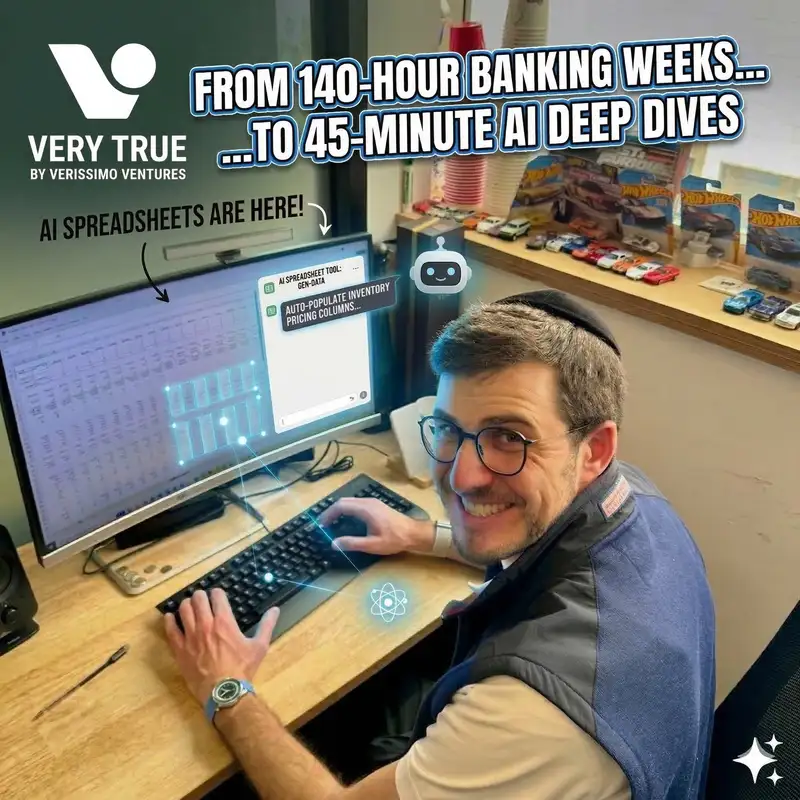
From 140-Hour Banking Weeks to 45-Minute AI Deep Dives
Welcome back to Very True. If you're a founder blindly handing over raw data just because an investor asked for it, you are losing control of your narrative. Today, I'm pulling back the curtain on my elite tech investment banking days to talk about a taboo subject, massaging the numbers. I'm not talking about putting lipstick on a pig. I'm talking about translating your startup's raw, messy reality into the exact financial story that buyers actually care about. I'll show you how to answer the fear behind investor questions.
and how to use AI to do weeks of high level financial modeling in under an hour. It's all about generating excitement and focusing on what makes you great. Let's dive in.
I'm back with another solo episode of Very True and I'm excited to share what I think makes up, frankly, the crux of my career and also what gets me excited and what's led me to what I do now and why. that may not even be apparently obvious by the end of this podcast. So hopefully I'll get back to it. But I'm going to start with this thing called investment banking. Everyone's heard of it. Everyone knows people who've done it.
You may have even done it. Like, what does it mean? The terms make no sense. It's banking something. Is it investing? You're not investing and you're not a bank. Like, what does it even mean? You're a broker. You're a salesperson and you're an analyst all at the same time. If you do it right. I think a lot of investment banks and the way people think it, think about it is it's about being a spreadsheet monkey and just doing PowerPoint slides and trying to be clever and rinse and repeat and doing a lot of things.
Truthfully, I think a lot of investment banking probably is just that. It is rinse and repeat. And frankly, a bunch of what I did was also rinse and repeat. But some of it, I was very lucky and some of it was like really awesome. Like really just threaded the needle, capturing the nuance of a business, iterating through it.
And that was really, really rare. I worked at Morgan Stanley in the tech group in Menlo Park from 2011 to 2013. And just to give an idea of what was going on in that era, there were a bunch of consumer IPOs, there were a bunch of enterprise software IPOs, there were a bunch of enterprise software M &A deals. And then towards the end of while I was there, there was like a bunch of debt IPOs. It was a wild time to be there. I think everyone in my analyst class like worked on a lead left IPO, went on a road show.
did a multi-billion dollar &A deal, it was wild. ⁓ Just in my first year alone, I worked on an internet IPO, a software &A sell side, and a semiconductor debt deal, which is like, that's all of tech banking right there, right? You get your three key markets of internet software and semiconductors, and you get your three key products of &A, equity, and debt.
And they were all multi-billion dollar companies that I'll share what they were briefly, but I'm gonna call out two people One is Michael Grimes who's actually been in the news a bunch recently because he's known as Elon Musk's banker This guy is extremely talented He's extremely intense he is not the salesy cool ex-frack guy was ⁓ NFL players roommate
like banker, he was an electrical engineer, computer science major at Berkeley. This guy is a maniacal business driven scientist and he's actually creative. And the other personal call out is Marcy Vu, who I worked with also even more intimately at Morgan Stanley on the Facebook IPO. worked with both of them and I worked with them on a couple of different things, big stuff. I worked with a handful of other people at Morgan Stanley that were just really good at what they did.
Dave Chen also the clever, clever things that were not just straightforward, right? It wasn't just rinse and repeat. was let's invent something new. Let's build this new dashboard. Let's invent evaluation methodology. Let's figure out how this works. And it's not just making stuff up. It's because the businesses that we were working with our clients were building new business models that had never existed before. And they were doing that in markets.
that also never existed before. There was nothing to rinse and repeat because it was fundamentally different. And look, sometimes we push the boundaries on that a little bit. I think you have to. Sometimes it was just what things called for. Like can't just do the same old comps analysis. Can't do the same old DCF. Like some of these things, yes, fundamentally they might work, but you have to be really clever with how you apply it.
The way, I'm not gonna get into the details now if you want, I'll tell you privately, like how we valued Facebook during the IPO. It wasn't just finger to the wind. There was a really complicated, nuanced way that we did that that was really, really interesting. But I'm gonna zoom out for a second and talk about what that role is as a banker and what makes a banker great. And you basically are behaving as a translator.
you need to really understand what the buying world wants, whether that's institutional allocators for an IPO or strategic M&A buyers or private equity buyers or credit or debt world. You have to understand what they're looking for, what they care about, and in what terms they need to understand it. You also really have to study and become a student of these businesses.
In a lot of markets and a lot of industries, the businesses are really straightforward and it's just, here's this one. And maybe this one has this slightly unique feature. Like that's just not always, I don't know. For me, doesn't, that doesn't get it. It doesn't excite me. I still remember when I was interviewing for banking jobs, someone asked me like, you know, like, why do you want to do tech banking? And I was like, dude, I'm not doing banking if it's not for tech. And I didn't even understand like what that meant and why now I do.
Because this is actually what gets me excited. It's taking a company that's doing something that no one ever did before in a way that no one's ever done it before and figuring out how to bridge that gap and take what the founders and the executives live and breathe and know every day and why it's so valuable and translate that using the right financial frameworks into that buyer universe in a way that they can really wrap their minds around.
So I'm gonna use this term massaging numbers. And I used it today when I was talking to one of my founders. And it's like, it's not about deceiving, right? I used this term before, you when I was advising companies years ago, people would ask me, can you help my company, you know, one of my portfolio companies or whatever, they're gonna raise money, can you help them? And they basically were like, all right, what charts do we need? And I'm like, well, I need to see the raw data. And they're like, why? Like, this is the, I'm like,
That's not really what we do here. You know, like we're not just we're not just playing a game trying to like make things look good just to get through the fundraise like I just won't be part of it and The number of times that like I'd meet a company and they'd be like, yeah, we're at 10 million revenue We're gonna grow to 25 next year and I'd be like, alright Let me pop the hood on this thing and get into the raw data, you know I'm talking about Salesforce HubSpot like looking in the in the product data, you know Digging deeper on the financials not just the outputs but like what's actually in the accounting software?
and being like, guys, this ain't going to 25. You'd be lucky if you go from 10 to 13 next year. And then, you you never hear from them again and they never raise money again. So I guess that kind of answers that. They didn't get acquired, they didn't raise money. But I always said, the line I use is, no one's gonna pay me to put lipstick on a pig, but I will put lipstick on a supermodel. And I had the great opportunity to do that a couple times.
with a couple of companies I worked with here in Israel that were just super models of companies. But the other thing I always say is that the only way to make sure that you look good is to actually be good. that's the only way that no matter what angle someone looks at you from, no matter what things they push on, you know you're going to end up looking good is if you actually are good. It's like, be healthy. It reminds me of that. I think it's a Homer Simpson thing where it's like,
He's like, I lost a bunch of weight. Then they zoom or go around the back of him and he has like little clothes pins like pinching his skin, making him look skinny. It's like, yeah, it's just, it's, can't be that house of cards. So when we talk about massaging the numbers, we're talking about actually being good and then looking at something that is good through various lenses to figure out what is the best way to communicate what makes us great. We know we're great. We can feel it. Okay, now let's put the numbers to it.
Now let's translate those numbers to a more broad based thing that someone who's just getting up to speed in a matter of days or weeks can wrap their mind around based on the context that they have in their world. So this isn't like an easy thing to do. It's not just like, build this chart, build that chart. I always say also like, you got to know how to make a good chart. By the way, charts have value. Making a good one is not that simple. I've seen people do, there's certain rules that you have to follow. For example, that like the
Independent variable goes on the X axis and the dependent variable goes on the Y axis. Like people don't even understand what that means sometimes. so, you know, first other examples, like, you know, certain things should be line charts. Certain things should be bar charts. Certain things should be scatter plots. Like they, just behave differently. but that's just one small part of it, but you've got to get in the weeds and really understand this. I think that to some extent,
AI can do a decent job of this, but you've still got to be really good at instructing you what to look for, for that to even be relevant. again, this idea of massaging numbers, of building a numbers-based narrative is frankly what I've built my career on for the last, I don't know, I guess forever, since I started working professionally in 2011. This is always what I've done. It's frankly, it's what I love. It's...
It's understanding the essence of what makes a business great and then being able to numerically and explain why that's the case in a rigorous fashion and do that to an audience with the perspective of who that audience is and what they need to really understand and wrap their minds around that. I have lots of stories I could ⁓ tell about this and I'll jump into a couple of them.
as I worked through what I realized was this transition that started in the summer of 2011 and I feel like has finally maybe peaked, like two or three weeks ago.
The first stage, the example I'll give is when I was in investment banking training. hadn't even hit the desk yet. And they gave us, they put us in teams of four across every group. All of us were in New York for the summer doing training. And they said, okay, put together this valuation deck, which is like a very standard thing. Like do a comps analysis, do a &A analysis, do a DCF, do a whatever. Do all these different things. Now to do this properly,
Probably would take like a experienced investment banking analysts like Let's say four hours. I Think it took us six hours and was four people right? we're talking about something that should have taken one person four hours Took four people six hours because this is what I call a horizontal team Where like no one knows what anyone's supposed to do, you know, obviously these are a bunch of like Morgan Stanley like kind of like
recent Ivy grads, everyone wants to like be a team leader and be like, all right, let's delegate this, but like, nobody had that personality. Horizontal teams, like they just don't work. I don't know about some of these like high operating military units, but I have a hunch that like, each person is a specialist of some sort. Yes, you might have a couple. But one person needs to own one thing. This also answers the question people always ask, like,
If you're working 140 hours a week, why don't you just hire three people and then can each work like a normal week? The answer is that it would take each of them would do like, it would end up being probably a hundred hours a week and it would be 300 hours of work instead of 140 hours of work. And it would be worse. Like the output would actually be worse. So that answers that question, which I get a guess a lot. was like so massively inefficient. Also, remember reminds me of in college, I took this class on like organizations and
think three or four of us had to write a two page paper as a team. Like, and again, it was an organization's class. was to basically prove this point that like the communication overhead is just like nasty, especially when the roles aren't naturally clearly defined. Again, you can force it, right? It was like, all right, like in an example like that, you just be like, all right, one person is just going to write the whole thing and then one person is going to edit it. And like, that's it. Like,
Okay, maybe one person will write the outline. We'll kind of look at it and agree. One person take that outline, write it, then one person like review it and that's it. Like maybe that can work, but when there's no natural division, it's just massively inefficient. So then let's go to the next stage, which is vertical teams, right? Now you get into what we're going to call the coordination tax, which is up and down the stack. So anyone who's worked in.
frankly, like almost any organization, but for sure, professional services, especially banking and consulting, where you've got like analyst, associate, VP, director, managing director, partner, like whatever, up and down the stack, where each person kind of has some vaguely defined roles. Like, you the analyst is doing the grunt work, putting together the spreadsheets, like jockeying all this stuff. The associate is effectively just checking it to make sure it's right. My friend who runs his own small investment bank,
recently told me we just hired our first VP. The VP's job is just to be smart. Like figure out what questions are going to get asked, ask them before it gets to the people they're going to ask them. Like their job is just to be smart. And then the director who's owning the more owning the relationship with the client, right? Is understanding what the client needs and can then bounce things off that you're going up and down the stack. And then you've got the senior, you know, the managing directors or the partners that are, you know, maybe they own the relationships, but more likely they kind of come in over the top and
bring their brand and their network and their years of experience and nuanced understanding and kind of put the cherry on top of some of this stuff. that's how it works. things just go up and down this chain, up and down this chain. It's painful. I got into arguments sometimes with associates and VPs I was working with as an analyst because they'd be like, do this this way. And I'm like, that's not what we need.
I know what analysis is going to look like when I do that analysis and it's not going to make the point we want to make. And sometimes my associates were like, thank you. You just saved us both a bunch of time. Sometimes they were like, no, you have to do this. like, lot of, ⁓ bad stories that I'm not going to share, but, but it was really interesting where, like, for example, when I was working on the Facebook IPO and the team was Michael, Marcy, Ali, and then me and Cindy.
And Cindy and I like sat right next to each other. And so we were actually, we were, and she was more senior than me by a year. We were a good team. We delegated a lot. We have definitely that like in the trenches sort of bond, even if we haven't been in touch in a long time. And normally we'd run things up and down the stack. that, that's, that's how investment banks run. But I remember on one occasion in particular, we're running the actual model that we used to value Facebook and
I had Michael Grimes over my shoulder. I was running the spreadsheet. My hands were on the keyboard. He was looking at it. He was pointing at points on the screen, trying to figure out what was going on. And we were optimizing this model and figuring out exactly what was going to work and what the numbers pointed out. We got done in like 20 minutes of him standing over my shoulder. What would have taken maybe a day or two days between just timing communication, other projects, whatever of going up and down the stack. So that was just one example of like,
when you collapse the stack from like top to bottom and there's actually enough communication there and you need do things that are at a high level, like that can work really, really well.
Big questions on, don't, again, I would love to maybe have someone who's in investment banking now and has thought about this on the podcast of like, how does AI change this? Because like you still need an analyst, people still need to be close to the data. Like what's the answer here? And we'll get into maybe a little bit where this can go in my next two stages here, but it's, banking's inefficient. Things could take dozens of hours. I mean, just crazy. Like, and that's part of it. I'm actually like grateful for a lot of those experiences because
You might not know why you're doing something, but then you'll learn and you'll figure it out later. And like that experience is super valuable. And that's how you build instincts. I'm a very big proponent of instinct building. So now let's get to phase three. Now, again, that was 2011 to 13. Now we're going to fast forward to 2015. This is now 11 years ago. And I was working at NEA. was like, uh, was actually towards the end of my second year there. And one of the GPs was like, Hey, can someone
help one of our companies do some valuation work. And I don't think any of the junior folks were like kind of assigned to this company. So I like, I raised my hand, frankly, because I think if it's not abundantly clear, I enjoy this stuff. And I went out, I sat with the CEO, he walked me through the business, walked me through the numbers. I was like, okay, great. The first step was like, let's figure out what our comp set is. And that's not like,
such an obvious exercise, but I learned this in investment banking. You have to cleverly think through who your comps are and you have to make an argument and make a case for every comp. Because obviously everyone wants to pick the best comps, so you're valued the most, but you can't just do that. You can't be like, hey, we're growing 20 % and we're in a small market and our margins aren't great and we want to compare ourselves to service now. Yeah, good luck. Everyone's just going to discount the heck out of what you're doing. So you have to cleverly pick this.
You can't ignore what kind of the obvious stuff is, but you got to be pretty clever in picking who your comps are. So that was the first thing did. Next thing I did was like the kind of down the middle of the fairway stuff, which in a typical investment banking environment would have been mostly an associate digging up some other decks they had done and then telling me, do this analysis and this analysis and this analysis and this analysis. Right. And what they would have done was run, they would have been, as I iterated through these analyses, they would have been telling me to change who the comps were. But I,
was doing this all at the same time. So I was looking at what these comps were and then figuring out, this is going to look like this in this analysis. And the iteration times just obviously collapsed. Now I'm a one man show, right? I'm the solo performer doing the whole job, right? I'm doing four people's job by myself. And I still had that CEO relationship to tell me what mattered and what was going on and how it all fit together. But this is where it got really interesting.
And this is what I quite understand. You know, something that I think Michael Grimes has been known for is being in the weeds. Like he, that wasn't, that wasn't rare for him to be over my shoulder or over someone else's shoulder or in the model. Right? Like I remember when I was at Morgan Stanley, we had file locking like in our EMC, you know, array, and you could see if someone was in a file and you tried to open it, you could, you could see which user was in the file.
So could actually like go over to their desk and be like, yo, get out of my file. But sometimes you would like open it. You try to open it and it would be like Grimes ⁓ or like Voo Marcy or whatever. And you'd be like, ⁓ okay. Like they're in it. Like, and if they weren't at their desk, you'd be like, crap, how many? And you'd go to their assistant and they'd like log into their computer and like save and close or whatever. Or you just duplicate it and start over. But.
being in the numbers is what gave him that ability to create that really creative way that we actually valued Facebook. So what I was able to do was actually experience that myself. In this particular case, we're working with a company in a space. They, I'm trying to think of the best way to explain this without like divulging what might be confidential information.
even though was 11 years ago. I picked all these comps, great, built all the models, built all the projections, built the cases, run it through DCF, discounted equity valuation, &A precedents. I even did like an IP valuation, obviously trading comps. And that's all well and good. But when you're doing an &A deal,
or when you're pitching an IPO, you need excitement. You don't just need here's the numbers. I think even for private equity, I don't know if, I sold one company to private equity when I was at Morgan Stanley. And that was like a little bit more straightforward. Cause then they're gonna do all their own work. They got everyone on the same team on the other side, but you still need to help the company. But anyway, cause you still want to get the best price. But,
You got to figure out that hook in an &A scenario, strategic &A scenario, it's usually making it a defensive acquisition. Like the first deal I worked on at Morgan Stanley was selling success factors to SAP. And we figured out how to make it a defensive acquisition. Okay, how? Like what was the genius? And there was a guy named Chuck Corey who had come out of retirement to work on that deal. And he figured out how to make it a defensive acquisition. In this case, this deal I was working on,
I made it into a ridiculously opportunistic synergistic acquisition because I was able to point to another large company that had just been started disclosing its financials, one of its subsidiaries. The equity research analysts were then valuing that subsidiary separately and saying it's worth X percent of the whole company. And we could apply that same method because that subsidiary was very similar to what our business.
would enable the acquirer to build inside their business.
And then we could attach that to their sales team. And instead of us growing from, say 50 million of revenue to 75 million of revenue or a hundred million of revenue, all of a sudden we're growing from 50 million of revenue to 500 million of revenue with their sales team in a year. And you're going to be able to break this out and get valued the same way as this other company will and get that boost on top of what you're already doing. Because you're launching the business a new figuring that out.
I remember the look on the CEO's face when I showed him that I put together that analysis. I showed how these equity research guys valued that piece of that bigger company. The look in his eye. I mean, this guy made so much money on this deal. I think he personally made like 200 and $200 million on the deal or something like that. He wasn't even the founder. He was a professional CEO. He saw that and he was like, you know, I'm always thinking like,
What is it like? Pepe Le Pew, the cartoon where like the hearts come out of his eyes. It was like that. He was like, my gosh, this is gold. Like this is platinum. This is diamonds, you know. And he ended up giving me an amazing shout out and everything. But he was like that. That's gold. And we ended up selling the company for double what what it was originally offered, which is which was a lot. But the point of that whole story, besides that, I enjoy it.
Obviously is that that whole exercise probably took me like 30 hours, but the first 29 hours were just pounding away at the data. I was just going through comps spreadsheets looking into different companies trying to figure out what their products were. What made them special understand why they were valued way the way they were understand our business have the CEO explain it to me go back and forth with him to really understand it again. This all happens fairly quickly when it's just two people having a conversation and one guy with the Internet and a bunch of you know and a capital IQ plug-in in Excel.
But in that last section, when I was able to have that realization that it's like this other business, that generated more value probably, I'm pretty sure actually, than any other thing I've ever done in my career.
And that whole thing again, took like 30 hours of work. If that was an investment bank, it would have been like two weeks of all-nighters for like four different people. Now let's enter 2026, fast forwarding 11 years from that experience. And I'm an early stage investor. I run a fund. I still love doing this stuff. I don't get to do it nearly as much as I would like to. But one of the things I remind my companies of is like, if and when you need to sell or want to sell, like we can do this exercise.
And I, what I explained, said to these founders, like there's a very obvious acquirer for this company. And I was like, I told him the story that I just told you guys. And I was like, we need to figure out our version of that. We need that strategic synergistic fire. That's going to make people jump across the desk and be like, we gotta have this. Whether it's defensive or not, or just extremely offensive.
Like we need people to be getting excited and be like, we must have this to take our business to the next level. And that's the key. And in that conversation, I said, okay, we were actually on a board meeting when I explained kind of the high level of that. I then got on a call right afterwards, immediately after that with the two, two of the key executives of the company, including the founder CEO. And I was like, okay, we're to do this real time. I shared my screen on zoom.
pulled up to 10K for the acquiring company. was like, I don't know really much about this company. To be honest, I don't even know that much about like the company I'm invested in. I invested because of very basic fundamental things that I liked. I'm not in the weeds, right? I have a lot of portfolio companies, but I'm like, okay, let's get in the weeds of the acquirer.
First thing I did, again, I was like, okay, guys, we need to figure out how to do this. So I broke it into steps. was like, okay, first thing, let's understand the acquirer's business. I know enough about our company to be dangerous. I was like, let's understand the acquirer better. So first thing I did was not go to their website, actually. It was to go to the SEC website. The company's actually been taken private and is owned by private equity. I found their last 10K from like two years ago or something. And I dumped that entire 10K into Gemini.
And I said, I asked it like 10 questions about the company. Like just find all this in the 10 K less than 60 seconds. had everything I needed to know in order to do what in order to ask the next round of questions. Okay. So now I asked that next round of questions. Then that took me to their website. Then I was like, okay, let's figure out actually what their products are. Right. Let's figure out how they target it. Let's figure out what's, what's there. We went through this exercise and
We figured out that we can offer this company something that allows them to effectively double their ACV inside their existing customer base, which is already has like crazy high penetration in their target market. So there's not a whole bunch more customers they can even go after. Their only option is to increase their, you know, their, their price effectively per customer. And this moves them from we'll say back office to front office inside those customers.
Not like a trivial thing to do, but the opportunity that is going to make a lot of people a lot of money. The three of us on that call, which was, I don't know you asked them, it would probably be mostly, I was asking them a bunch of questions along the way because again, they know their business. They know the acquirer's business. And at the end of it, it was like, okay, here's the pitch. Like here's what we offer them. Here's what they need. Here's how it impacts it. Here's the numbers that back that up. Here's what we've done.
Here's what you need to understand about our customer relationships and what our product does for them and how they value it. And therefore it's how it's going to double your ACVs. Right? And that was that magical moment. And again, this is just going back to this concept of like massaging the numbers, but there's another big important piece that I'm weaving in here. We've gone from stage one, which is horizontal teams to stage two, which is vertical teams to stage three, which is the solo performer to stage four, which is the solo performer.
empowered by AI. it took me, the output of that exercise was here's an outline for that deck. The deck that I made 11 years ago, which took me all this time and formatting, whatever, give me the outline for the deck. Let's dump that into a deck generator. And then boom, that was like 98 % complete. And that whole meeting with the founders doing the AI, woking up the 10 Ks, all this stuff, that was 45 minutes.
The whole thing was 45 minutes. Like, we'll see how it ends up turning out, but that is the exercise. And it's extremely powerful. I'm not convinced that if, some of the, we'll call it, I don't even know what to call them, proponents of AI will say, you could just give the AI two websites of the two companies and be like, tell me.
what the best pitch would be for one company to acquire the other company. Maybe I'll try it. Maybe I'll try it and we'll see. Actually, you know what? I'm going to try it right now. Let's see what AI has to say about this.
And if it can actually do this or you actually still need that human element
So I'm giving him two names of the...
the two names of the companies saying, look at this company, look at that company. I'm saying research their websites, understand their products. A lot of people are going to be like, your problem sucks, but we'll see. Understand their products, figure out what the main growth drivers would be for this company and therefore what they might need to or want to.
Look at their last filed 10 K to better understand the metrics of the business and customer dynamics. You know what? I'm giving it too much. We got to keep this simpler. I'm doing the whole thing that I did before. We're to keep the simpler. Just check out this company, check out this company, research the website, understand their products, figure out potential synergies and give me a
pitch for why this company should acquire this company. Let's see what Gemini has to say. We'll do this live. I think it'll be fun.
Okay, so we have our response. I'll be honest, it's a little bit better than I thought it was going to be. It doesn't get into the actual numbers. Maybe I could ask that, but it understands what these two companies do. It understand it gave me potential synergies.
And then it says, this is the problem. This is the solution. It's pretty good actually. Didn't come up with what I came up with though, which is frankly much more powerful, but it's pretty good. That kind of proves my point even further. Even someone you don't need, again, I was in the example from 11 years ago, I was the solo performer. Now you need someone who just like understands, is there a decent question to ask here?
And we can push that further. Maybe it shouldn't have taken 45 minutes. Maybe it should have only taken 15 minutes, to be honest. So, but that's all to say we're in a really interesting time that we can put this all in context, that it's not as like totally game changing, completely different world, but it's actually like a, I wouldn't want to call it a linear progression, but it is a progression. It's not a step function. It's on a curve.
And this is what I've been saying about AI for a long time. Like we are on a curve and the more data points you've lived on that curve, the easier it is to understand that curve. I'll say that again. Like I've been working since, you know, summer of 2011, not that old, but have a decent amount of experience at this point. and I've seen these different eras and I've experienced these things. And I guess one of my, ⁓ skills is the ability to.
understand what drove these things. But this example of narrative design, which is still very, very real in terms of what drives value in companies, you know, for my companies, we've still got follow on investors making decisions the same way they've always made decisions. If not, they're probably probably worse at making decisions. And we still need to optimize for those things. And so I will
So.
That's all to say that it still behooves someone who can understand the nuance, somewhere who can ask and answer the right questions. can basically strap a jet pack to a lot of what people were already doing. And if you're clever about that, you can elevate yourself and whatever you're working on really, really quickly using the power of AI. But let's get back to this concept of massaging numbers of narratives, right? Of
of actually translating, of saying, okay, this is what's important to this person. Again, this M &A example is great. This is what matters to this person. How do we figure that out? What do they care about? And this is what matters to this person. Now, if you're a startup pitching a VC, it's not so easy to figure out what the VCs care about. There's a lot of, I'm founder of mine, send me a LinkedIn post where the VC was, or some founder was like, do this. And it's like.
Don't talk to these people, only talk to these people, only do this for this many weeks and da da da da. And it's like, skip this, do that. And I'm like, he's like, is this real? I'm like, dude, it's LinkedIn fluff. Like, don't worry about it. You know, like it's not that simple. Part of the issue is that people don't explicitly say what they want. Cause they don't know. I don't even know if they want to know. But they, they, they can't.
articulate or they don't want to articulate or they just don't publicly articulate what they're actually looking for. And you've got to sift through that. And the way that you do that is you just, it sounds like it sounds a little bit poetic, but it's like you get back to who you are and what makes you great. Nobody knows your business better than you, meaning you being the founder. You know what makes your business special. It's so easy to get wrapped up in
what you're doing, how you're doing it, the mechanics, the hiring, the customers, the product, the sales, the engineering, the process, the compliance, the legal, the finance. I I do this. I'm running my own fund now for the last six years. It's exhausting and it's so easy to get lost in that and get focused on one thing. And I've started using AI extensively in my own business to just pull me out and basically say, wait, hang on, what's worked for me? Like just start telling it stories and let it distill like what's actually worked.
for you. So when you're a founder and you've got to pitch your company to investors, you have to understand you are the expert in your company. You are also dealing with all of the nitty gritty garbage in your company. I always, this is one of the things I've started telling founders. Your main job as the founder of a company is to capitalize the company. I would say it now, sorry, not as the founder, as the CEO.
Your main job as the CEO of a company is to capitalize the company. Now there are different types of capital. Now everyone's thinking that means raising capital. Like you need capital, you need dollars from people, but there are different forms of capital. There's human capital, there's technology capital, right? And then obviously there's equity capital, there's debt capital, and your job is to capitalize the business. And then your job is to generate value. The machine between those things of, okay, so you get equity in, you hire people, you build products.
Right? Fine. Then you build a machine, that machine, that machine is the business. It is the business. goes, the business is the people. No, it's how the people work together. It's what they output. It's the mechanic of how this person passes this person to this thing. And this number goes to that and this person gets served that like that is the business. It's that machine. That machine cannot be a black box. The founder's job is to understand every facet of that machine. CEO's job is to understand that facet of that machine.
And it's so easy to get stuck on one little part of that machine. Sometimes you want to say, just AI do the machine for me. That's not right either. but it also is, it's easy to get fixated on one minor part of that machine and lose again, miss the forest for the trees. Being able to zoom in and zoom out, go from on the ground in the dirt to a hundred thousand foot view is the job of the CEO. If you, and by the way, I'm talking about early stage companies right now, but
The reason I'm defining these things this way is that if you look at a Fortune 100 company and you look at what the CEO's job is, what they're mostly doing is setting the strategy, hiring the key executives, and managing Wall Street. Huh, that sounds an awful lot like capitalize the business, right? It's the equity capital and the debt capital. It's the people, right? And it's the technology and the product and the market that you're going after. Like that is...
You know, the technology or whatever service or whatever it may be to go after whatever market you're going after. And then it's the mechanics of that business usually are the thousands of people below them. And in that case, when you've got all these executives, whole idea is that the CEO is delegating almost everything. Like almost everything. If you listen to the acquired interview with Jamie Dimon.
you start to understand the sense of the gravity of what he's dealing with and how much he needs to rely on the people below him to make these decisions. And it all trickles down. That organization design is that black box, which should not be black. Like it should be clear. You should be able to see through it. You should be able to understand it. Someone should be able to map it out. know, the other thing, sorry to just throw this in here, but like, you know, all these people are getting laid off now. People go, AI is taking jobs. I actually don't think it's the AI taking jobs.
I think that if you've ever worked in a corporation, you understand that there's just corporate bloat. There's people who are doing things that don't need to be done. There's it's like the guy in office space. I would say office space was a documentary. It's like, I'm a people person. Like I take the stuff from the customers, the engineers is like, well, I couldn't the customers just go to the engineers like, because they don't talk the same language, which is funny because that's kind what we're talking about here. The guy's like, well, do you actually take this stuff? He's like, well, no, my assistant does it. And it's like, there's so many people like that in these companies. And so
I think right now it's going on with these layoffs has less to do with actual AI being used by people and more people just starting to think again, like, wait, do we really need that? Like, what are they actually doing? If we map out this machine that is our business, like is, is that the appendix? You know, like, do we really need that? Like, and again, you don't want to be the person who says like, they're pulling out this little thing and then the whole thing collapses, but you got to do it intelligently.
But yeah, there's a lot of that going on in the world right now, which I think is scary, but it's honestly, it's healthy for businesses. So again, that founder's job is to be able to zoom in and out to capitalize the business. It's hard. Again, I've been doing it for a while. It's a little different running a phone than a startup for a bunch of reasons. If I'll get into another time, but I see it all the time. I invested in early stage founders. That's what I've been doing for a long time.
I'm their guy a lot of the times. So we'll get back to what you actually do with this. How do you define your narrative? How do you control your narrative? It sounds silly, but like so many founders I find are reacting to the questions they get from investors as if the investors know something about their business that they don't. Like, frankly, they shouldn't. And I think you find that the best investors in the world, they might ask a couple like things just to make sure that
They're not missing really big stuff, but in general, it's like, I got to bet on the person and the fact that they're going to figure it out because this stuff's going to be changing all the time and they're building the machine. The machine doesn't even exist yet. The machine is the business. So for example, when an investor asks a certain question, you have to listen through what they're I'll give an example. They ask about customer concentration.
What do they really want to know? Well, customer concentration is a problem. Well, why is it a problem? Again, you just keep asking why. Why is it a problem? Don't ask them. Do this for yourself. Why is it a problem? Because it introduces risk. If you have high customer concentration and you lose one of those huge customers, then like the business isn't going to do well. Like this is not good. So, okay, so let's understand what, let's say we do have customer concentration.
But now we have to contextualize that in our machine. So yes, right now we have two customers and they're huge and we have 10 more customers and they're small. But we have to put everything on a trajectory. Things move fast in startups, right? How big will those 10 other customers be six months from now? Are the two customers that are huge, huge because we've had them for nine months already and they've grown? Or is there something fundamentally different going on? And so you've got to figure out the right way to say, ⁓
We're going to paint this picture of what's really going on and what matters and use that question. Ask yourself why, why, why does that even matter? And the answer might be, it's a lazy question and it doesn't matter. In which case, again, you got to grab the narrative by the horns even more aggressively. You've got to think about all these questions. You've got to run through all the potential objections before you even get there. And that will just come through in your answers. And now again, going back to my banking days, when we would go on a road show.
as an analyst, you would literally have to write down the questions. You'd be like taking notes and writing down the questions in each investor meeting that they're asking the company. And then at the end of every day, you'd put them in a spreadsheet and categorize them. And this was all done very, very manually. This was like, call it, ⁓ OI, organic intelligence, where you're like, you have to have a smart person doing this. You're getting off the plane and you're staying up all night sorting through questions to try to figure out what were the common things and the stuff that people pushed on. You don't have to do that anymore.
Everyone's got a, you know, recorder, a granola, a circle back, a notion notes, whatever, a zoom AI taking recordings of meetings. can dump every single one and founders. You got to do this. I know it's a little scary to do it, but it takes like 10 minutes. Take every single recording, every transcript, dump all of them into AI and say, tell me.
what people are asking. they're like investors react to things. So if they're all asking the same sorts of questions and you might not know have a good answer to that question or you might not like that question, you are not leading them to the right question. That is your job. You are controlling the narrative. They don't come in just asking you questions. You come in saying, this is my story. This is what I'm doing. This is how I'm changing the world. Like the way you give that over is prompting their questions.
This is not like some thing that's out of your control. I always used to give this piece of advice when you go interview for a job. Everything in your resume should lead to everything else. It should be easy for them to walk through the resume of this leads to this leads to this leads to this. okay. There's a flow there. Like you don't have to wait to get asked those questions to do this. Again, this is a little harder because it's a lot more complicated than just a resume and it's changing a lot faster. But take all of that. Take all of those questions and figure out like, okay, what am now?
What am I saying that's leading them to ask the most common questions like ask the AI just be like What are the most common themes of questions? What are the most common questions like give me a chart of? When are they asking it in which part of the presentation as a reaction to what am I saying like? These are not hard things to put in AI and every founder should be doing them So I'm gonna reference another idea which I think is super important here because it kind of frames this broader idea which
Ben Gilbert again on acquired. Those guys are so good. I haven't seen David in years. he talked about this concept of lossy compression as the definition of communication. A person has a thought, they express it in words. The other person hears the words and has a thought. So the thought is some complicated, fast moving multifaceted thing. You are then consolidating it into words, which is exactly what I'm doing right now. You are now hearing it and you are
relating it to other things in your life, you're implying different things from it, you're making inferences, all that different stuff. Accept that that's the reality. Accept that that's what people are doing. Make it easier. You get to design your own lossy compression algorithm. you've got to, again, own the narrative, grab it by the horns, take control of it. So figuring out what that underlying risk is, what that thing is, like, you've got to answer those questions.
You also have to understand, take a step back. This again, it's hard to take a step back. It's hard to go from in the weeds, in the dirt, like all the way up to like, you know, debugging code to like, how are we going to change the world? Like that's a hard thing to do. Take time every week and don't just answer the fear questions. People don't invest in startups because they're de-risked. People invest in startups because they think they can be massive and change the world. You started a company because you thought it could be massive and change the world.
By the way, if you, that's not why you started a company, you probably shouldn't be raising venture capital. Probably a conversation for another time, but.
That is the bigger point, which is like, get back to like, why does this matter? Like I was doing this one with one of my founders, cause he's a solo founder. For solo founders, it's even harder cause you don't have anyone to bounce it off of. can't, it's actually easier for a, think emotionally healthy person to get excited about their partner. Like if you're the CEO, they're the CTO, you're like, wow, my CTO is so amazing. Like they're the best in the world at this, this and this. You're like, hell yeah, that's why we're doing this.
It's harder to do that for yourself if you're not like a complete psychopath, I think. So you got to take the time to do that. And what I was doing with one of my founders, understood he was getting bogged down. So I would just randomly text him and be like, what's the most important, what's the biggest problem in this entire market right now? And he's like, well, it's this. And I'm like, and who's the single best person in the world to be solving that? He's like, it's me. I'm like, yeah, damn right. It's you. now garner that excitement.
Add juice, add so much more, add numbers, add references, add explanations, add details, add nuance, add fire to that. And that is your narrative. And that's what you have to bring to the table. And that's what gets people excited. And again, you can use AI for this. It used to be like you'd have to sit down and write all this stuff down. You can run at a million miles an hour. I always say this behooves.
the ADHD person because you can just like have an idea type, prompt and then like put it to the side and let it like do its thing and then do something else, do something else, do something else. I was just talking to a friend of mine yesterday and we both had the amazing experience of working with, you know, with Harry Weller at NEA and he was both of our mentors and he was an amazing person. passed away a little over nine years ago and this guy was so ADHD, but you know what? There was no way he could have been.
keyboard member on 17 companies, if he wasn't, including public companies, like if he wasn't, you just can't process that much. If he was alive to see what was going on right now, I just, I don't think the world could handle it. Like his ability and how empowered he would be would honestly exciting for me to even think about, but it would have been so incredible. So the other thing you've got to do is you've got to, and I'll kind of end with this. You got to, have this line written here, which is smooth curves.
for smooth brains, which goes back to my point about charts. Again, I'm here, I'm a numbers guy. This is what I've been doing for my career is figuring out what's the right chart to tell the right story. I got a bunch of anecdotes for this. smooth curves, smooth brains. Again, I don't mean to be insulting, but it's also just like make it easy for people.
make it just make it easy. Make the conclusion jump off the page. Show things up into the right, not just for up into the right sake. Like there's got to be some meat on the bone. It's got to make sense. The X and the Y axis have to make sense. Like, but sometimes you got to smooth stuff out. Like for example, there's a, an accumulation chart, right? Like sometimes you just need to use an accumulation. Like by the way, every ARR chart,
is an accumulation chart. Like that is what ARR does, it accumulates. So if you're not an ARR business, you don't have stacked subscriptions accumulating with each other. Sometimes in order to approach your investors who are used to seeing stuff like that, you need to create your version of that. And as long as you're explicit that this is an accumulation, it's fine because it's still showing the trajectory that you want to show. And everyone in their head, whether they know it or not, is taking the derivative.
and figuring out what's going on. Don't deceive. Say that it's accumulation, but it's often easier to show. And by the way, if you look at S1s and you look at their cohort analysis, they're almost always accumulations. And by the way, they have no numbers on it. There's no numbers on those charts. just show how cohort from three years ago has expanded as part of their revenue, which is crazy. So I know I covered a lot here. Everything from
how to use AI, to how teams work, to what investment banks do, to how founders need to focus on de-risking their business and also getting people excited about their business, but most importantly, how to preempt questions from investors. So I am going to wrap up here. As always, I'm available for questions. There's a Q &A submission form.
If you want specific questions, if you want a call with me to discuss your business, for me to pick it apart, for me to get maybe get energized and do one of these sort of hopefully game changing &A sort of exercises with you, reach right on out.
Creators and Guests