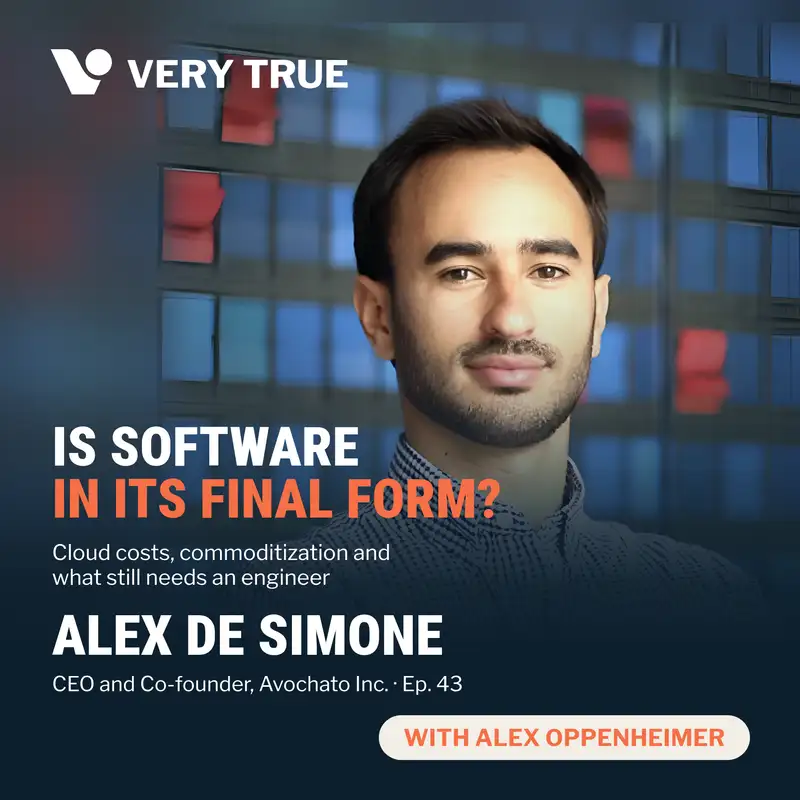
Is Software in Its Final Form? Innovation, Commoditization, and Why Alex De Simone Left AWS
Alex sits down with Alex De Simone, a friend since their Stanford days and a fellow mechanical engineer, for a conversation that starts with a VCR turned into a Hot Wheels garage and ends with a server rack in Santa Clara. Alex De Simone is the CEO and co-founder of Avochato, a business messaging platform coming up on ten years, and Alex is an investor. They walk through the company's origin as "Caller Zen," born from waiting on hold with Comcast in a business school dorm, and how texting became the channel that gets people to actually respond.
The core of the episode is Avochato's decision to pull its OpenSearch workload off AWS and onto its own hardware after the cloud bill tripled as a share of costs. A team of two toured data centers, spec'd a 42U rack with help from AI, and ended up with half the bill, far more compute headroom, and sub 80 millisecond latency. From there the two Alexes go wide: whether software is approaching its final form, why the things that get abstracted away are exactly where the security vulnerabilities live, why learning to code never mattered as much as learning to think like an engineer, and what they'd tell a 25 year old asking for a guaranteed career path. Expect E30 manuals, Rolexes, resto mods, and Tiger Woods versus Roger Federer along the way.
Guest: Alex De Simone, CEO and Co-founder of Avochato.
Episode Highlights
From CallerZen to Avochato: The original idea was simple: when someone doesn't pick up, send a text. The first customer was a pet gift box company sending delivery updates in 2015, back when most notifications were email if anything.
The Yelp Cloud Line: Alex recalls how mutual friend Mike Stoppelman kept Yelp right at the edge of where it made sense to be fully cloud, and how that line kept moving as the years went on.
Software's Final Form: Alex's thesis that a lot of technology's goal is to disappear into ubiquity, like the plastic cup, the modem-router combo, or spices that were once the most valuable commodity on earth.
Why the Abstracted Layer Bites Back: Every major security vulnerability lives deep in something someone stopped thinking about. The E30 manual teaches you to fix the whole car; the 2025 manual says don't drink the oil.
Leaving AWS for a Rack in Santa Clara: When OpenSearch jumped from 20% to 60% of the cloud bill, Avochato went back to first principles. The result: half the cost, eight to sixteen times the compute potential, and full visibility into their own logs. Alex De Simone's analogy is buying a nice car and renting the valet garage instead of leasing.
Learning to Code Never Mattered: Alex argues that what accrued real value was learning to think like an engineer, and that coder, computer scientist, software engineer, and architect are four different jobs that got lumped together.
The DIY Spectrum: Alex De Simone on why it's fine to pick where you want to play, whether that's patching bike tubes, doing your own brake pads, or assembling a watch movement from a kit, and why the only wrong answer is ignoring a lesson from history because it left your field of vision.
Advice for the Mid-20s: No more guaranteed paths. Optimize for what you're passionate about, what you're good at, and what the world needs, and if you can't get an internship, go solve someone's problem and get paid for it.
Full Chapter List
- (00:53) Introduction: Stanford, San Francisco, and a shared network
- (01:38) Alex De Simone's origins: taking apart the VCR, mechanical engineering, and fluid mechanics
- (03:01) Why solved problems get taken for granted: banking coverage of semis vs. internet companies
- (05:00) The birth of Caller Zen and waiting on hold with Comcast
- (08:59) First customer Pet Box, Twilio, and Uber's build vs. buy
- (10:31) Same problem, new challenges: where AI bots fall short
- (12:37) Mike Stoppelman, Yelp, and the ever-moving cloud line
- (14:15) Is software approaching its final form? Plastic cups and Wi-Fi routers
- (17:45) The 1987 E30 manual vs. "do not drink the oil"
- (19:15) Why security vulnerabilities live in the abstracted layers
- (20:46) Cloud bill as a percentage of revenue, and the OpenSearch problem
- (24:30) DHH, the pink chained elephant, and touring data centers
- (26:45) The rack at Equinix: half the bill, sub 80ms latency, and the valet garage analogy
- (29:33) Patching bike tubes, teenagers who don't want to drive, and the car ownership spectrum
- (31:20) Software as a layer of the economy, and why it only matters when it hits the physical world
- (34:00) Learning to code never mattered; thinking like an engineer did
- (37:22) Obsolete vs. commoditized: fax machines, Micron, and Ambarella
- (40:00) Nick Greenfield's rule: go in naive if you want to build something big
- (42:23) Software's final form, explained: Riverside, spices, and Deel
- (45:42) Robotics and bridging the software-hardware gap
- (46:51) 2006 BMW 7 Series vs. 2026 Corolla, and the resto mod world
- (49:17) Handmade vs. machine-made: the Rolex tangent
- (50:19) The DIY spectrum: E30 brake pads and DIY Watch Club
- (52:56) You don't know what you'll learn: banking, Jane Austen, and being forced out of your comfort zone
- (57:14) Don't just AI your way to code: read it, review it, be around people who speak it
- (1:00:36) Range, rich kids in pro sports, and NBA injury theories
- (1:04:42) Advice for the mid-20s: no guaranteed paths, lean into who you are
- (1:07:54) Pleasure vs. enjoyment, and turning an internship into a founder's eye
Links & Resources
- Avochato: https://www.avochato.com/
- Alex De Simone on LinkedIn: https://www.linkedin.com/in/ajdesimone/
- Verissimo Ventures: https://verissimo.vc/
- Alex Oppenheimer on LinkedIn: https://www.linkedin.com/in/alexoppenheimer/
- Range by David Epstein
- Slow Productivity by Cal Newport
About Very True
Hosted by Alex Oppenheimer, Very True by Verissimo Ventures explores the honest, unvarnished stories of founders and the real problems they are solving. We look past the hype to find the truth in technology and entrepreneurship.