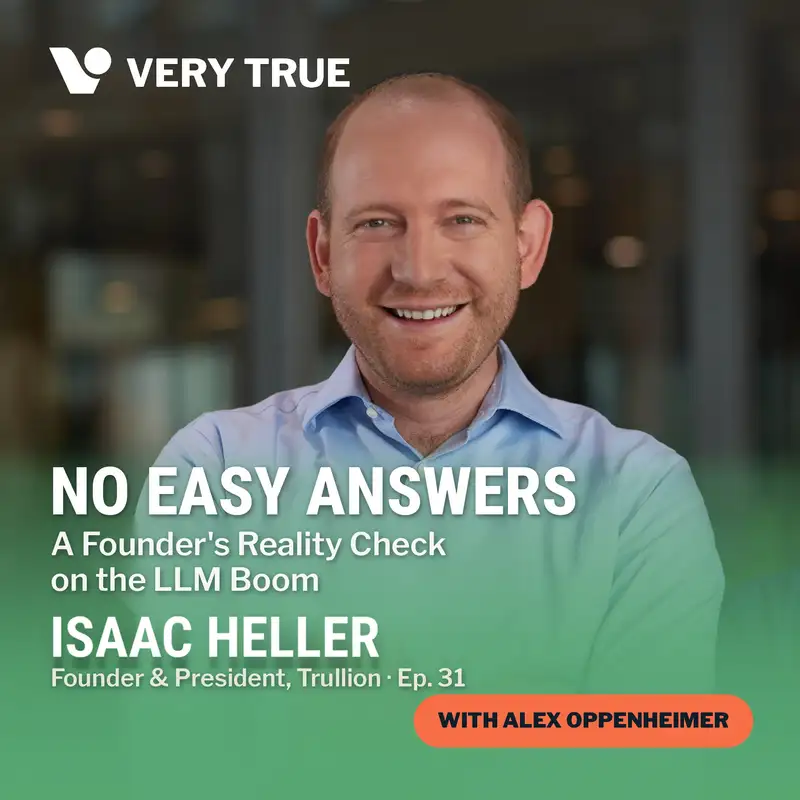
No Easy Answers: A Founder’s Reality Check on the LLM Boom
Alex (00:00)
Welcome back to Very True. I'm Alex Oppenheimer. My guest today is Isaac Heller, founder of Trullion. Isaac built an AI accounting company, and accounting, on the surface, is the most borring market in software. That was the point. As Isaac puts it, pick a good table before you worry about being good at poker. We cover a lot of ground. The skills people thought were valuable, coding, law school, climbing the corporate ladder, and why those turned out to be wrappers around something else entirely. Why LLMs are really a distribution story, not a technology story.
And why the entry level job is breaking and what that does to a forty year career.
We also cover what we'd tell a twenty two year old right now. Let's get into it.
Alex (01:30)
we are back with another episode of Very True by Verissimo. I'm super excited today to have my good friend Isaac Heller on. Isaac and I met, I think, coming on more than seven years ago, right when Isaac came to Israel. And we've been friends ever since. We, within six or twelve months, started working together, and I'm really excited to have him on. He's had an amazing career.
Life experience, a lot more amazing things to come. And this is one of those friends that I always feel like I don't get to spend enough time with, even though we live like a 12 minute walk away from each other in Jerusalem. But I will hand it over to Isaac to give a bit of a background. And as per usual, I will be interrupting him, and that's probably where we'll take things for the rest of this conversation.
Isaac (02:14)
Amazing. Well, it's good to see you as always, Alex, a close friend and and a confidant in the business world. should also give a shout out to those of you who are big fans of the Very True Podcast.
I'm excited to talk today. I mean it's quite an insane time in the world, at least in the business world and the software world and the services world and we've had a front row seat to all that fun turbulence and you know you're always one of the most exciting people to talk to it about.
Alex (02:40)
So I want to start in Texas. you know, now we're we're professionally, we're physically in a very similar place in our lives, but we started in pretty different places and we've come to this similarity through different routes. and so I'd love to take it back to to before even Dallas and hear the story from there.
Isaac (02:43)
Yeah.
Mm-hmm.
I I was born and raised in San Antonio, Western Conference Final Champions, San Antonio Spurs. and I would just I would just characterize my my life in Texas as ⁓ middle class suburban boy. you know, n not too many highs, not too many lows, pretty good. ⁓ a few Denny's and Starbucks along the way. And and and you know, I I lived in San Antonio and Dallas and then I went to UT Austin.
Again, I went to public high schools, public school. and you know, obviously after after college went back to Dallas. Actually I went I went to China and taught English for a year, but then I went back to Dallas. So I'm Texas through and through like like thirty years of my life. I don't know, you know, how that how that connects today. I w I would say Texas, like, you know, it's kind of in the the middle of America, so it doesn't experience the the highs and lows of like a California or New York.
But also doesn't want to be like either side. So it's pretty chill, southern comfort. We are we are, we're good where we are. And ⁓ I guess the the best part is that I feel like coming from Texas you can relate to a wide range of people. You know, that that guy coming from New York, for the bachelor party, or you know, that gal coming from California for for more space, you know, in her house or whatever. that's that's Texas, you know. We
We are we are welcoming of the whole spectrum. So that was kind of my childhood, middle of the road.
Alex (04:17)
Amazing. And so you taught English in China for a year. What else did you do while you were in China? I gotta ask.
Isaac (04:21)
Yeah.
⁓
okay, so there there was a lot more that happened in in Texas and in China. I mean I I started an eBay business when I was twelve, ⁓ you know, buying and selling sports memorabilia, mostly basketball cards. I in high school I I picked up poker and card games in a very early day. ⁓ it's just a coincidence that I'm from Texas, but
Texas Hold'em was was my game before it was on ESPN. And then so, you know, obviously in in college I was playing a lot of of cards and pokers on the side. It wasn't, you know, full time, but when I went to teach English in China, I taught during the week and then I would I would go to a place called Macau on the weekends and and play what what you would call professional poker. and so that was that was that year in China. But ⁓ you know, it was it w it was a lot of fun and
you know taught me a lot and there's definitely a big contrast between, you know, teaching ⁓ fourteen year old students during the week and doing lesson planning and then, you know, staying at the the Venetian Macau ⁓ on the weekends and and playing till like five in the morning, you know, poker sessions with a notebook. but it was fun.
Alex (05:28)
Amazing. That's such a cool experience. and so so then you got into the world of software. ⁓ but not the I'll just call it out, not the cool, sexy kind of software that everyone talks about now. ⁓ even in my career, going back to just 2013, when I started at NEA and my partner was like, What do you want to work on? I said early stage enterprise software. And he was like,
Isaac (05:34)
Right.
Right.
Alex (05:50)
Dude, why? Like you're 23. I think I was no, I was 24. It's 2013. Why? Like, what do you care? Like, this isn't cool. you know, and that was just 13 years ago. Now software is all the rage. but tell us tell us about where you started and how that shaped your view of of business and opportunities.
Isaac (06:08)
Yeah, definitely. Well, look, after that year brought in China, I I thought I was gonna go to law school, but I ended up working at a travel agency. So I worked at a a sports travel agency. We brokered athletic events and and sport international sports tours. So I would go with like a high profile basketball team in college, like a Duke or a North Carolina
to Italy or China or like one of these these far places. So I was a travel agent. Like I would help book and coordinate those itineraries. I ended up doing a lot of back office processes and and finance and pricing and stuff like that. I also worked at a company called Sabre, which was travel technology, so specialized for airlines and and booking companies like Expedia.
And also did a lot of finance and strategy and and back office and stuff like that. So as it relates to enterprise software being boring, I didn't know what enterprise software was. I just knew that when I did finance and accounting, it was painful. I was reading documents and putting things into spreadsheets and then paying an auditor money to test one one thousandth of my work. Right. And so I just
in my in my naive, you know, Texas head, like that didn't ⁓ make sense. I would say, look, a a couple things. I was doing fine like if something's cool and interesting meaning there's money to be made in it, it eventually gets there. Okay. And so right now, twenty twenty six, like it is it is en vogue.
To be automating accounting with AI. It is really, really cool. So whether you're Claude or the half dozen company that raised crazy valuations or the Sequoia paper that talks about services as a software, it's now cool to do that. So it eventually got there, but it wasn't at the time that the sexiness was applied somewhere else. It was just interesting to me. And I do think that's probably where a lot of good businesses come from is just the actual
day to day, don't listen to what they're saying out there. Do you feel it? Do you experience this? Do customers experience it? Well you then you might be on to something. so just just the idea that I was unfiltered from this world of investing or enterprise software or New York or California, I think gave me just a tunnel vision on the accounting challenge and the the ability to apply AI. I would say that the second thing is
I had no qualms about going into an unsexy market. So once I realized through rejection and lack of literature that this was not an interesting market, besides you and and some of your close friends, once I realized it was it was unsexy, that became more interesting to me. And that's probably the poker analogy, surprisingly, is when I went to China in ⁓ two thousand seven, poker was very new.
Okay, so it was popular in Vegas. There was a growing group of people that would play professional poker, but it was new in China. And so you could sit at tables and win more simply because the other people were less experienced or there were less professionals going to Macau ⁓ at that time. Eventually a few years later, they started figuring out there was some poker to be played there. And so I I was not afraid of an unsexy market because my
you know, thought process was like it's better to to play at a ⁓ pick a good table than to be good at poker. Right. And so in in twenty, you know, nineteen when we started, sitting at the accounting table was a really good table 'cause nobody was really messing with it. There there's some other players that were doing stuff like in bookkeeping that we can get into, but
Yeah, like I didn't even know what you talked about with like enter I didn't even know that stuff. I was just like, There's a lot of pain here and nobody seems to be playing. So let's take a shot.
Alex (09:47)
Yeah, I think this is it's microeconomics in motion. It's just a matter of supply and demand. And one part of it is this concept of taste, of like when is something cool, when is something sexy. My general view is once it's cool, it's too late. And I've actually been wrong about that several times. Where I'll be like, ⁓ if I know about this and if
Isaac (09:53)
Right.
Alex (10:08)
you know, my group of friends knows about this, then it's too late. Like it's already priced in. And I the first time I remember experiencing this was actually my freshman year of college in 2007. And a friend of mine was like, dude, we got to invest in Apple. I was like, why? He's like, because the iPhone is sick. Like it had just come out the summer before my freshman year of college. And he was like, the iPhone's sick. We have to invest in Apple. And I was like, yeah, but
Dude, everyone knows the iPhone's sick. Like it's all over, you know, like we see it, everyone else sees it, like it's priced in already. And I was wrong about that. like, yes, it was sick and everyone knew it was sick, but that term I'm using that it's sick, like, okay, but why? And what makes it that way? And and are people underestimating it and what trajectory is it on? I think honestly, the biggest mistakes I've made in my career have been kind of calling the top too early.
And Bill Gurley famously said that there's no value in calling a top too early. I learned that a little bit too late, because the most interesting stuff tends to happen right before the top. And I think that there's a couple things going on here. One is this concept of taste, of being in touch with yourself and trusting yourself and saying, I like that. I don't care what other people want to do or think is interesting.
I I like that. I'm not gonna be contrarian on purpose and be like, what does everyone hate and not want to talk about right now? Like, no, no, no, no. Like it's gotta be in a vacuum coming to it yourself. And that is taste. And I think that that's trading at a premium now more than ever as things move faster and faster. But I think there's this other almost overcorrecting element that I've experienced. I don't know if you've experienced it as well, of kind of calling the top two early and being like, okay, the taste has been made.
like there's no more money to be made here. And I think if there's one thing we've learned over the last five, six years in technology, is that like the top is there is no top. I don't know. Like I don't know where things go. so anyway, I I'm interested in your thoughts on that.
Isaac (12:06)
Well, I mean, there there's there's two perspectives, right? you you you know, as an investor, right, whether you're you're deciding to invest in ⁓ early stage companies like you do, or Apple, right? A a public stock, you should probably have a basket or bucket of investments. And that's a really good way to say, I don't know which of these are gonna hit and which of these aren't gonna hit.
But I wanna I wanna get the aggregate benefit of good ideas that are popping out. And and you know, just the fact that you have access to early stage deals, or even the the access to the stock market. I know now it's becoming more and more accessible, but just to be able to invest in Apple, like I think those are asymmetric advantages at any time. Like just to be able to invest in a product online that could be ubiquitous globally, like a phone, right?
You know, it's it's very hard and stressful to figure out which is which. But yeah, if you see a twenty two year old like becoming obsessed with something, there's probably some There's there's probably something going on there.
Alex (13:08)
there's a whole other rabbit hole there, which is like a friend was telling me recently, I mean, he's not like a sophisticated investor, but he's a self-aware guy. And he was like, Yeah, I got this email trying to sell me into like some pre-IPO shares crazy access thing. I'm like, if it's an email that's getting sent to you, then like people have exploited this privilege and
It's no longer a privilege. It has been democratized, which is good, but people are still being tricked into it being a privilege. I have some friends that do these like late stage kind of hype deal SPV sort of things. And everyone just wants what they can't have. I I think that that's an extreme version of this. People are willing to pay fees on carry on fees on carry on fees on carry to get into one of these companies at an unknown price, which is
Isaac (13:57)
Right.
Alex (13:58)
Mind boggling, and it's because it's not investing, it's just emotional attachment. I don't know what else to call it. and that I think feel like that that back and forth where it's like at on one end of the spectrum, everything's democratized, everyone acts as has access to everything, but on the other end of the spectrum, everyone is such a sheep that like it's so easy to suck people in, cult of personality, FOMO, whatever you want. Like,
These two things are exist existing simultaneously and it makes no sense. I've been I've spent the last year trying to make sense of it, which has involved a lot of running and riding bikes, and I've I've made a little bit of sense of it just by trying to find that quiet. But I feel like that's what everyone's navigating right now.
Isaac (14:36)
Right.
Well yeah, I mean that from the investor perspective, it makes sense until it doesn't make sense, right? It you know, it it's like, I don't know, real estate always seems to be a good investment and then like you know, once every few decades there's a crash, right? And and so I would I would suspect that the same thing holds true of public markets and private markets, right? And so th those people are chasing the the cult and the hypothesis
based on some sort of historical data point that this could work, or at least it works in aggregate if I make enough bets. And they're probably right until they aren't. And so you just the I I I think the issue here is you you talked about cult of personality. I do think it's very hard to attribute success appropriately when it comes to investors who invest in early stage and early stage founders, right?
I think that there are very successful investors and very successful founders and entrepreneurs that do not have the outsized returns for various reasons. And then there's there's others that do have those outsized returns that you may not hire if they came in for an interview, right? Or even reference the people they've been around. Right. And so that's that's reality. Now, a lot of that's from an investment perspective. So from an investment perspective, you you gotta you gotta build a basket of of risks and
you know, have have an aggregate ⁓ you know, trajectory. Building, I think, is much harder when it comes to trying to predict, right? Because we essentially at at Trullion we get one bet. Right. Truth is we get a a few bets. We've we've built multiple products, but like as an entrepreneur, that's what really hard is you get one bet.
And it's not just a bet for money to make money for investors or for your company or whatever, it's a bet on people. So you have to explain to people, we're gonna make this bet, even though our last bet was wrong, or you know, there's a big competitor in that market. And we're all gonna work really hard to go after that opportunity while in your heart knowing that you have no idea if this is gonna work out. Right.
And I would I would take that a step further. any entrepreneur who's been building in AI or AI enabled SaaS for more than two years. Okay, so if you're if you're two or three years in, you can still get a honeymoon. that's what I've remembered. But anyone who's been building longer than that, it it has been topsy turvy, right? And so you don't you don't get to decide on the like I don't get exposure to the LLM
you know, proliferation from a financial benefit side. I gotta decide a am I gonna are you gonna you know it's not even build by partner, it's like kill, slow death, or like maybe partner, right? And like that's that's how this stuff works, when you when when you have the the turbulence of AI right now, right?
Alex (17:32)
Absolutely. yeah, I think that is the hardest part is making those bets. Now, one of the reasons I like being in venture and especially early stage venture is that I get to be wrong. that's part of it. It still hurts. I still suffer what I from what I call Michael Jordan syndrome, which is I care more about the shots that I missed than the shots that I made.
I have to like remind myself or have someone else remind me that like, yeah, I'm in all these great companies. but the ones that end up taking your time are the hard ones. The ones that are off to the races are just off to the races. Like they they often don't need that much help.
but again, I get to make a lot of bets. I've experienced making too many bets. but making one bet that you're the driver of, that is a fundamental difference. Like I'm picking which airplane to get on.
And then there's a pilot.
The pilot or the or let's say it's a driver of a car, whatever you want, ultimately can then pick the route and the destination, even if we had an idea of what that destination may be. And it's a very different experience. we've talked about this because we've been through, you know, like we have a bunch of kids that are the same ages. we've been through.
Isaac (18:27)
Right.
Alex (18:37)
Pandemics, we've been through wars, all in close proximity to each other. We've been through stupid amounts of travel and the stress that puts on our bodies and our families. and one thing that I'll just say, like that I've been very grateful for, is that I work in a business where more often than not, doing nothing is the right thing to do. Because again, I'm just my job is to sit on that airplane or sit on that bus or whatever it may be.
Isaac (18:56)
Yeah.
Alex (19:02)
⁓ and you know, maybe it's serve food on the bus, maybe whatever, just kind of help out, navigate to the nearest ⁓ gas station, maybe. I don't know. But I ultimately have this great benefit and I'm grateful for it of being able to just stop. And I think that what you've alluded to here is this concept that when you're a startup, I I think whether or not you take venture money.
This is the case if you're starting a company. is that you're in grow or die mode. unless you're profitable. you either are grow or die, because growth is the currency, or you're profitable and then you can grow if you want, or not, you know, if you don't want, you can just kind of keep doing your thing. but that's a different level of intensity that you've experienced over the last seven years.
starting this company. And I think that now the volume has just been turned up to eleven in the last couple of years. I mean we can sit on that. I'll just hand it over to you.
Isaac (19:57)
Well, in terms of the grow or die, like look, everything has ratcheted up in venture capital based software and AI investing. So if you were like f first of all, a long time ago, you wouldn't get to the opportunity to raise tens of million dollars with pre product or
even a million in revenue, right? That that wasn't a thing. So only in the past, I would say, let what, 20 years have you been able to show kind of the triple, triple, double, double trajectory and start to attract venture capital. And it did get to a stage where a few companies in B2B spaces, there could be a few expense management tools, a few accounting tools, right? A few you know, sales recording tools and stuff like that.
And and so that's an era, right? But now it's ratcheted up to another level. And that level I think is the LLMs, right? And so I think that you know, where where it was whereas before there was some grower die sorting and like more verticalized specific applications, now there's some like grower die sorting at the LLM level. So even from a venture capital perspective, my feeling is that just an
disproportionate amount of like concentrated capital has gone to the LM companies. Now they're they're creating a return. So there there's no you know there's no Yeah, let's see. Let's see. But but when I say return like like anthropic and open AI are are things. They're real, real things, right? And where they sort out from a valuation perspective or from a retention perspective, like we will see.
Alex (21:16)
We'll see.
Isaac (21:33)
But they're they're very, very, very powerful things. And so I think that's creating another ⁓ grower dice stage in in venture capital investing, which essentially can an LLM do this? And it's not even do this, it's like do this good enough. And so in our space, by the way, w truly, and we are in we're very fortunate, okay. Let me let me just make the disclaimer, like we build and sell and service accounting software, okay.
And with accounting software, things like audit automation and lease accounting and revenue automation, the one of the valuable motes and and really like the core value is the auditability and traceability. So if you look on our website, the reason it's auditable AI is because when we produce a journal entry or when we validate an audit, we are explaining to you the logic through a series of deterministic events.
That lead to that outcome. Right. So so that is a that is a fundamentally different view of an LLM, which says we're going to take a series of probabilistic steps on your query. Okay, hey, Mr. LLM, Mr. Anthropic, like can you tell me if I don't know this general ledger matches these series of documents? And it'll go through a series of steps. It'll say, we're we're pretty sure about that. And we're pretty sure about this, and we're pretty sure about that. And it goes through those steps.
And it does give you an outcome that oftentimes is right or close to right, but it's based on a probabilistic ⁓ series of steps. So just, you know, truly in ⁓ we're lucky that we're in the accounting space for that reason. ⁓ but in in other spaces, like I think if you're building right now or investing right now, there's a very, very serious question, which is like can the LLM do this? I know I'm not the first one to say this, but I will emphasize that it is more
clear and it is more obvious than it has ever been before in my five years of like watching this stuff evolve. And so I think that's a I guess that that kind of circles back to your point of are we at the top or is there or is there more space to go of investing theory is like, yeah, can can some of these tools break through the LLM noise? And it's not just the LLMs as technologies.
Right. I think the probably the most underrated element of the LLMs, I'm talking about anthropic and and open AI, is their distribution power. Right. We all the the the you know, if you want to get ahead of a curve, I think there's still people talking about the distribution and the relationships matter. So these services companies or these software companies with really good customer relationships are gonna be able to persist. Yeah, maybe for like the next renewal cycle, right?
But when you have companies that have created this like seriously low barrier of entry, I'm talking about Claude. I'm talking about the fact that I couldn't explain to my grandmother what Google did. I couldn't explain to her what Facebook did. But I can be like, you can talk to this thing and just talk to it, and it can give you a response that may that that's really, really powerful. And so if you can unlock that
type of access to an entire consumer market, an entire enterprise market as a distribution channel. So now we're not just talking about the technology, we're talking about the distribution power. And that's that's gonna happen that's gonna impact a lot of industries. You know, we're again we're fortunate truly and because we sell auditable AI, they sell unaudited, you know, AI. And and we can you know we can demonstrate our our accuracy chops. But whoa, it is, you know
There's turbulence on the plane.
Alex (25:05)
That's a really good point that I'd love to dig in on a little bit more, which is that on what makes this LLM technology unique from a lot of other technologies is its end-to-end nature. And the fact that you've got an deeply useful enterprise tool that is equivalent to like the television set in the 1900s. It's like it's in everyone's home. You know, whether that's
On a computer, on a phone, on an Alexa, whatever it may be, it's it's already in everyone's home. And whereas the cable companies, it took a long time for this to happen, but like you had the cable companies, you had the media companies, and then you had the actual TV manufacturers. And there was this three-part kind of team effort. And
It's really interesting because I what the other idea that just popped into my head is this concept of like antitrust, which breaks up horizontal monopolies, but vertical monopolies. I don't again, I'm not an antitrust lawyer, but and we've kind of seen Google and Facebook try to do this over the last 20 years, where you know, Facebook tried to like launch a device, Google has launched devices and own the entire stack.
From selling the ads, delivering the products, right, all the way into your home, the interfaces and everything in between. Apple is another example, Amazon increasingly trying to do this. the LLMs may be the first ones that truly can. and and they're like, Okay, we're we're not cloud infrastructure here, right? Like you your grandma doesn't know anything about cloud infrastructure, even if she uses it all the time. ⁓ this is
Isaac (26:36)
Right.
Alex (26:37)
A brand, it's an experience, And by the way, going back to that TV example, NBC Universal Comcast, isn't that all one company now?
right, like so they figured it out ultimately that it's better to own the whole stack. And I maybe that's a trend that we're going toward. And I remember talking about this in the old world of enterprise software, about how platforms won the day in operational software, but best of breed always would win in like cybersecurity. Like I needed I need a tool for DLP or SEIM or whatever. best of breed would win that. And then like
Isaac (26:46)
Yeah.
Alex (27:11)
A workday and Oracle and SAP, like the bigger platform was Microsoft, just do everything for everyone. this vertical specific, People are verticalizing. Like I I listened to ⁓ interesting podcast where they talked about every interface with a supplier, that interface gets calcified. and this is why
SpaceX started doing everything in-house. Like the deliveries to SpaceX are raw materials. They're hunks of metal. They are like raw carbon. And they do everything in-house because the optimization you need needs to be able to cross these interfaces. And when a supplier, buyer relationship gets calcified at that interface, you lose that flexibility, which
just crushes your ability to optimize and deliver the best products. it's very visceral with SpaceX, where it's like the thing takes off and lands, and that's the result of this. Whereas the entire US economy feels like it just became just multi-layered. And you know, this all started too going back to like direct to consumer products, right? I we, you know, we were the series A investor at NEA in Casper.
That was one of the first direct-to-consumer brands that really went big. It was not in an area, you know, it's mattresses. It wasn't in an area that people expected, but the math worked. You cut out a lot of middlemen. I don't know. there's a term that I've I came up with, which I hope you'll love, which is corporate gerrymandering. Right. So for those of you who are not familiar with the term gerrymandering, I know it happens in America. I don't know if it happens elsewhere in the world.
Isaac (28:20)
Right.
Alex (28:44)
Where basically they redraw congressional borders to optimize literally specific houses to maintain like their voter base and continue to win their rep seats in the in Congress. and so you're basically carving out, and if you look up like congressional maps in Texas or elsewhere, they just look outrageous. You would expect either following geographic borders or nice squares in the Midwest, and they are like
Hilariously shaped. And so corporate gerrymandering is where people adopt these very specific jobs. I was saying to my dad, yeah, we only sell to people who are left-handed in West Texas on Wednesdays. it's something like that, which is comical and sounds ridiculous, but I've worked in a 400,000 person company. My sister also used to work in a 400,000 person company. And you see that these jobs just get
invented and arbitrarily specific. And the image in my head is obviously the guy from office space who when the Bobs sit down with him and they go, What is it that you'd say you do here? ⁓ and he's I'm a people person, you know, I take the things from the engineers to the customers. Like, so you physically do that? They're like, he's like, no, my assistant does that. And then he freaks out and it's ironic because he's supposed to be a people person and he just like loses his cool completely. But that's not really the point. The point is
Again, this concept of corporate gerrymandering, all these people have all these jobs. There's a tremendous amount of, I'll just call it out as entitlement. I think more in our parents' generation. Now they're retired, it doesn't really matter. A lot of them are. that they sh they should just go to work every day, do some arbitrarily specific thing, and get paid for it. And that elevated to the corporate level that, like, I'm gonna serve this thing.
A lot of people have started businesses where I do this very specific thing for this other thing. Why does that exist? Right. I'll just hit on this from another angle. Living in Israel, you realize that nothing's made here. Everything gets imported, And everything that gets imported to this country has a middleman locally. whether it's like Kia cars or like
GE gas turbines or plastic spoons, right? somebody owns the rights to be the importer for that, which those are generally given out at a governmental level in not the most we'll call it straightforward way. And then someone just owns that and clips fees on that for their l or rest of their life and their children's lives. And that's just dissolving.
Right, whether it's in a corporate environment, in an import-export environment, in a specific job, in a product that fits into a stack, that's all falling apart. my just emotional state when I think about that is like it's scary, but it's also in theory a good thing. Is it a good thing? Like, did the world need this? Were people just doing arbitrary arbitrariness? I feel like you know, in the Truman show where they have these fake jobs.
Right? okay, now that's coming to an end. Now what? Okay, now we have our AI overlords who, you know, we just have to lease everything from and and hope they're generous to us. when robots come, we're really toast. Like, I don't know. What like how do we feel about this? Like, where does this go? to what extent is it healthy versus scary versus both? It's happening faster than anything else has ever happened.
Isaac (32:01)
Right. Well, I think okay, so so ⁓ first of all, like I'm a hi I'm a history major, so it's always good to look for pattern recognition, right? And so you know, as a as a founder I try to pull on my limited career and look at pattern recognition. So I always think about when travel agents got disrupted by ⁓ online travel agency like Expedia and Kayak and and Travel ocity and how that shaked out twenty years later.
and it's it kind of worked out. So I just I'm like reassured. Right. Well we'll we'll come back to that. I mean from a from a job from a jobs perspective, the the the the travel agent market either had boutique travel agents that did highly specialized things, or my friends, my peers, a lot of them went to go work for Priceline and Kayak and these other areas. And and those will hit another revolution. But like, you know, if you're just thinking about your twenty or thirty or forty year career horizon, like
Alex (32:30)
I would disagree with that, but Yeah.
Isaac (32:54)
it's gonna be okay. I think that the bigger that there's bigger macro questions. and I'm just trying to think of like different things you said. So so ⁓ yeah, go ahead.
Alex (33:02)
Well, we can dig
in on that travel agency thing. And the reason I said I disagree is that it like it was okay. So on an individual level versus like a product stack kind of industry level. So on an individual level, in your personal experience, like it was fine for most people. And like by the way, I use a travel agent now. And I'm like a flight nerd, but I use a travel agent because whatever, it's been difficult getting flights and he's a guru and he's very good at what he does, and like great. but
Isaac (33:20)
Yeah.
Alex (33:28)
I think that this OTA takeover was done with not a lot of foresight and it kind of ruined air travel I don't know as much about the hotel world, but it it made travel too cheap. It made the experiences bad. It resulted in tons of added fees. Like, where's everyone going all the time?
Isaac (33:39)
Yeah, I mean l no
Alex (33:48)
Why is every airport packed? Why are domestic flights delayed 80% of the time or something ridiculous? Like, I would blame OTAs for that. And so there was this side effect of what felt like an efficiency that's actually like kind of ruined it, even if micro individual careers have been okay.
I would blame that all on OTAs and the and the prevalence of OTAs and that that it kind of like it can't OTAs came in hot, right? You would know better than I do, but like OTAs came in hot, they came in fast, and you could argue they made a mess of things. And so going back to history, a lot of people are okay and it's generally fine because what we've learned in life is like most things are generally fine most of the time, and people overreact usually to the wrong things and just
Isaac (34:05)
Yeah, I don't Right.
Alex (34:29)
Overreact in general. But this is coming in hotter and heavier and wider, I feel like right now.
Isaac (34:35)
Right.
Yeah, this is. So like in travel and and OTA's online travel agencies are like the kayaks and the expedias. And I think to to to look at the travel industry, you know, the the the question became could more people travel? Could more people go on airlines, go in hotels, go to countries they've never been to before? And the answer became yes. And how all of that supply of
hotels and airports and ⁓ airlines got to those travelers is a different story. And ⁓ there's there's regulatory issues and and when when markets grow faster than the infrastructure can support it, which is like American airports, there there's other issues. But like just in aggregate, like if you ask the question, is Google going to kill the travel industry or is online travel agencies going to kill the the travel agency, the answer is
travel inventory going online and moving into like a connected information era ended up creating more opportunities to travel and and in aggregate ⁓ it it became cheaper to travel because you could you could book a flight online versus a travel agency. So the question now becomes will and you have to fill in the blank become more cheaper efficient and when we talk about LLMs, it's pretty scary because of the order of magnitude like just
To give you a sense, LLMs could probably book travel. There should be a new fear about how they will impact the travel industry, right? I had Google Flights and TripAdvisor and like blogs of the friends I trust, and now I could just aggregate those things, right? I I'm saying the LLMs are that powerful, and you have to fill in the blanks of like what are these? ⁓ I don't know the answer, but I would say that.
you know, think think of like a big word, like LLMs are democratizing information, like information, right? And so if we're sitting here, we're living in the IT era, the information technology era. And so everything we talked about from work day to point solutions to OTAs is information and and you know, Google was an information commerce marketplace.
Right. And so the LLMs are this information marketplace. And they're extremely powerful because you know, Google could say, I am capturing consumer intent and providing them with indexed information to supply answers. And so I get this two sided benefit and I throw ads in there, and then I could sneak into YouTube along the way. Like that's a pretty powerful business model. by the way, I'm gonna invent mail.
docs and Excel just to make sure people never leave my, you know, empire. And and now the LLMs, like we we could probably quantify this, but we we wouldn't even know where to start. Like are the LLMs capturing 10 times as much information about intent, a hundred times, a thousand times? They're not just doing it on a consumer level, they're doing it on an enterprise level, like enterprise are getting clawed and saying, hey, can you connect like these three apps? And so
I think that's the that's the thing we're in. And that's much scarier. Like you you you know, and you don't know till you're in it, right? Like travel like again, we were like, hey, at Trullian, we're gonna be really focused on accounting. And we believe this is gonna be verticalized, and we believe you need focus and domain expertise. And the reason I I say it in the past is because spoiler alert, Claude can do a lot of the the crap that we thought it would take five, ten, fifteen or maybe never be able to do.
as a fundamental LLM. So a bunch of us went around saying we're going to specialize in accounting, we're going specialize in law, we're going to specialize in marketing. And Claude and and OpenAI said, we've actually just built a superhuman, That can specialize in any of those things. You go back to your Elon Musk SpaceX analogy.
And you're like, they just get the hunk of metal delivered and they refine it themselves within SpaceX, Well, what if information was just a hunk of raw material? Right? And you could refine it internally. Okay. So you could have access to the most valuable specialized tax opinion. And instead of it going through like steps of associates and junior associates and entry-level data collectors, you had it at your fingertips. And so
I think that's the question is like is is knowledge this like information, I guess we called it, is it this like raw mineral that all of a sudden these companies have figured out to refine or are there places where it's specialized? Going back to your org anology, like is the is the best person in the next world gonna be a generalist who can just orchestrate everything, or is it gonna be a specialist who's really good at one thing? I have no freaking clue. if I
pull on history again, what what gives me solace is just to think about art like for a second and just think about like the the valuing and then devaluing of an artist. So somehow we emerged in, I don't know, the 15th or 16th century with a renaissance of art that by the way, to this day we're still mystified by, at least in in my circles, like like a a chiseled statue or a
⁓ gothic like church. I mean those things are like freaking yeah, sistine chapel. Like and so so like there was this there was this world where the artists were they made the most money, they were the most prestigious. And nowadays it's like, yeah, we don't really value art that much. Like nobody goes to college and they're like, I'm gonna be an artist. So I think when you think about what let's say our parents did, I'm doing that in air quotes, like
Alex (39:47)
Painting of a ceiling.
Isaac (40:09)
Being an accountant or being a lawyer or being a doctor that could like interpret radiology scans, we will just look at that as an art and we will appreciate it, right? And and we should, and there's a beautiful thing, but it just won't command as much money because there will not be a demand for that art. And so that will become art.
And then the next thing, whatever the heck that is, agent orchestration or I don't know, carpentry will become more valuable and command the premium. Right? So I again I don't know what shorts out, but I just keep going back to like pattern recognition. Like is this is this travel? Is this information? Is it a metal? Is it a refined metal? Or is it a rare earth mineral? I have no freaking clue. But it's coming. So it's here.
Alex (40:57)
Yeah, this this is something I
I I wrote about this recently on my Substack, this idea of like this arc, this 250-year arc of like what it meant to kind of be a professional and work.
so there were two things that came out of that. The first is that what people thought was valuable ended up not being what was actually valuable. But if you did what people said was valuable, the side effect ended up being valuable. So the example I give from just the very last iteration, right? From like when I was in college and then a few years after that was everyone's gotta learn how to code. You gotta learn how to code. And so everyone like
Isaac (41:32)
Yeah.
Alex (41:33)
Took computer science classes. But anyone who's taken computer science classes know that you don't just learn how to code. You actually learn how to think and solve complicated puzzles and do math. And like that's the thing that mattered, not the learning how to code. And as we know now, codecx claude code, whatever, is a bajillion times better than anyone. It can translate between any coding language instantly, better than any human ever could. And so the learning how to code piece, if that's really all you did and you didn't learn how to think, also.
Then you're kind of dead in the water. So that's one concept. usually it works out, but it's usually not the reason that people thought it was gonna work out. And it's it's the side effect. The second thing that I call out pretty explicitly is that what worked for the previous generation almost certainly will not work for the next generation. And we've all kind of lived that it feels like sl in slow-mo.
Isaac (42:09)
Right.
Alex (42:22)
People like human beings are not good at thinking at generational scale, right? Like a generation of 25 years, 50 years, people are not good at having that perspective. I know people who are in their 90s, and they don't have the perspective. Right. And I know people, by the way, who are in their 60s who do have the perspective. and people also who are in their 40s who have the perspective. And it's more of a gift than anything else. But it feels like generations are shrinking.
And so the thing that was safe for 50 years, I just feel like is no longer safe. And so you talked about whether it's the radiologist or the accountant or the lawyer, And by the way, we all know lawyers who are wildly successful and lawyers who are not successful, right? It's it's yes, there is kind of a path there.
But it's not uniform by any means. And if you look at what separated the really successful lawyers from the ones that didn't go anywhere, it's not how well they did in law school. It's usually not even where they went to law school or the type of lawyering they even do. It's their customer relationships and it's their insight.
And so one thing I'll ask here, because it's a theme that's come up over and over again, and I know you get this a lot too, which is people who are half a generation younger than you and me asking for career advice. And you and I have, you know, I'm 37, you're a few years older than me. Like, we've lived the last
One to two decades in a professional context. We've lived a wild upswing. We've caught some of it. We haven't caught all of it. We know people who've done much worse. We know people who've done much better. But people are asking, like, what do I do now? And I used to take a lot of these calls. And now I'm like, I don't really know what to say anymore,
You know, six months ago, I was like, all right, just learn how to use AI. And now it's like, well, now learning how to use AI is not even hard. So, like, what next? You know, what's the next thing? And the one piece of advice that I do stick with is this generational piece, which is that your parents probably and hopefully love you, but their advice is terrible. And I I tell them to do like Charlie Brown, like in Peanuts,
Think of the adult voices like they are in peanuts, which is wah wah wah, wah, wah, wah, wah, wah. And I'm like, just hear from your parents that they love you and they care about you and they want to be successful, but know that they have no idea what they're talking about. in general, in most cases, I meet these guys, they're like, their parents are like freaking out. They gotta go to law school. And I'm like, I think that's a dead end road. I I know a guy who
interned as a chemical engineer at Tesla and had an open-ended full-time offer to go back. And instead, he went to med school. And to be fair, he's a ridiculously sharp, impressive, hardworking guy. And I saw him and he was like, Yeah, I'm gonna be a dermatologist because it's easy and you make a lot of money, right? Because the entire healthcare system is built on procedures.
And dermatologists do a ton of procedures and you don't need like crazy fellowships. It's not brain surgery. So fine, he'll do fine. It's like if you're that guy and you work that hard and you're that smart and you're that likable.
Like it doesn't matter what you do, you will be successful. And maybe that should grant people a lot of solace. That like it really just does depend on you. so anyway, those are my pieces of advice, I guess, for people in their mid twenties, early twenties, late twenties. what would you tell those people now?
Isaac (45:36)
⁓ well it's the summertime, so we're getting a lot of those questions with interns and you know, graduating seniors and stuff like that. wow, it's tough. look, my guess is they're asking the question or they're asking the question in the wrong way. Because when they're coming to you or me looking for advice,
My guess is they're more likely to be looking for professional advice. that's my guess. I know it I know it works it there's both of them. And you know, I I think that's good. And I think it's good to ask for professional advice, but I would assume because there's been ⁓ more and more generational cycles on professional kind of professions, like we're not like the the LLMs are not it's not just one.
like cycle. It's a it's a series of multiple professional changes, like exacerbating himself. I won't get into the exact history, but it just it feels like there's been a lot of turnover ⁓ in terms of what was valuable when you started versus what what was valuable when you kind of got into your career. Plus this idea that you kind of are expected to work for 40 years in Western economies, 45 years. Like those are big
big horizons to be able to time what you should do with your life. Right. And just to give you like I'm I'm forty. Yeah.
Alex (46:54)
Especially now. Again, you could argue that
in the baby boomer generation, they had like a solid 30, 40 years. And as long as they kind of didn't screw it up, it was relatively linear, you could say. I feel like just since I went to college, when I went to Stanford, computer science was not the number one major. When I graduated, it was. And like now it's not again. What are people doing like
Isaac (47:05)
Right, right. So
Exactly, exactly.
So look, and there's different tranches of this. So ⁓ I I don't know how this will come off, but if if if someone's going to Stanford and Harvard, that is a certain path, so there there's some advantages that you're gonna have there, and I would say and all honestly some call it expectations or grooming, both going in and going out and into the world. So that's that's one area.
You know, the other area is I would say like everyone else, and it and it extent it extends to how you were brought up, what your network is, what city you're working in, like what your ambitions are into and I'm I'm connecting this because the the question is like, what are you asking? Are you asking what I should do with my career to make money? Are you asking what I should do with my career to to be fulfilled?
And I I would just assume that it becomes harder and harder to find that advantageous path, of being a dermatologist or whatever. I just think over time, back to your spoons lop loopholes, like those will just get closed and close as the world gets flatter, information becomes democratized. with AI, I'm like, look, we're all in this together. So I can't really as an AI entrepreneur and
One of the early ones, early like five years ago, not two years ago. I I can't really tell you any special insight or like what vibe coding tool you should use. but I can tell you that we're all in this together. Like even Sam Altman, you know, takes a beating quite a lot. I mean, I don't have any sympathy for him. He's doing great, but I'm saying like e even he, is gonna be looked at like, hey, why aren't you better than the next guy?
I'm su I think he was like kicked off his board one time kicked out of his company one time and then like, you know, coup d'etat back. But anyway, like we're all in this together. Okay. AI, like, we're all in this together. So nobody has any additional information or insight. That's and that's a really good place to be, because then it's like, why am I trying to get ahead here? Like vibe coding is good if you want to make a buck and you're good at it, but vibe coding is silly if you actually want to have like a
forty year defensible career and quite frankly, hopefully a hundred and twenty year life. And so
Alex (49:23)
maybe the
answer is be the Renaissance man, be able to pivot, have a bunch of things that you're good at. I don't know. Like is that the is that is that where we're headed?
Isaac (49:30)
No, the answer the an
no, no, look, the answer is do things that have stood the test of time. And I think f finding if you're in college, like finding a partner, husband, wife, is a really valuable thing to do. And you know, making sure that you're confident and comfortable enough to be in a stable relationship is a good thing to do and you know what you're looking for and like
painting a vision for like a home or hopefully a small family, like those are good things to do. And those are pretty time tested. I know there's some there's some statistics on on different sides, but like those types of things. joining community groups, your your synagogue, your church, whatever it is, like those are time tested things. And so I would say like we're all in this together. Like work as hard as you can and network and like do all those professional things. But ask the better question.
build a stability and a foundation because because it's a turbulent time and you have to you're gonna have to pivot two or three times over this span if things continue to go, like make sure you have a solid foundation and that you don't anchor your whole like vision of the world on what you want to do w with your life. Like maybe we just lived in an arbitrage where you could be a dermatologist and make money without doing stuff. Like the four hour work week might have been the peak. Like I don't know, you know how
how this is all going to play out. So ask a better question. Like what should I be focusing on that foundation? And then, you know, as it relates to professional skills, I would assume going back to your point about like entry level, like what what what your parents thinks and like this, I think we're talking about coding, entry level is definitely screwed in the in the sense of like this is your entry level like internship position. Like do this work.
enter this code, label this data, like that or maybe label the data labeling we find for a while. But I'm saying like like that's screwed in the sense of how we right. That's screwed in the sense of like how we define what it meant to be an entry level experience. And that will that will unfortunately upend our model of professional growth because the whole entry level was a stepping stone to being a you know an associate or or like the next stage and the next stage and the next stage. And so if you
Alex (51:17)
Yeah, now that now that's huge again. ⁓ that's that's the Uber drivers of twenty twenty eight, right?
Isaac (51:41)
pull out the rug from the entry level, then we have bigger problems on how to be a software architect. Or, you know, if you're a chief financial officer and your experience of finances is stitching LLMs together to get you answers, you're not going to be able to identify the nonstandard things that actually make you a good chief financial officer. Right. And and those things, right. And so yeah, like we we work with
Alex (52:03)
This is a big question right now of like when without having to like get
your hands in the data, are people building instincts? Will this create a big professional gap?
Isaac (52:12)
That's a re it's a regulatory issue. We we deal with it right now with SEC PCOB that where they're asking questions, right? Like are we are we raising people that know how to tick and tie financial statements? Or are we raising people that understand like financial custodianship and like in financial integrity and stuff? And so it's big questions. So on the on the professional side, the entry level is gonna get upended and
there's gonna be a gap in just general like critical thinking or like objective thinking. So you're gonna have to supplement yourself. And it's probably just gonna be like it could be calculus, it could be an instrument, it could be carpentry, it could literally be that art. place value back on art. You may not be making money, but like do art for the sake of art. Do art for the sake of critical thinking. Read a financial statement with a blue pencil
So that you understand how a balance sheet connects with the cash flow for an income statement because that art and rhythm is is what you're you're actually gonna need to go to the next step. So yeah, ask a better question about what you know, what you wanna do with your life and definitely supplement that stuff because there ain't no clear paths anymore.
Alex (53:19)
Absolutely, no guarantees. I absolutely love that that answer. And that's what I've been telling people also. One of the things I come back to is there's two things that matter and two types of people that I've always looked up to. And when I find that there's a confluence of both, they end up being awesome, which is the willingness and ability to work hard and then really knowing how to think.
And there's a couple people that I've I'm good friends with or that I've learned from or spent a lot of time with that fit into that mold. And I remember I spent a lot of time with a good friend of mine. His name is Daniel Slate. And he we went to Stanford at the same time. We were not in the same social circles. We ended up, he ended up spending several years at Palantir from like 2009, I think, to 2015, and then going to yeshiva for three years.
And then going back to Stanford and doing a JD PhD. And now he is a professor at Notre Dame. And I was roommates with him in Yeshiva for a year, and we spent a lot of time together. And we knew each other before that as well. And he stuck out as somebody who
was just extremely deep and smart and thoughtful and really knew how to think, but was also not afraid of working really, really hard and knew how to focus. And I I assume you grew up in a similar way to I the way I did, which was like my high school was notorious for this, which was you either are smart or you have to work hard. It's one of the two.
And in my world, like I was quote, smart. And so it was all about how not hard can you get away with working. And that was the goal. And I feel like there's nothing to hide from. And for me, I worked at Morgan Stanley in tech investment banking from 2011 to 13. I did a bunch of big deals. It was physically, emotionally, mentally exhausting. But I'll tell you what, as much as yes, I learned how to do all those things you said, tick and tie financial statements.
Dig through, develop systems for operating, but I also learned how to work really freaking hard. Like all day, all night, till you're delirious, till you can't see anymore. I remember I was sitting in my chair one time and I was singing, and I didn't even know I was singing. And the guy sitting next to me was like, dude, are you serious right now? Right. Like, that's the limit.
maybe that's an extreme and people don't need to do that. But there is this element of like, maybe you can learn things in places that you didn't think you could learn them. And maybe those are the things that actually mattered, and that's our side effect. It's learning how to think, And it's learning how to work really hard. Like being in the army, learning discipline, doing arbitrary things and following directions, and then being able to be your own instructor. Maybe that's
More valuable than it was, at least for you and I growing up. I think it's an interesting way to frame this question about like what to do now and what matters and try to get ahead of that side effect.
Of what really ends up mattering is this this context of like what would you tell a twenty-two year old to do right now or an eighteen year old to do right now?
Isaac (56:08)
Well, the army, I mean the the army is actually a good analogy and it's a good option because, you know, it there was no prestige in going to the army, at least in my in my school. We did have an ROTC program, but like just the fact that there was no prestige in that is an interesting idea, right? Although there there might have been in being a doctor or lawyer or accountant or whatever that is. and then the army itself, let's say like take the US Army,
is not really fighting any wars, right? So it it's an interesting I mean now I'm we don't have to get into politics here, but I'm just saying like if you're growing up in like the nineties, it's not like I get drafted in the army so that I could go overseas and like be a be a career like correct. So so obvi obviously that it's a different plane, but like I'm sure people are in the army, especially in more like peacetime oriented armies, value that
Alex (56:46)
Yeah. The European front.
Isaac (57:00)
army because you're waking up really early every day for years, right? And you're in a structured disciplinary environment where it's hopefully somewhat of a meritocratic, but you also got to be patient and like wait. You know, like I'm saying there there are disciplines about the so whatever my my point would be is like probably some of those professions like being in the military
or being a farmer, you know, where you have to wake up with the sun and like actually experience seasons, probably have a lot of value. And you may be laughed at a little bit or like your parents would tell you not to do that, but they may actually be really, really valuable enduring lessons that would be in a weird way a safer thing to do right now in your life when when
you know, Alex and Isaac, the AI entrepreneurs and investors fifteen to twenty years in are already like, whoa, it's crazy. Like we don't even know what to say. Like, it's probably a good time to like garden or teach or or something. That's just that's my gut right here. and and that like that military analogy is pretty good. the the value of the military is not, I got to solve in wars and shoot guns.
The value of the military is like I learned how to coexist with ten people in a really stressful moment. Okay. You know? Or or I realized that like, yeah, like if I if I didn't tuck the corner into my sheet, that would be unacceptable and like everyone needed to to to swim in the same boat and stuff like that. So yeah, go go check that stuff out. Underrated though, right?
Alex (58:23)
Do things I didn't want to do, right?
Amazing. dude, this has been awesome. Like I feel like we don't get to have these conversations so much anymore 'cause we're just too busy. And I like you gotta get on a bike and come bike with me. That would be that would be the better option. ⁓
Isaac (58:44)
Well come hang, come hang. ⁓ yeah.
I can't
I can't do that stuff. I'm a I'm a basketball player, you know. I got I I yeah, I should
Alex (58:54)
That's fair. Biking and
is more conducive to schmoozing though.
again, this was so much fun, super interesting. I think we had s covered some amazing points here. Is there anything that you wanna leave off with?
Isaac (59:06)
I I love the the truth and the very true and the Trullions so I I love this this podcast, Alex, and I appreciate the time and ⁓ you know, see you next time.
Alex (59:16)
Thanks, man. Appreciate it.