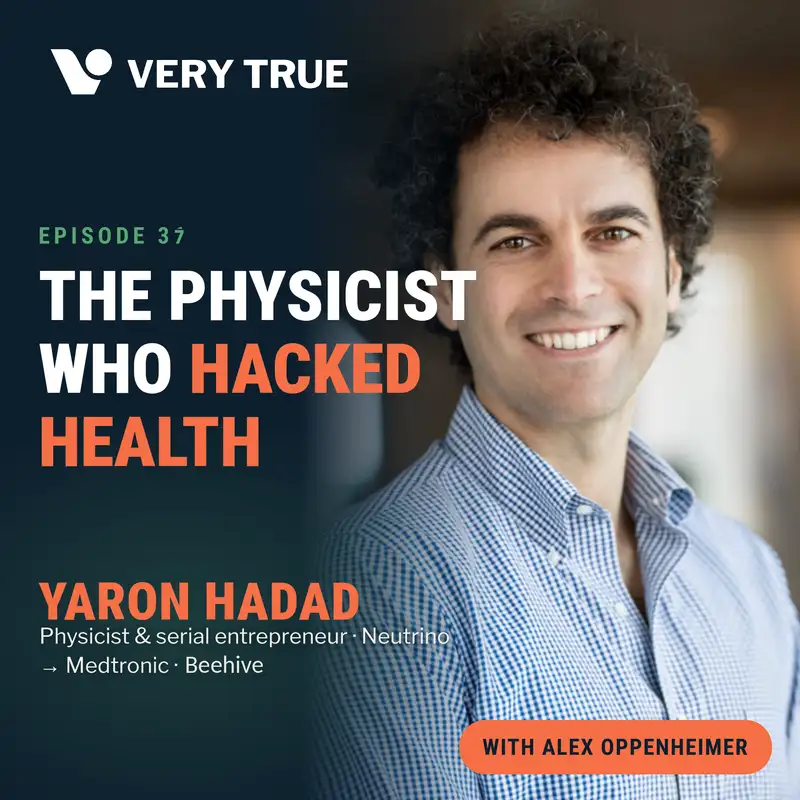
The Physicist who Hacked Health - Yaron Hadad
Alex (00:53)
welcome back to another episode of Very True by Verissimo. I'm super excited today to have my friend Yaron on. we have only hung out in Palo Alto. we got to get you here to Israel again one of these days to hang out locally, but I'm excited to have you on because you're always one of my smartest, most intellectually stimulating conversations when I make my rounds in Palo Alto. So I'm excited to share that with the audience.
I think we've known each other now for six or seven years. I think that sounds right. so I'm excited to hear a little bit of this your story, which I don't yet know. we could take it way back and and then we'll take it from there. I imagine our conversation will drift into the various
Yaron (01:22)
Yeah, I think so.
Alex (01:35)
Topics de jour, which are mostly just AI and its various manifestations, opportunities, challenges, and everything along the way. So I will hand it over to you to start with your background and you just know that you can't go too far back.
Yaron (01:47)
Cannot go too far back. Okay, fair enough. Thank you, Alex. I appreciate it and thanks for the nice words. It's always a pleasure talking to you. I always enjoy it and I always learn from it. Which is one of my favorite things to do. so a little bit about myself. I grew up in Israel in the eighties and nineties. I I was really into software from the time I was a kid. So I used to I work as a basically as a software developer already since I was 14.
I ended up taking a different route from software after the military service. I went for math and physics. My goal was to become an academic for different reasons. I read a bunch of Albert Einstein biographies that really inspired me to want to work on general relativity and some of its limitations.
As part of my PhD, I did work on the mathematical foundations of general relativity for a few years, and particularly on you know, the light stuff, yeah. the particularly on new solutions for Einstein's equations and gravitational waves and black holes a bit. And I like to say that at some point I came back to Earth.
Alex (02:37)
Simple, simple stuff.
Yaron (02:50)
academia somewhat disappointed me in different ways. So I think it wasn't my my calling after all. we can talk about that. But I ended up starting a startup called Neutrino. And Neutrino developed a way to quantify and predict how food affects people from a health perspective by using AI and various other types of algorithms together with information from medical and wearable devices.
we call that concept footprint. I kinda like always like that name. and eventually Neutrino got acquired by Medronic. Medtronic, for those who don't know, is the biggest medical device company in the world. It's a huge company covering over a hundred
Alex (03:28)
What year did
you start it and what year did you sell it?
Yaron (03:31)
we officially I think registered the company in twenty eleven and we sold it in twenty eighteen. I started working under Trino full time from twenty from the end of twenty thirteen after I finished grad school.
Alex (03:45)
Amazing. And then what was it like being in the largest medical device manufacturing company in the world coming from a startup?
Yaron (03:51)
Well, let's say it was some elements were similar to what I was expecting, others were not. I get to I'll I'll I'll tell you the the good, the bad and the ugly. I mean I I got to work with amazing people and working on medical devices is very inspirational because at the end you're trying to help as many people as possible solve some of the worst, you know, sicknesses and diseases they have. that's a lot of the good. the bad was the speed, right? Your
B company, compliance, FDA, all that kind of stuff. It was really painful to observe and experience. And I think that for me was the hardest thing. I always like to move faster in terms of building and inventing and so on. yeah, anyways, Metronic. So that was that. after the acquisition, I led their AI and data strategy for three years.
some of the claim for fame there in terms of projects we work on, worked on was the artificial pancreas project. So they took the neutrino technology and we implemented it basically into an insulin pump and a glucose monitor combined that had the goal of automatically injecting insulin to people using AI to adjust the basically the therapy.
that's a very hard problem. We can talk about that. specifically because AI often I mean AI is statistics in nature in most cases, and it's a class three medical device. It means it has the highest level of regulation. If you're making a mistake, you can kill a person. So the bar there was really high in terms of quality and what we needed to do. And we were eventually successful to get in getting
breakthrough designation from the FDA for this technology. and after after that I left Medtronic after about four years roughly. I was involved in co-founding four other startups in different industries.
Alex (05:33)
Amazing. And where does that bring us to now in twenty twenty six?
Yaron (05:36)
Twenty twenty twenty-six. So yeah, so I hi I I'm still involved with a bunch of different startups. So I both work so okay, so the main startup I'm spending my time on is a company called BeeHype Software. we developed basically a new framework to develop AI and software, and we can talk about that in a few moments. I also am involved with a few other companies that I I co-founded.
atomic growth in the e-commerce space, vegan America, which is the largest plant-based marketplace, kind of like Amazon for vegans. that's a that's a third one, and a company called Green, which is a device to monitor your teeth. I'm on the board of a bunch of companies, I'm advan advising a bunch of companies. I I'm still investing in startups, and I try to do a little bit of research on the side, but that's
You know, yeah, that's that's always harder, but I I do get like at least a publication or two a year, which is kinda nice. working on AI for math mostly recently. Before that was a little bit more about physics.
Alex (06:35)
Okay, amazing. Very cool. So where I'd love to jump in is on this anyone, you know, this idea of size versus speed and what it takes to innovate. I think that the rule was typically that small is agile and that's how innovation happens. But at a certain point when you're ready for the big show, like you're a cre class three medical device, like you need all of those stop gaps. And
You know, everyone talks about the 80-20 rule. It's more like a 95-5 rule, I feel like, where it's like, you know, 95% of the innovation to figure out this thing and how it should work is like 5% of the work. And then 95% of the work is like how we don't kill people. And that's obviously an extreme version, but if you apply that to Intel, I think you see a lot of the same. And anyone who's worked in large enterprises versus startups.
Has seen this, that agility is your friend. I remember meeting a startup years ago that said, Yeah, we solved this problem with like six engineers. Such and such big company has put a hundred engineers on it and they can't solve it. And I'm like, Well, that's because it's a six engineer problem. And I guess the first question would be: is there such a thing as a hundred engineer problem anymore? I think there was, right? Like the Mercury.
You know, program in NASA, right? The Apollo program. Like that was hundreds of engineers, and engineering management was a real art back then.
Like now it feels like can can six people do everything? And we know that I guess I'll just throw in another piece from my own l little background, which is I worked in investment banking for two years out of college. I worked 16 to 20 hours a day, basically seven days a week for my entire first year. And people ask, why don't they just hire another person? Right? Like that's that's more than
On average, like on average, that's more than a full quote, you know, eight-hour workday. Like, why don't they just hire another person? And the answer is that like you need to hire smart people that can hold everything in their head and move things forward faster and more cohesively. I remember investment banking training, they had a team of four of us work on a project that normally a single analyst would do. And it like it took longer for all four of us to do it than it would have taken if we just asked one person to do the whole thing start to finish. And so
This is like a broad orgs problem. It's not just like an engineering problem. I guess what I'd love to dive in on and get your take on is like, has AI fundamentally changed that? And if so, are companies that have a ton of engineers and are organized in a certain way with engineering managers and whatever it may be just totally screwed?
Like do they need to burn the whole thing down and build up from scratch?
Yaron (08:57)
That's a really question. so a couple of different comments here first, related to your what you started with. I was always like a big fan of Jeff Bezos' two pizza rule. Are you familiar with that? Yeah, like if you have a hard engineering problem, make sure the team can be fed by two pizza trays and it doesn't get too bloated.
Alex (09:08)
Yeah. Yeah.
Yaron (09:18)
Which again it's it's hints towards smaller teams. But that being said, I do think there is there are problems for which you need bigger teams, but often you don't want to work on them as singular problems. You wanna break them down anyways, you know what I mean? So let let's say you wanna work I I don't know, you wanna build SpaceX biggest rocket, Starship. You wanna build Starship. I mean, six or ten people won't be able to build that entire thing in a reasonable amount of time, but you will
Alex (09:31)
Yeah.
Yaron (09:43)
Fi you will split that problem into a lot of sub problems that are to some extent decoupled, right? Obviously there'll be the teams will need to communicate with one another, but but yeah. so I agree with you fundamentally that like smaller teams can move faster and often can solve most problems, but in reality, I think if you're looking at huge scale, especially infrastructure projects.
You will need a lot of people, one way or another, today.
Alex (10:10)
So
one thing that comes to mind, I listened to a really interesting podcast interview with the founder of of General Matter, which is building nuclear reactors. And he was talking about how some company had come out and said, We have 900 suppliers. And the point that he made was like every time you have a supplier relationship, there's a certain amount of calcification that happens at that interface. And SpaceX figured this out early.
And that's why they were able to move so fast. They just said, you know what? If we bring everything in-house, we will control the whole process. And on the surface level, that sounds like, yeah, so quality and everything. But what it really means is that you're able to uncalcify or decalcify those interfaces and move layers and have more open negotiations because everyone's pointed in the same direction and answers to the same people. And I think that.
There's probably a lot of teams. And again, anyone who's worked in a corporate environment knows that you have these like internal calcifications between teams where they become territorial, we own this, you own that. And that defeats the whole purpose of being inside the same organization, where we can say, you what, actually we can give a little here if we take a little there. Whereas if that's two different suppliers, they're not having it. and so I think that's probably the the nuance.
That makes the difference between a great scaled engineering team and a really dysfunctional scaled engineering team is like not falling into the trap of calcified interfaces between your own, like inside your own company. but even that, right? Like you can have experts. I found that in my own pretty basic use of AI.
Able just to hold a lot more in my head. Now, when I was an investment banking analyst, I also held a lot in my head. It was very impressive, but my brain plasticity was much greater at age 23 than it is at 37. and it was physically exhausting. a lot of people did get fat in investment banking, but when you're working your brain that hard, like it burns a lot of calories. So I my muscles atrophied, but I didn't get.
I didn't get the fat. It was interesting. Anyway, you're also at a young age, whatever. but I I found that, yeah, in using my in my own use of AI, like I am able to just hold so much and react so quickly. And it's like having that team that can just instantly respond to you and you can delegate and they come back to you with the right questions the way that you want them to. Is that still a skill in management? Like, are you know, or is yeah, and
Yaron (12:03)
Ha ha.
Alex (12:24)
I don't know. I I'm interested in in how you've been how you've been running it and what you've experienced because I'm I'm doing this on like a basic, a very, very basic level.
Yaron (12:31)
Yeah, so first of all I do think that the amount of bloat, like how how how much big companies are like bloated and and ran run inefficiently, that that's like obvious. And I think that in this coming new age already the new age that already arrived partially with AI, I think it will stop being a small disadvantage. It will
start becoming a much bigger disadvantage. And I think we will see like that fabric or maybe the you know the the framework that companies use in order to decide how big teams should be, how many managers and so on, that will, in my opinion, have to change for the world's most successful companies. So the world's most successful companies, I would bet, will get much, much better at working with linear teams.
They will leverage AI, you know, on every possible level, because you can get internal efficiencies that are ridiculous if done right. You can also get inefficiencies if you're not doing it right. yeah, so I I
Alex (13:30)
Have I ever told you my
definition of an enterprise?
My definition of an enterprise is a company that is so successful that it can afford to be inefficient.
And I actually paired that idea recently with some other work I've been doing in business modeling around the opportunities that AI presents. And one of the opportunities that AI-powered businesses does not present is what kind of the a lot of businesses and kind of this just this last era did represent, which was fat, fat margins. So whether you were Google or Facebook and you were just an ATM.
Or, you know, any any pharmaceutical company, you know, a big software giant, right? Like they just print money and that engenders inefficiency. That's what you everyone talks about. The beauty of a startup is you're always almost running out of money and it forces you to be lean, which is a big question on the entire venture industry of pumping tons of money into these companies and thinking they can actually use it responsibly. I've seen this in my portfolio over and over again where like company raises a bunch of money early, they hire a bunch of people.
For whatever reason, it doesn't matter, but like it just inertia at the wrong time. But then that all came back to Mark Zuckerberg's famous line, which is move fast and break things.
That feels like a luxury that you only get when your margins are really fat.
And maybe that's the best version of the enterprise fat margins, like a business that's so successful it can be, at least on the surface layer, inefficient by breaking things because A, it's inconsequential. And B, they know that their innovation will actually be driven by this quote or inefficiency on the driving things forward.
Yaron (15:01)
Yeah, but I I do feel like that Mark Zuckerberg quote is very Silicon Valley and it's very, you know, software centric, right? Like if you look at a company like Metronic, just in in contrast.
Alex (15:15)
Don't move too fast, don't break anything.
Yaron (15:17)
Do not do anything that might break break the smallest thing. You're not allowed to break anything. Anything you break can get you in trouble with the FDA, anything that you break can hurt a person. Zero break, you know.
Alex (15:27)
Yeah, I mean, I I come from mechanical engineering, and like I've been saying this
for years, like that is the ultimate software mentality. And if you apply that in the wrong places, people die. Story for another time, but that's my thesis on what happened with the 737 Max. They they tried to debug issues without looking at it holistically. And that gets back to our previous conversation about like what is great engineering management and how do you do that effectively versus just kind of arbitrarily delegating things.
Yaron (15:40)
Mm-hmm.
Yeah. I and I you know, and I if I may add also that mentality has to be very different between hardware and software because if you ship, let's say, a device to someone's home, that device has electronics, has mechanical parts, has all that part, everything, right? It also has some software, but often you cannot just like upgrade it or fix something that you broke by the press of a button. You need to do recalls, it's like a whole operational nightmare. So
Alex (16:18)
Yeah.
Yaron (16:20)
It's easy when you're in the software world and you can deploy from your you know, from your office.
Alex (16:24)
There's probably listeners right now going, but doesn't Elon and Tesla do over-the-air updates? It's like, yeah, to your infotainment system and like minor parts of your like, you know, battery management system. But if the suspension has a flaw, like you're recalling tens of thousands of cars to come get it fixed. Once something's in the wild, it really needs to work. And that I would say that's probably the biggest difference between.
Yaron (16:40)
Is a problem. Yeah.
Alex (16:49)
What I learned in mechanical engineering. And mechanical engineers are the ones that put things in boxes and ship them. So you got to know a little chemical, a little electrical, a little computer science, you know, all that stuff together. And then you got to put it in a back in a box and put it in the world. and that sits on your shoulders. That mentality, maybe is that the mentality that people need now? And is that what they're actually capable of with AI? Whereas before it was throw stuff at the wall and
If it doesn't work, we'll just push an update over the, you know, AWS. And if it does work, great. Like, does that fundamental mentality need to change? And and can it change in software right now because of the power of AI?
Yaron (17:17)
Mm-hmm.
So you're saying just to make sure I understood, the mentality of what specifically? Like
Alex (17:30)
The mentality of like actually make this thing work, right? Like you can hold, as we say in the little Yiddish, you can hold cup, right, in something in the whole thing, right? That used to take some sort of freaky super genius. Now it's like, well, if you can have all the data you need to see almost immediately, like that's that's all of a sudden become a more kind of tenable thing to do. And you don't need to do as much aggressive, questionable delegation.
You actually can hold a lot of it in your head. And so are the standards just that much higher? Like when you ship something, it's just gotta work. Like no one has time for this silly iteration process. The expectations are that like things hit the ground running and go immediately.
Yaron (18:09)
I also yeah, so I I think so. I also think that like if you look at enterprises, whichever definition of enterprises, even if it's looking into you know, licensing or or buying new AI software, their patience for mistakes, silly POCs that don't really work, etc., that went down almost to zero already now. I feel like in the past you could have shipped like a
Alex (18:17)
Yeah.
Yaron (18:34)
partially working product just to start getting reactions and getting feedback and improving it with the clients, I think as time goes by it it's becoming harder.
Alex (18:43)
It's it is, I would say there's a like a very clear difference here. And it comes into like the determinism of the whole thing. Right. If some if someone ships a piece of software and the client has an issue with it, they say, that's a bug, we'll fix it, or they say, Hey, Mr. Client, you're not using it properly. Here's how you actually use it to get the most out of it. And they say, okay, and they move on. You ship something that's powered by AI, it's almost like the reaction to it when it messes up is more similar to that of an employee.
But an employee with no face and no name, and so you're just gonna be the most awful boss that's just ruthless.
Yaron (19:15)
That one.
Alex (19:16)
You gotta disagree with me about something.
Yaron (19:18)
Well no, that I agree with you about. But
yeah. I I I do I I think realistically what I've been seeing with the startups I'm working I'm working with, and also in in my companies, like people have okay, so what's what's naturally been happening if you think about the industries? So the cost of producing content, the cost of producing code, stuff like that has been going down. Okay, practically
de facto going down to zero. the as a result of that we're starting to see more and more content. Social media is practically a nightmare. People's attention span is going to zero, right? Because everything is thrown at you. And you know, for anything that anyone might offer, you see like a a hundred different companies offering in in many cases, right? It's like it's really yeah.
Difficult to keep track of. and I think that lack of attention span is becoming the hardest problem to actually solve for companies, both from a sales perspective, from product market feed perspective, etc. Like, how do you make sure you get people you get people's attention in order to put your product in front of them? And how do you make yourself unique, differentiate, etc.? And that is a little less about
Let's say only what you do at a given moment in time, I think there is almost like a continuum. Like if you wanna be a company that stays relevant, you need to keep innovating and you need to keep push pushing forward. I love your blog post about lazy SAS is dead because I I I do think we're starting to see it. We haven't yet yet seen it at full scale, but we're already starting to see it. yeah, and and I I and I think realistically it's gonna get worse.
Before people figure this out.
Alex (20:52)
Well, I'll I'll preview my next Substack, which I just wrote today, which it actually it puts the lazy SAS concept in context. And I'm interested in your thoughts on this. People are now talking about outcome-based pricing, usage-based pricing has become a default, subscription-based pricing is seems to be a thing of the past. And then appliance, you know, and renewal pricing is like ancient history.
And then just like a one-time purchase is like yeah, I don't I don't even know what that is anymore. Right. Like even even buying a piece of hardware, like a computer, like you buy a new one every few years, like there's no contract for it, but like it's re-occurring at the very least. The only example I could think of, frankly, for s for something like that is like jewelry, where like you really just it is very much one off. Although if you talk to people in the jewelry business, they have relationships with their clients. So even that, and basically
Yaron (21:41)
Buying a house? Yeah.
Alex (21:43)
Yeah. and even that though, so if you map that all on a spectrum of volatility, what you get is that like in the reverse order, like a one-time purchase, you just get your money, you deliver your goods, like conversation over. Then you have this appliance and renewal, which required like a big lift to get involved in. And then you had this basically 100% margin renewal stream. And that was again harder to break into, but
you know, very, very consistent once you're in. And that continuum continues all the way toward you know through subscription, back through usage-based, all the way into outcome-based pricing. And effectively you're trading for volatility. Right. And volatility can be a good thing because it means things can grow really fast, but it also means that like the ground underneath you is very slippery. So
Going back to just like the SAS thing, which occupied most of the last twenty years.
The transition from perpetual license software to SaaS, people forgot this. I was making slides on, you know, on this SaaS 101 I made when I was at NEA back in like 2013-14, trying to convince all of our perpetual license custom companies, even if they had like a hybrid approach, to just go complete subscription. And the question is like, why would you go subscription when if you have an actual perpetual license in a renewal stream, like how
What's the there's a there's a pricing equilibrium where like the LTV matches? So you have a big chunk up front and then little renewals, or just like an annual number. So it'd be like 400 up front and then like $20 a year or something, and or it'd be like just $100 a year. And so the idea with SAS, the original idea was you're basically pre negotiating your breakup. You're writing a prenup with your customer. You're saying, if you if you don't like it, you can leave.
That's what you're saying. That's what that and so people talk about like churn being some like, no, churn. I'm like, no, you pre-negotiated churn. Right. Like Oracle, when back in the good old days, was not ever selling a customer, ever expecting that the customer might leave. And the result was if you think SaaS got lazy, right? Like, look at appliance software. That is really lazy because they had zero motivation to make things better.
But I think there's a balancing point here where, like the actually by the time this podcast comes out, my blog post will almost certainly have already been published, but whatever. it'll be we'll tie them together either way. So the thing with SaaS is it's always pre-negotiated this churn option. And the result is that you have to deliver customer experience and you have to deliver new products.
In order to just maintain what you have. So the margins can never be as good as like if you want to again, SAS got lazy. Don't get me wrong. Perpetual license software was invented to be lazy. The salespeople, though, those salespeople, I mean, you probably know some Oracle salespeople from back in the day. That was that's talent. That is raw talent. You can't replicate that, you can't teach that. That is hustle and that is talent. And it doesn't exist anywhere else in the world to the extent that it does there. And by the way,
Again, if people don't know, I remember being at like Stanford Tailgates and there'd be these guys with like these crazy things. They were alumni from like the early 90s. It'd be like, wow, what does this, you know, what does this guy do? You're like a sophomore in college. You're wondering what this alumni is up to. He's a senior accounting executive at Oracle. We're like, really? It doesn't sound that cool. And you're like, this guy makes three million dollars a year and like works 80 days a year. you're like, okay, that sounds pretty cool. but you that's a that's a God-given talent more than anything else.
Yaron (24:58)
Are those really the numbers?
Those were those used to be the numbers?
Alex (25:00)
I mean, they're for some of the top guys, absolutely. So that's all to say that like SAS isn't as lazy as perpetual, but the stakes just got raised. But the biggest difference between the SaaS world and the appliance world was that the margins of SaaS could never be as good as the margins for perpetual license because you had to deliver your customers. So at what point?
Does the margin just completely collapse? This is what's been on my mind, because you know, I take a finance, you know, approach to all this stuff. Like, at what point are the customer expectations, because the the ability to churn is just it's too easy that like you have to just spend so much keeping your customers happy, otherwise they'll leave you. Right. Like, just in in my own last 12 months, I went from being a Chat GPT customer to a Gemini customer.
to a cloud customer and it's like boom, boom, boom, boom, boom.
Yaron (25:49)
Do you think the margins will have to collapse to collapse to a point where it's like non like not not economical for the companies to keep doing what they're doing? I mean it will happen to some companies, but it cannot happen to all companies. If it happens to all companies, there is no business, you know. There there there won't be a product that solves the problem that people are looking to solve.
Alex (26:06)
Have you have you ever been to a restaurant?
Yaron (26:07)
I have and they suck, yeah, usually. But they're exceptions. There are exceptions. There are always exceptions.
Alex (26:10)
Exactly from a business perspective, there are exceptions,
but restaurants are terrible businesses. This is like just a truth in life. Unfortunately, everyone thinks they're gonna be special, but most restaurants are terrible businesses and they come and they go, but everyone needs to eat. And if you look at the companies that make food, right, or
Ship things around the world. Like their margins are super, super thin. And so, but they're also not innovative. Maybe they were when they got started a hundred years ago. But the question is, how do you continue to push innovation when things naturally trend towards thinner margins? That's probably the biggest question that I have. How do you push innovation when margins get thin? Because
Yaron (26:38)
I
You don't
Alex (26:50)
Like I said with Mark Zuckerberg, like it was this fat margins that allowed them to just play around. Like with Google, all the moonshots, all these extra projects, because they were printing cash.
Yaron (26:59)
Yeah, there are like a a million businesses in the world with really terrible margins. Maybe not me a million, but that that have terrible margins but have a volume that allows them to push innovation. I mean that happens all the time. I've watched this really cool YouTube video of this company from China that has a lighter. They're like the number one lighter manufacturer in the world. Okay, lighters like the the the most commodized commoditized thing you can imagine. And you know, maybe
I mean I don't know the time frame, but let's say 120 years ago, lighters were relatively n not a completely trivial technology. Okay, and there are probably a bunch of other a bunch of companies producing lighters, but they're doing it at such crazy scale that they're okay with not making over a cent for a lighter. I think they were making a fraction of a cent per lighter.
But the volume is just so immense that that allows them to keep taking the profits and making the lighter slightly cheaper, slightly, slightly faster, slightly, you know. so volume always creates an advantage. And that will continue that will continue to happen also in software. It has to
Alex (28:02)
So two things on that. first, the the piece that I just published literally an hour ago talked about, I basically harked back to Thomas Friedman's, you know, the world is flat from 20 years ago. He said, Okay, the the internet made the world flat. Meanwhile, the largest companies ever came out of that. So it proved that it proved what you're saying, right? Where like you must have immense scale, otherwise you will not be able to innovate.
And the result is that, like I have this diagram that has like kind of uneven terrain with some like hills on it. And then as things have moved forward over the last 80 years, the terrain has gotten like dead flat, and the winters are just ridiculously spiky. It went from looking like normal mountains in you know hilly terrain to just like salt flats with spires sticking out of them. And
I guess that that's a little bit of a scary prospect, I think for a lot of people, where it's like, okay, there's gonna like three companies that control the world. And I know that's a narrative that people have been pushing where it's like, okay, Amazon's just gonna be the landlord, Microsoft's gonna be the landlord, you know. It's like NVIDIA is gonna control all the, you know, digital coal and fossil fuels of the whole world. Like, you know, is that where things head?
Yaron (29:02)
I think
It
I think it's extra scary if you combine that with the fact that people are thinking that AI is gonna take a lot of the work, a lot of the jobs that people have. Once you combine those two ideas, you know, there'll be a few companies making all the money, but then AI is gonna take people's work. So those companies can hire I'm not saying it's true, but let's play that. So those companies will need to hire less people.
And then I think people are really concerned about that.
Alex (29:36)
So what I'll point to though is as we go back in history, people were always scared of new technologies and always said that they would result in job losses, and they never did. They always resulted in job creation. And the other thing that I have in this image, which is nuanced when you look at it, is that the plateau for each level actually goes up. And then I use this analogy, which is that like the level, the altitude from which the basically you see level is.
continues to rise. So like these spires that are sticking out of the ground, everyone's higher up where they start versus like the old mountains from 80 years ago, like it was much lower. And so it lifts everything. And the analogy that I come back to is like people say, you know, a rising tide lifts all boats. A rising tide only lifts things that float.
If you do not float, a rising tide will kill you. Right. Like it should scare you a lot. And I think that's what you kind of always see. And people kind of for the last 35 years of you know, most of my life were always scared of internet, of mobile, of this, that, and the other thing. And people kind of always adjusted and figured it out. And yes, there's some professional casualties and some difficult changes of lifestyle that people go through. And there's a lot of fortunes made.
And it kind of always makes way for the new generation. But that's I think probably the key term is the generational shift. Generations, it seems like, have gotten a lot shorter, both culturally in terms of like
I think you're probably like around 10 years older than I am. And like, okay, you're only seven years older than I am. Like we're in the same generation, right? Like, but someone who's 50, it's not like that big of a difference. and that's Gen X. And I, you know, we're millennials or whatever. If you look at now, you have Gen Z, Gen Alpha. I think there's already another one after that for like my kids' age. You know, my oldest is six.
Yaron (31:00)
And forty four.
Alex (31:19)
And so it's a whole different world every every so like very, very quickly. So the question is, can people adapt? Or is it like you're in and out of style so quickly? It feels like the baby boomers got a great ride. You know, it was like fairly stable for most of their careers with a big uptick and the skills transferred. It kind of happened slow enough. Like, you know, my dad went from engineering in an oil refinery to kind of working in finance in like aerospace.
To becoming a tech software internet CFO. Right. Like he was able to kind of move through that. You know, I don't want to take anything away from him because it's not trivial what he did in his career, but it feels like that's like impossible now. Either it's impossible or if you're a freak of nature, it's like super duper easy because you could just like consume and create faster than anyone in history.
Yaron (32:03)
Yeah, I think that nowadays people will need and as time goes by, people will need to adapt and reinvent themselves more than ever in history. Like that that time of hey, I'm doing this one singular thing and I can do it for fifty years, I think that's gonna be harder if I had to guess.
Alex (32:20)
Yeah. So so let's shift back to you into beehive because I can, you know, pontificate all day long. how does that affect software engineering?
Yaron (32:29)
Yeah. I mean AI in the last three years, I I would say it's probab not probably it's the biggest change in software development that I've seen, you know, since I've been in this space and I I also think it can get even more drastic. so how does it affect it? So all of a sudden everyone is a software engineer, right? So we have clients that in the past, you know, for the smallest thing they would ask us to do it, right? The smallest little thing, change some copy on a website.
and now people can very easily do this kind of things themselves, right? You don't need to write code, you write in English prompts, right? And and you're fine. I think as a result of that, generally the efficiencies of writing software are so nuts that you can write software faster, obviously, than ever before. And the bar to write software went down. Realistically, what that means is that
Yeah, it's I I think what we're seeing happening is like IT agencies and generally generally you know, I I wrote a blog post about it. Maybe I'll maybe I'll take it back a few months ago. But basically what's been happening is a a continuation of a trend that we have seen, but at like at a crazy extreme. so if you think of like assembly back in the day, a few people knew how to code. It was
Very kind of like mechanized, really hard to understand it. I don't remember the number, but I think it was like a a million, a couple million engineers around the world or something, relatively low numbers. Then there was like a higher level of abstraction. People, you know, we started having like BASIC and Pascal and C, etc. Higher level of abstraction, becomes easier to code. You don't need to some at some point you didn't have to manage the memory yourself, all those kind of things. More and more people started doing it.
It got to tens of millions and so on. Python, even more English like. And basically we are almost like at the last evolution of that, last generation of that, if you want, where now in order to code, you don't even need to know any computer language, you just need to know your own language, you just need to know English. And as a as a consequence of that, maybe I'll add one thing before you respond. another thing happened is the level of compactification.
Alex (34:24)
Yeah.
Yaron (34:28)
So if you wanted to write a piece of software in assembly, and let's say a piece of software that required, I don't know, 10,000 lines of code, later with C and Python and so on, you could do this with a fraction of the number of lines of code, right? You could do it probably with like a thousand. I think there was like 10x or 20x or something. And now with prompts, you can write like a sentence and basically develop a POC, like a proof of concept of a piece of software. and the machine does
A lot of it for you. so those two trends happen together. I'm gonna let you respond before I continue.
Alex (34:58)
I wrote a piece a while ago that talked about each generation of work and basically that the side effect of whatever kind of the the lore and like the conventional wisdom was, it was actually a side effect that was key. So like right after I graduated college, CS 106A at Stanford became the number one class, computer science became the number one major because people said you gotta learn how to code. Right. That's what I heard from my dad. You gotta learn how to code, right? You know, and that became like a thing. Teach kids how to code.
Teaching kids how to code is like teaching kids how to speak French, right? Like it, it's it's just a language, right? It's syntax. But if you actually have ever taken a computer science class, you know that the subject matter of those classes is not just how to code. That's a prerequisite, right? Studying French poetry, that's the art that comes out of it. That's the that's actually the key thing. So
Learning the puzzle solving, learning how to think like an engineer, you're learning how to make the most out of what a computer is actually capable of is the thing that actually mattered. And so I always tell people, you know, the the the language in in any sort of model, whether it's financial or anything else, is always garbage in, garbage out. No matter how good your model is, garbage in, garbage out. So I think what AI has resulted in is that you could actually, in some of these things, put garbage in and get something decent out.
That's a big leap forward, but what you can't do is put nothing in and get something out.
Yaron (36:16)
At least today that could change. You know, you could have system you can imagine a few year maybe even a couple of years from now, a keep p systems that derive intent from what you're doing and trying to build things for you based on your intent and not on what you put in
Alex (36:30)
Yeah. And your
your implied intent, right? Like that's that's Facebook versus Google, right? Google's expressed intent. But I I think that, you know, I always say like I used to get all the I still get them, like these kids, you know, 18 years old. Hey, I have this amazing idea, I'll tell you, but you can't tell anyone about it. And they'll tell me about their idea. And it's usually like 90% of the times it falls into one of two buckets. Bucket A is, I'm like, wow, that's an incredible idea. Have you heard of Uber? Like
Like, you know how good of an idea is that is? There's like a hundred billion dollar company that does exactly that, you know? Like, like, wow, that's a great idea. Did you do a Google search to see if anyone else was doing that yet? and then the other bucket that the ideas fall into is like they're so stupid and not well thought out that it's like, no, just no, like no actually people want the opposite of that. Like nobody actually wants that. And so I I don't know. I mean, if the AI can be so good, is it just gonna tell this person like
Is it gonna start building them and bill it billing for this thing that like literally no one would ever want? Or you know, you see those memes of like the worst products ever where like you can't adjust the volume and you know it's like stuff like that where it's like, or is it gonna just start building it, or is it gonna say, hey, dum dumb, here's why this is a terrible idea, and we're not gonna waste compute on this.
Yaron (37:36)
Yeah, I think
I think that if you think about the objective function of of these LLMs, they are trying to satisfy you. They are trying to make sure you're happy. They are most likely to let you build silly things that is useless just because that's what you're asking for. If I had to if I had to guess, at least today. But
Alex (37:57)
So so
what do you think are like if you're 19 years old right now and you just finished your freshman year of college, what what are you spending time on? Like what are the skills you need?
Yaron (38:07)
Yeah, I think that some of the skills you need haven't really changed. so if I if I had to say, you know, for me
There is like a few basic skills that are eternal, right? That if you know, if you have those skills, you you can be very efficient what at what you do, probably almost independently of the kind of stuff that you want to do, as long as it's in the realm of building things and yeah. And those yeah. So first of all, I'm I'm talking about general skills and then we can talk about what you need to study in order to to get those skills.
Alex (38:32)
Tell me more. What are they?
Yaron (38:39)
Skill number one, problem solving. Okay? You will need to problem solve, even if you have AI that is doing a lot of your work. You'll need to think about how you want to solve it or stuff like that, even to guide the AI. Problem solving, I think for me that's one of the reasons I wanted to study physics so much. Physics, math, even computer science, even though you don't need necessarily to learn how to write specific lines of code, it teaches you a lot of problem solving. I think, by the way, general science is good for it, but physics is like the ultimate way of doing
learning about problem solving at scale. also because you get exposed to all the other tools related to it. You get exposed to math, computer science, programming, chemistry, and so on, just as part of it. So one is problem solving. Second thing, which is much harder to learn typically, like at least with the current academic framework and so on, is communication. Because if how well you're doing things is
controlled to some extent by how well you can manage AI and agents, and you need to communicate with those agents. They're not going to you know, do everything that you want if you cannot communicate it well, but also communicate with other humans. I think that one of the things that we are seeing because of this trend in AI and all this content in the world and BS low quality software that is really easy to produce right now.
Trust is eroding, right? So trust is becoming an issue. And who's gonna have an advantage in that world? It's people that can really you know, communicate, convince people, get people to trust them, understand what they're talking about, inspire people, things like that. So I think communication is for sure a really huge skill to always master, right? Historically, but it's a hard one to master.
I would say those are probably my my my my top two if I had to guess.
Alex (40:20)
Okay, let's keep going though. I want to hear more. What are the eternal skills?
Yaron (40:22)
More?
one thing that I think was a miss. So okay, it depends now where you want to play in your life. But let's say you want to play in the world of startups and technology and so on, which I assume a lot of your podcasters, a lot of your listeners are are in. I would say
Digesting for a second.
I think one thing that I'm surprised that the public education system is typically not teaching is finance. Not at the very basic level. Finance, investing, you know, what do you do with money, how you manage money, all those very, very, very basic things. I think that if you want to play in the world of startups and investments and all that that realm, in general, even investing in the public market in public markets, that's something that you need to understand. Okay. And I think
Just by having some financial call it literacy, you'll have a lot more people better off than otherwise. So I think that's something that if you know, if I was a dictator, I would make this like something that is mandatory, mandatory learning in like middle and high school, probably, at least in high school. more?
Alex (41:26)
I wanna see how deep we can take this. This is the this is the juice right here.
Yaron (41:30)
This is the juice. Okay, I love it.
I think that people should spend more time obsessing about where value is. Okay, so if I had to guess, and and where value is for humans generally, for the most part, is where people have problems. So I think I always like to see the world. Okay, this is even I even thought for a while of doing a podcast related to this, but I I haven't done it. I always love viewing the world around around problems. Okay, problems in the broad
sense of the word. So, you know, a person wants to get from point A to point B, you have taxis. Taxis are sometimes annoying because you cannot get a taxi or you need to call someone and then they don't pick up, etc. Uber comes up and completely shakes that model, right? Uber and Lyft. That's a problem. You can also talk about problems in the sense of scientific problems. I am trying to
you know, understand how matter works. I'm trying to understand what happens when you break matter to smaller pieces. I'm trying to understand what happens if I send a rocket to Mars, etc. And so you can really try and get that put that hat and watch the war the world from the vantage point of problems. Okay. What problems are unsolved? Okay, what problems are unsolved for most people, what problems are unsolved for some people, what problems are not solved for firms.
And one of my favorite things to do, and this is something I've been doing for about 20 plus years. I have this list on my computer with basically I try to write down an idea for either a problem to work on or a suggested solution for a problem every day. Okay, that's a really hard brain exercise. It's it's it's easy at the beginning sometimes, but then after you do it for a while, it's getting harder and harder and harder. So the idea there is how do you turn your brain
Into like a problem detector, because a problem detector is an opportunity detector. You know what I mean? If you're coming up, if you're observing the world and seeing people around you and seeing what they struggle with, and seeing what they're unhappy about, unsatisfied about, and so on, typically all those problems are opportunities for new companies, new scientific ideas, new innovation, and things that add value, basically things that add value to us all. So I
I think that this is something that, you know, is extremely difficult to teach. How do you find new problems and new opportunities? A lot of people, you know, don't try to view the world that way, but I I I think for me, this is really one of the most interesting perspectives. And if I'm 19, I'm trying to learn about problem solving. I'm trying to be a better communicator, to better, you know, manifest my own opinions, represent myself and so on.
I want to know some of the basics of business and companies and the economy and how this all works. But I also need to understand where I put my time into. And where I would like to put my time into is A, problems that are meaningful, that provide value to the world, value to people. Okay, so a lot of that is about having the widest net that you can have. So the more problems you observe, the more opportunities you'll have. But then if you have your problem-solving head, you can actually try and put a dent on them. Whether you decide
To start a company to solve it or to join a company to solve a problem or a non company, it can be a nonprofit, etc. ask me anything.
Alex (44:31)
Amazing. That's gold. I hope people take that to heart. I had a really interesting interesting experience, which I'd never had before on Saturday night. I was basically walking the streets of Jerusalem on a Saturday night with an influencer, with like a Jewish influencer. And he's an influencer for like the best.
Reason, I would say. he has a real like world positive mission. But the people that we bumped into on the street that wanted to take a selfie with him or whatever it may be.
Yaron (44:59)
I'm curious who that is, but yeah, keep going.
Alex (45:01)
I
I worry that like that generation of eighteen to twenty year old, sixteen to twenty year old kids, like they see problems different than the way you and I see problems.
Yaron (45:10)
In what sense?
Alex (45:11)
Right, like just for example, this guy's an influencer, he's 22 years old, he hasn't really made any money, but he the opportunities sit in front of him. I'm walking next to him, right? They don't know who I am.
can help them a lot. And instead, they had no interest in who's this guy hanging out with this other guy. Like it it was just take a picture of us. Here's my phone. No please, no thank you. Like just take a take a picture of us. because they think that like that will solve their problems. And so I guess the way that I would almost push back a little bit on that is
Yaron (45:22)
Mm-hmm.
Alex (45:42)
There's acute problems and there's big problems. And then there's world positive problems and world negative problems. So what the only kind of refining push I would give is like not just like what's the problem in front of you, right? Like, I want these new Jordans and I don't how to get them. That's not a good problem to spend your life on. and and so I guess that's the only way that I would refine that is like it's
Yaron (46:02)
Yeah.
Alex (46:02)
The world positive lens of really rooting yourself in values and figuring out like what's actually good for the world and what's good for me in the long term, not just what's going to make me feel good tomorrow or make other people in my generation feel good tomorrow. And taking that to like a much higher level. But I think that that's probably not the skills question, right? That's the that's the how does that tie into the values and the goals question, which is which may be
Yaron (46:25)
Yeah, to
Alex (46:27)
another skill on its own of like how do you actually understand, distill, and codify your values and goals in life.
Yaron (46:33)
A hundred percent, but to be clear, I didn't mean hey, find all the problems where there is value where you can actually make money necessarily. I what I was think what I'm saying is more like from a funnel perspective. Try to give the w Yeah, look at
Alex (46:44)
Yeah, the exercise is extremely important. But when you talk
to like these eighteen year old kids, if you did this exercise with them, it would take you probably days to get down to a something that you would actually believe is a real value.
Yaron (46:55)
I'm sure. And I think but one of the things that will happen, you'll have a bigger val, you know, you a a bigger list of problems you look at, you start talking to people about it. Certain things will intrigue you more than others, certain things will make you more passionate about than others. I actually work with a lot of a lot of younger people in companies I invest in and advise and and I also help companies like informally very often, much younger people, right? Usually in their mid-twenties to mid early thirties.
And I'm amazed by how much this like newer generation is interested in impact and looking at solving things that actually make the world a better place. And I absolutely love that and I think they should keep doing it because I think that's that's more important than than the rest.
Alex (47:36)
Well, this has been really fun. I'm looking forward to doing it again soon. And we'll hang out in person, hopefully, and when I'm in town in October. thank you for the wisdom. Thank you for the perspective, and thank you for the time. this has been great. I'll talk to you soon. Thanks so much. Absolutely. See ya. Bye. Thanks. Remember to keep the window open. See ya.
Yaron (47:46)
Thank you for your time. Yeah, looking forward to visiting you in Israel. Take care. Yeah. Sounds good. Take care.
Bye.
Creators and Guests