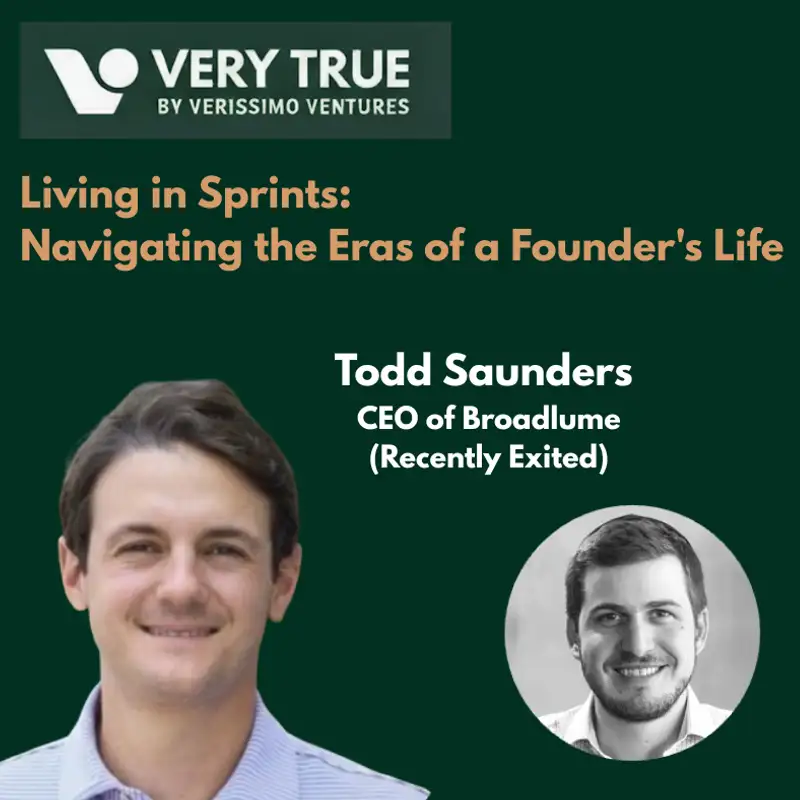
Living in Sprints: Navigating the Eras of a Founder's Life with Todd Saunders
Sophia (00:59)
Welcome to the Very True Podcast. I'm Alex Oppenheimer, the founder of Verisimo Ventures, an early stage venture fund investing in Israel and the U.S. Previously, I was a tech banker at Morgan Stanley and a VC investor at NEA. I then spent several years working directly with startups on finance, business models, rev ops, and more before launching Verisimo Ventures in 2020. I got into this business because I enjoy working with founders and helping them realize their vision and fulfill their potential. I created this podcast to shine a light on the day-to-day reality
that most people are too afraid to discuss. The pivots, the fumbles, and the so-called non-core aspects of building a business from scratch. Rather than focusing on the end of a successful road, we spend time here discussing the tougher, lesser-known parts of the startup life cycle. The goal is to offer insights to founders to improve their startup experience, whether that means avoiding problems and finding success faster, or just feeling more confident and less isolated on their entrepreneurial journey.
Alex (01:52)
So I'm super excited today to have Todd Saunders on the podcast. He has been a friend for many years. I think we've only actually met in person one time in New York, like a few years ago. We got introduced to Max and he's an incredible operator and founder. I am not going to preview too much about.
Todd Saunders (02:00)
Nah.
Alex (02:09)
What he's done, I'm going to let him share that. And he has some really interesting fun facts as well. Like accidentally becoming a city council person for his hometown and then moving and moving back there. But ⁓ he's got a lot of share, a lot of wisdom. His track of building a company I am constantly intrigued with. Some of you have probably seen his content on LinkedIn. It's fantastic, super insightful. And so I will hand it off to Todd to introduce himself and.
Kick us off.
Todd Saunders (02:35)
Yeah, I appreciate it. would probably change your intro a bit to say I've realized I'm a good founder. not sure how good of like, I've realized there's a lot of operators, which is a whole other kind of we can probably get into anyway, like bringing a COO and an operator to our business was like, mind blowing for me. But anyway, happy to be here. Yeah, my background is started my career at Google, take you through the quick story, started my career at Google.
launched an ad tech company in 2015 after being at Google for two years. Did the Techstars Boulder Accelerator, really in the hype of like accelerators and like venture capital and like ex-Google ad tech money, right? Totally different market than it is now. But long story short, grew that business from 2015 to 2019 as this ad tech business. And in 2019 realized that a third of our revenue was coming from the flooring industry, like local flooring store owners.
Alex (03:21)
You
Todd Saunders (03:22)
Turns out there was a website company who was selling websites to flooring stores who was then using our ad tech. But we were just like founders running around with their heads chopped off being like, money, we need customers. And we didn't really realize that there was like segment that not only was 30 % of our revenue, like 90 % gross margin, like 100 plus percent NRR versus like the rest of our business was like completely, you could imagine a horizontal ad tech platform, like 75 % gross margin.
Alex (03:49)
So, but let's take a step back because, so you decided to start a company after working at Google for two years. Did you go to college thinking you'd start a company? Did you figure that out in college? Did you want to work at Google to kind of launch you into that? Google 10 plus years ago was a very different place, I think, than it is now. But, and people went there kind of for different reasons. I would argue that Google now has become like,
Todd Saunders (03:49)
different businesses. Sure.
Yeah.
Alex (04:10)
21st century General Electric or Boeing where like you go work there for 30 years and you end up super wealthy. ⁓ But yeah, what was it like?
Todd Saunders (04:14)
You're right. Agreed.
Very good take.
I've never heard anyone with that take. It's a very good one.
Alex (04:21)
I appreciate it. What was the calculus on your end? I think the decision to become a founder, is it a decision? Is it a pull? I've heard the worst takes on this of people like, well, I did this, I did that, and I feel like the next step in my career is to start something. I'm like, that's not how good companies come into existence. I guess, yeah, just give us a little background on the thought process, which again,
Todd Saunders (04:37)
Yeah.
Alex (04:46)
In my own experience, the thought process for impressive people is often, you can package it up, but it's usually not, it's more whimsical than people think it is. So I'm excited to hear your thought process to go from college, Google, you know, and then starting something.
Todd Saunders (04:59)
Yeah, that's a very good question. Listen, my dad is a small business owner. He was an accounting firm. My grandfather was the same way. So it probably wasn't my DNA. I think growing up, I was always interested in like unlimited upside opportunities, which I think you could also like equate entrepreneurship. So I think I had it in me. But listen, like I wasn't the best high school student. I got into college. I have two options to go into college and then I'll get in. This will give some background like.
I could go to a kind of like a typical, fairly good school where I'd have a lot of fun and there's football team or whatever. But then I realized that track could get me into a very good academic school that I couldn't get into myself. And so I ended up going to William & Mary and that was my first, when I kind of made that decision, I think I made the decision that like, what was important to me was finding a way to have unlimited upside in the rest of my life, whatever that meant.
and be able to just do whatever I want, whenever I want. That was always in the back of my head. I'll take this full circle. So when I was at William & Mary for four years, to be honest with you, I applied to a bunch of jobs. I'm not sure I knew Google was cool, like Facebook was cool, Meta. There was all these up and coming awesome tech companies, but at that time you're a college kid. And my resume was not any different than anyone else's. So I don't even know why Google took me. And I think looking back, I actually looked at the Google
Alex (06:06)
It wasn't meta yet.
Todd Saunders (06:14)
interview application. All throughout college, I had done weird, interesting side hustles. So I had that in me. They called it the Googliness or whatever. But I only got one job offer. So I only got one job offer from Google. I didn't even get the job offers to the IBMs and other places. So I didn't go there thinking that, this is a launching off point. And then when I got there, the reason I left was because it wasn't as
unlimited upside. If you grind it out and you do this, your upside is unlimited. upside isn't just money, time, flexibility, money, income, whatever, all of that. So I definitely did not go to Google thinking that was the start of business, but I did go to Google because it was my only offer. However, I also appreciated about Google is that there was a lot of like-minded people that just get your energy going. So was really whimsical. The reason we started a company is we wanted to leave Google. It wasn't like
It wasn't like we started an ad tech business.
Alex (07:04)
goes against so many
things. Like, you know, go to something, don't go from something, you know. ⁓
Todd Saunders (07:09)
Yeah, we just like, we just were sick of I remember my last meeting at Google. It was like, you did all of these things, but like you got a two score on active listening. And I'm like, hold on. So I was the best salesperson. I was the best of this. Okay. But I didn't do active listening. said, can you define to me active listening? She's like, well, not really. And it's like some googly answer, you know, whatever. And it's like, and we're to give you a 3 % raise this year. And I'm like, okay, like this is what we're going to do here. So we just
my co-founders at Google and we were like, we need to go do something where we're in control of our destiny. And that was really the anti-Google goddess there. But I can't say I chose Google to then go to start a company.
Alex (07:47)
Well, it's interesting to say, you know, had one job offer. I also had one job offer. And I think I've really, I think maybe there was a couple of internships I had simultaneous job offers for, but I think there's two kinds of people in this world. There's the type of people who like prepare really well and know how to market themselves and they go collect job offers. and then there's other types of people. Sounds like you and me share this, which is you get one job offer.
And sometimes it works out to the right thing. I don't know. I always tell kids that like at some point you transition from kind of the college application process to like the dating process where like you just need that one that fits. And yeah, it's just a different, I think it's a different personality type. And I would, I think there's an argument that like, I don't know, I'd be interested to look at founders and, see what like kind of archetype them on this where it's like.
Whatever. was talking to this kid who was doing one of these work trial things at one of these hyped up YC companies in San Francisco, led by a handful of new grads who had like interned at these like Spitz, know, Bain, Goldman like type of things. And then they started this company and went to YC and like, okay, I'm pretty sure those kids were the collect job offers type of people. and now they're starting this very hacky company, which like,
has grown really fast, but like, just do not see a path to success. Whereas I when you look at like the, probably the most successful companies come from people who had zero job offers, right? You look at like an Evan Spiegel, a Mark Zuckerberg, like a Bill Gates. ⁓ And then, and then like the good ones that are probably a little bit more like stable. The one job offer people like, you know, it's not zero, it's not five.
Todd Saunders (09:00)
Yeah. Yeah.
Yeah, sure.
Yeah, no, I
totally get the analogy. But listen, the whole time I was like, this is just a, whatever I do is just a step before the next step of whatever that looks like. And when you're out of college, you don't know anything. And the same reason people ask me like, how did you pivot into flooring? Like, were you interested in flooring? I'm like, that was so happenstance that that happened and whimsical. And just like, I'm a big believer in like, you create your own luck.
You grind, you figure it out. If I got a job at IBM, think I'd still somehow be somewhere similar to where I am today. just like, some people create their own luck and want to take control of it. And others, think, go to a Google or a Facebook, like the new GE and they're there forever. you know, it is what it is. ⁓
Alex (10:01)
way to generate wealth.
just takes us that also takes a certain type of personality.
Todd Saunders (10:05)
Yes, and has you have to be willingness to be part of the machine. I had this debate with someone recently, which was for the first five years of my career. The argument was like I didn't have work life balance because I was working at a startup or not the first five years of Broadlume And my argument was always like, I like what I do. So like you think it's work life balance and I think it's passion and like, OK, fine. And busy people find ways to get things done, I believe. like.
It never felt like it was overwhelming for my life the first five years at Broadlume although you hear all these like hustle stories. It was, but we made it work. But now look at the next 30 years of my career. For me, I have the ultimate work-life balance because I put in that five year time. Now take the story of the person that works at Metta. They will probably end up, they will end up in a very successful wealthy place at the end, especially given the growth of like
SPY and like every, know, if you got into Google or any of these companies in any time in last five years and you just sat there and you are, you became wealthy. However, you're still going to be in the middle and end of your career without flexibility and having to put in your sick day and going into the office five days a week and having that team stand up that you really don't want to be on. And like, who has work life balance then? So it's like, when do you want the, yeah.
Alex (10:57)
Yeah.
So it was really interesting. I was
I'll just kind of give you one of my, I don't know, I would say it's like a medium warm, not super hot take, but you look at financial services, you know, kind of business services in general, corporate operations, whatever it may be, even in startups, like early employees, I don't think it's like done insidiously in like a manipulative way, but you definitely see this in the finance world where they pay you enough that
Todd Saunders (11:46)
yeah.
Alex (11:47)
you feel really good about how much money you're making, but then they're inviting you to all their clubs and vacations. So you actually spend all of the money or if you live in New York, just living, you just spend all of that money. yes, you might be like, I literally had a friend who was making close to a million dollars a year. He was like 28. And he was like, I want to leave and start my own business, but I need to make sure I can make money right away. I'm like, why? He was like, well, I'm...
Todd Saunders (11:51)
Yeah, you're working minimum wage.
Alex (12:14)
I like golf and I like traveling and I have a skiing hobby and I'm like, dude, you're spending like $350,000 a year post-tax money on hobbies that I guarantee his superiors who are making $20 million a year are just pulling him into. And again, it's not insidious. don't think it's like structure. I think it is structural, but I don't think it's like done like with four, like malice of forethought, as they say. And then it's like, you can't leave.
Todd Saunders (12:14)
Yeah, you get waste out creep. Yeah.
Alex (12:41)
Oftentimes they also, again, they pigeonhole you into a specific function or sector or something like that. Like you see this. For sure.
Todd Saunders (12:47)
The golden handcuffs are real. Those are the
tightest handcuffs the digital internet has ever seen. ⁓
Alex (12:55)
Yeah. If you work at
a big venture fund, for example, and you're a junior partner, like they're like, okay, you're going to focus on one area, maybe two areas. You're going to do one, maybe two deals a year. And if you're not right after like three or four years, we're just going to throw you out. And if you get lucky, then we'll make you a GP. And the problem is if they throw you out, like, yes, they give you a year of salary and blah, blah, blah, blah, blah. But like they were paying you probably a million dollars a year. Your carry is going to take
Todd Saunders (13:00)
You're in it.
Alex (13:21)
forever if it's worth anything at these massive venture funds and then you have like hardly any marketable skills because the business of venture and like what I'm doing now running my own fund is so different from that like Find the one deal a year that matters thing that all of these like scaled operations force you into and so it creates this like I Don't know if it's a hamster wheel or a vortex or whatever you want to call it that really wraps
I wouldn't call them young people. I'm talking about people who are 30 years old, like again, in the grand scheme of things, they are young, but they're not like 22 straight out of college. if you're smart about it, like I have a friend who was working in big law and he was living like out near where you're living, not in Manhattan. And he was just like stacking cash and that's freedom.
I also have this, you this definition. think one of the things that like tech people get wrong is we see these windfalls. Like our business is a business of windfalls, like massive exit. Like company exits for $800 million. Founder makes 250 million cash, like deposited in the bank. Like my dad has a friend who sold his company after 40 years, literally got wired $2 billion. Like he makes $80 million a year on interest though.
So when you think about wealth, wealth is cash flow. And that was the case for 1,000 years, more than that probably. wealth is cash flow. And it's like, that's the power when you get that huge windfall. And so I think what people miss out on, especially in tech, you're generating wealth by the nature of your cash flow. Don't just totally bank on the equity side.
You also got to, and we live in a world now where like ventures flowing, like the dollars are flowing because it behooves the GPs at big funds to raise bigger funds and pump companies full and create competitive dynamics for hiring. like, ⁓ so take advantage, but like that doesn't mean, you know, live in a 4,000 square foot apartment in Manhattan. Like it means like stack cash. Cause also like when I was, I have a, LP who's like a really successful operator in the financial services business.
who's from Australia, lives in London. And he sat down with me before he invested in, he was like, why are you doing this? Walk me through the math. This doesn't make sense. How are you making money? You're an incredible software analyst. Why don't you just go be Goldman Sachs' software analyst? And I just, again, it's all DCF. The definition of value is DCF. So I just gave him the DCF and I was like, okay, first of all, I can't just join Goldman tomorrow. They're gonna make me their head software analyst.
Second of all, their head software analyst probably makes between two and $5 million a year with zero upside effectively. And it's going to take like eight years to get to that. There's only one seat of that. and by the way, there's like a 20 % chance of you getting fired by none of your own doing every year. And that's your discount rate. And so I'm like, I can make this much money on fees. I can have this much upside. and by the way, this is my personality. And he was immediately like,
Okay, yeah, I mean, like that math makes sense. You're you're investing in yourself, you're approaching it properly. But yeah, I think so many people get sucked into that and then they miss the boat. Like, no, no, no, that is what it's...
Todd Saunders (16:20)
Yeah.
Yeah, I
think there's even a tangential part of it, is like, again, it's hard for me to think about because I've been on the other side. So this comes from, I don't want to call it a place of privilege, of nuance, because I've only really been in startup. When I was in Google, I was like blind. I was like, I need to get out of here just because it wasn't for me. It was a lot of like kumbaya. Like it wasn't for me. And I didn't know that until I got to Google. And Google is a great place. I would still work at Google later in my career. But when I'm early in my career trying to, you know.
do the grind. wasn't for me. I think there's also something to be said about like working on something you care about doesn't feel like work. I think it's like cliche to say that. But I have friends that work at the meadows and the and the whatever the world and it's like the job every hour. It's a job and it's just like it's a they're drained on the whole thing. And then they see me putting in 60 70 whatever it is our 80 hours of broadly much. By the way, you don't have to work 80 hours like
You could do the job in 40 good hours. But I cared about it whole time. I never felt like work. Never one point was I like, man. I also think about folks that have to spend 40 hours a week on something they really don't like doing. I don't like spending one hour in my whole week at all. Even on the weekend doing something I don't like doing. But I loved building. So it never felt like work. So no matter what the outcome of Brodden was.
I was happier than I was at Google at the time. That could be an age thing, that could be a flexibility thing, I don't know.
Alex (17:50)
That's the other half
of the wealth equation, right? Like what is wealth? It's cashflow, but it's also your life experience, right? Like I grew up with a guy at, he lived, I lived on like a street with, I don't know, 15 houses on it. And one of the houses at the top of our street, there was a guy, and it's like giving me chills to like say this, but there was a guy who he was like, I'm just gonna work my butt off until I'm 40. Then I'm gonna get married and have kids and build a family.
Todd Saunders (17:56)
That's it. That's what matters most.
Alex (18:18)
And I know other people who've like done that, you know, made it like, I'm going to just hustle, hustle, hustle, all work, all play. And then I'll settle down once I'm in like a comfortable place. And there's actually like a big Torah idea about this is like, don't say I'll do this later because like you might not have time later. And the saddest thing is that like, so this guy does that. He gets married. He has two kids. I think when he was 45, he got diagnosed with ALS. So it's like.
Don't do that. You know, like you're not in control. Like you, gotta learn to love it. And then, so I think we've talked about this, like I brought on or hired whatever you want to call it. Started working with one of my good friends from Stanford. name is David Rust as an executive coach who's absolutely fantastic. I like try to convince all of my portfolio companies also to, to bring him in and like, I'll get these texts like from some of them being like, just had my session with David, like game changer. And I feel that all the time too. He's just really gifted.
Todd Saunders (19:10)
Yeah.
Alex (19:11)
And he's also,
he's done the startup thing. He's done the scale up thing. He's failed. He's succeeded and he just has a certain. Skill, but we're talking about this literally yesterday where if you drive towards what you're excited in about. Like, yes, there are always going to be other things you have to do in life, but the goal is to like, I guess, get to a scale where you can outsource those things. And usually you can outsource more of those things than you think you can, but just.
strive towards what excites you and trust yourself. And I think part of the issue too is like, if you're young, and I think we get this in academia, we get this in the kind of corporate world as well, which is like, you push on something and because there's so much like personal politics inside these organizations, you just get like smacked down early. Hey, I think we should do this this way. And you just get like traumatized.
Like, no, no, no, you can't do that. This is how it's done. And you're like, all of a sudden you start questioning yourself when I still remember in high school, they had this guy come speak to us. I don't know. He was like a sensei or something. And he was just like, trust your instincts. Your instincts are always right. If it's not right, it wasn't your instincts. I'm like, I kind of like that. And if I look at the mistakes I've made, whether it's investments I've made, not made, you know, things in conversations and relationships, it's always been like,
Todd Saunders (20:19)
Yeah. Yeah.
Alex (20:28)
or I hesitate, or I let someone else kind of into the decision in the wrong capacity. And yeah, I don't know how you train that. how do you grow into that? I mean, I can imagine it sounds like you started with a lot of that, but how did you, I guess, how do you feel like you developed that? Again, because that's what great founders do is like they instinctually
can move through prioritizing things and selling and knowing what to focus on. And that whole side of the equation is so critical.
Todd Saunders (20:55)
Yeah.
The same will to kind of get yourself to want to go control your own destiny. Also, if you have that mindset building a company, like you're going to be a very successful founder. Like looking back, ideas literally mean nothing. Like there are some people that like this is the thing and they have a business plan and it's like, I'm not disregarding that like some that's not the way for some people.
But if I look back on our journey, like we had a crazy pivot, crazy. like, insert that, but along the way, I can think of like 40 times we could have died or like one decision, one decision. Everyone's like, well, how'd you make that decision? And I'm like.
Alex (21:31)
You
Todd Saunders (21:34)
my instinct? don't know. I've someone of a wrong, right? Some of you just get little meteors that hit you that you just have to figure out and kind of make your way past it. But like, I always when I started, like you hear like people first, people first, now that I'm done, I'm like, yeah, as long as they like directionally know where they're going, I will bet on these people because they'll figure it out just like just like how you figure it out to leave Google or get a job at Google or start a lemonade stand. Like I just I love betting on people that just figure it out. And that's really old.
We just were determined to get to the finish line, whatever that was.
Alex (22:01)
There's a really interesting conversation that I've been, it's an ongoing conversation over the last couple of months with a young founder that I know. And he's out trying to raise his seed round right now. And a lot of the feedback is we don't see how this could.
Todd Saunders (22:12)
Give me the
profile of the bit. Don't tell me the, but give me like the revenue. How big of a company are we talking?
Alex (22:18)
It's him and one other guy. Like they have like five customers, but like lots of interest. And it's really interesting because I explained to him that a lot of the feedback he's getting is like, we don't see how this can be a multi-billion dollar company. Now I'll take a page out of, yeah. mean, first of all, that's just a, I'll just say it. That's a dumb comment for a seed investor. if that's yeah. And it's like, well,
Todd Saunders (22:32)
At least favorite.
It's also just lazy. It's just lazy comment. And it doesn't
have to be. Can I just say something? That is the problem with venture too, right there.
Alex (22:43)
that sector, we're not sure that it can support this sort of exit.
Because it's always wrong.
You're always wrong. But what I explained to him is that's what they're saying, but it's not actually what they mean. And they may not even know what they mean. Sometimes they know what they mean and they're just trying to be like nice about it. But what they really mean is, hey, you're young, you've got a lot of energy, but we don't see in our conversations, your illustrated ability to navigate the challenges of this for the next seven, eight, 10 years.
to build this into a multi-billion dollar business. And that's just, I don't know if it's just a confidence you need to exude that you're gonna make those changes and you're gonna navigate it. It's like, has nothing to do with the actual idea or the company or the market. all I know about this market is that it's not gonna look like it does now five years from now. That's the only thing that we know is that it will change. And I guess, look, there's a lot of annoying seed and series A investors out there that are like, like I had a friend, I'm like, I can't believe this guy's VC.
Todd Saunders (23:29)
Now
Alex (23:45)
I told him about a company I was investing in, in the consumer space. And he was like, that's a big market. was like, yeah, it's 50 billion a year. And then he's like, do people buy that stuff online though? And I was like, no, that's the point. Like they will, we will make that change. Like every great business affected behavior changed and either created or moved to market in a way that like, if you're reading Gartner reports, like you're just not going to get that.
Todd Saunders (23:59)
Yeah.
Yeah, we'll make them better.
Alex (24:12)
So I guess cybersecurity is probably the exception to that where it is like much more straightforward and you're selling into a bucket. But I think that's going to change too because it's just gotten out of control. So it is that point of like, we think you can build a multi-billion dollar business. There's no such thing as a multi-billion dollar idea. Now there's this trend of like what I call the hundred million dollar seed round, which we've seen a bunch of where it's like a third time founder doing the same thing again.
going after some big existing market and they're just gonna blitz the market and your favorite multi-billion dollar funds are like, we're just gonna king make this from day one. Anything like that, that I hear someone talking about that's in any sort of space, I'm just like, immediately I'm like, that might be interesting, but it's not interesting because that's already happening. And it's like, you remember the Drake, he came up with a mixtape that said like, if you're reading this, it's too late.
Todd Saunders (24:43)
Yeah, I get it. That's what
Yeah, yeah, yeah.
Alex (25:04)
I did like a LinkedIn post years ago where I just crossed it out and wrote, like, if VCs are talking about it, it's too late. Like if Andreessen Horowitz has already done their like landscape piece on a market, like don't start a company there. And hey, seed guy, don't build a company there.
Todd Saunders (25:11)
It's true.
would say don't start a company now. A few things to that. Every market commanded something different. People ask me too, would you raise venture? And I'm like, well, yes. Sorry, would you raise that valuation? Because I now talk a lot about valuation optionality. I'm like, would you have burned that much money looking back in the first three years? I'm like, the market dictated that. If I didn't do that, I had to do that. What are we talking about here?
So there's like a big market change. also think if you're that founder, you need to say, I'm not doing a good job. I think there's some self reflection, like either I'm not doing a good job communicating this vision and getting them excited in me as a person. Okay, fine. But B, it doesn't have to be a multi, like that, just, it doesn't have to be a multi-billion dollar return. We, our first fundraiser was at 6 million, which I know now and see you like,
I can't even follow seed anymore. We sold the business for a couple hundred billion dollars and all of the investors thanked us and they all did pretty good and all my employees did well. That's a good business. We were not in a billion dollar market. We got to 30 or so million in revenue and people kept telling us, there's only this many flooring retailers, this many, that. The business at one... How can you even say that when we're like,
We don't even know what we're gonna be in three years. You don't even know what we're gonna be in three years or four years and five years, right? ⁓ Especially the seed level.
Alex (26:34)
So I'm gonna read some text
messages from a friend. I was meeting with a company yesterday that's adjacent to his business. I'm gonna try to make this vague enough but relevant. So I said, hey, like.
have you seen this company?" He says, that's the third one of these I've heard about in the last three weeks. That's wild. I said, do you think it's too competitive? And he said, there's a lot of people in that market. It's a big market, but hard to say it'll be a $10 billion company. And I was like, I'm over that. Too many VCs trying to underwrite $10 billion outcomes. Like if you're investing in a $3 billion valuation, you need to underwrite a $10 billion outcome. And
And then the other problem is like the founders, like this founder was looking for like a ⁓ mid, like a 10 % dilution mid, I guess, eight figure valuation with $0 in revenue, but a bunch of like pilots that could convert into a lot of revenue. I'm like, yeah, like, so my friend then I said, let's just get to a hundred million dollars of revenue first.
And he says, show me the math to a 5X net fund in 10 to 12 years. I'm objective. And I said, look, it all just depends on the fund size and the entry price. And that results in like ownership. it's like, yeah, if you come in at six, everyone can make money. This guy wants to raise at five, eight times that. yeah, the VCs aren't gonna make money. Like don't do stupid deals, you know?
Todd Saunders (27:54)
Yeah,
exactly. And as a founder, don't do stupid deals. It feels so good until... our story, another part that I think was very, very helpful to our story that I didn't appreciate, but now that I've had time to look back on it, was we ran a venture. Talk about having to pivot the business style. Forget even the business...
the business we were in, we pivoted. think our business style had to change given the markets. And this is the thing that founders like good examples of founders. We ran a venture business for a few years. Then we ran a bridged venture backed business that pivoted. Then we ran a angel business. Then we ran a growth equity minority business. Then we ran a growth equity minority &A platform roll up business. Then we had to become a profile of a
We need to sell the private equity as the one getting rolled up business all while in a market in 2015. We, you know, is 12 times revenue, whatever markets are 10 to 20 times revenue. And at the end of when we sold markets are whatever three to seven times revenue for kind of the vertical sass, you know, whatever grower tip grower that we are mature business. And like the amount of change that's happening and you had to like evolve who you were to the market was
Unbelievable a skill that I something that I never appreciated going into it that has nothing to do with features nothing to do with industry nothing to do with product nothing to do with anything like we just had to evolve and To kind of go full circle here, which is why I could I just like I'm not a good seed investor
Alex (29:21)
There's a lot of suspension of belief, I think, that's required in the startup world. And it used to be a lot less. When I was at NEA 10 plus years ago, you didn't have to suspend belief that much when you're investing in a company with 1 million of ARR with 4 million in the pipeline and you're investing at 25 posts. You don't have to suspend belief. But I was listening to...
Todd Saunders (29:21)
This is a 10 year fucked up journey.
Alex (29:42)
David George from Andreessen on Patrick O'Shaughnessy and two things from that whole podcast stuck out with me. The first is he was talking about who wins markets and he quoted Glen Gary Glen Ross and he was like, most of these markets play out like the sales competition in the movie, which is first prize gets a Cadillac, second prize gets a set of steak knives, third prize is you're fired. And there's like, for example, you know, like there's all these companies doing like corporate payments, like ramps killing it.
Todd Saunders (29:46)
Mm-hmm.
Alex (30:07)
Brex is doing perfectly good. Everyone else, you're fired. Maybe you become like small regional player, you get gobbled up by someone else who wants your feature set, but like, what are these investors thinking? So that's one. The second piece he was talking about like when they invested in Waymo and some of these other things and like the decision processes behind those. It's like you do all this underwriting and like, thank God, like I've been trained very well and like I have these skills also to like do this like.
underwriting and you can go on public comps and you can time adjust it and average it and use &A comps. Like whatever, you can do all these different things. You can be clever on how you run projections and the details and the mechanics of your model. Fine. But then you just get to a decision point, right? I always tell people like it's just an old school negotiation. Like we can do whatever we want with the numbers and then it's just an old school negotiation. I think I told this story on another one of my podcasts where like the first deal I worked on at Morgan Stanley was selling success factors to SAP.
And we're like doing all these models and all this stuff. And then like Lars Dahlgaard hops back on the phone like 15 minutes late on this call as we're like walking through our latest Morgan Stanley deck. And he goes, I got $40 a share. And there's just like books closed. Like how did he do it? He flew to Bermuda. He sat with Hasso Plattner. Like that's how deals get done. And it's just a gut thing. And like, yes, you have to train the instincts. That is important. That's where you grind. But yeah, a lot of these things, again, you're saying like, I don't think I can meet you as a seed investor, but
I think that if you can separate your psychopath for trying this as someone who's done this, who did a 10 year journey versus like, go right ahead, but I see you've got that healthy dose of insanity to go after. I actually want to tie this back into something we talked about earlier, which is
something I've thought about a lot, which is living in sprints. You know, a lot of engineering teams use these like sprint, whatever, but I thought about this many years ago where, you know, like in high school, I worked my butt off. I transferred to like a very academic private high school in my sophomore year and like worked super hard, got very good grades, you know, did well on my AP exams and my SAT and everything. And like, I got into a lot of colleges. I only didn't get into two of them and
But then when I made the decision, was like, people don't even believe me when I say this. like, how'd you decide which college to go to? I'm like, I just thought about where I was gonna have the most fun, which in hindsight was like the complete correct framework. Because where you're gonna have the most fun, where you're get the most excited is where you're gonna be the most successful. And it's where I learned the most, it's where I built the best relationships. And it's, I went to Stanford and it set me up for amazing things.
But anyway, like this living in Sprint's piece, it's hard to know. Again, I think that you see the academic to professional trajectory and you're like, okay, I sprinted in high school and then at Stanford, kind of like, yeah, I worked hard. I studied mechanical engineering fine, but like, it wasn't that hard of a major for me because I'm really good at building stuff. I drank a lot. I had a lot of fun. Like I had my hobbies, whatever. And then.
enter investment banking at Moreland Stanley in Menlo Park for two years. I don't even know if I want to call that a sprint. It was like gauntlet, right? It was like sprinting a hundred meters for two years while getting punched in the face. It was very brutal. They had to clean it up. Like some really bad things happened there. Like we did good deals, right? But, ⁓ you know, bad things happened. And then, then enter like 2013, I joined NEA, moved to Washington, DC. And again,
Todd Saunders (33:08)
Yeah.
Alex (33:25)
It's not to say didn't work hard, like, you know, I got to like take my foot off the gas. was traveling. I worked with much nicer people. Like the lifestyle was much more stable. Like I wasn't pulling all-nighters. was like the people that I worked with, the two main partners that I worked with, Harry Weller, who passed away almost 10 years ago and, and Peter Barris, who's now retired, like they're wonderful people. And they kind of taught me balance. Like Harry used to do this thing where he would go to Telluride every summer for six weeks.
and put in a way message on his email. Which is just a gangster thing to do, but let me tell you, that was the easiest time to get in touch with him. Like, I wish I still had it. July 4th, 2014. I'm like in Fort Mason hanging out with friends, and I get a voicemail. I have a missed call from Harry and a voicemail. And it's him just like rattling off ideas for this like,
Todd Saunders (33:54)
Yeah, that's tough. Yeah.
Ideas,
Alex (34:15)
model
that we were working on. And then at the end he goes, yeah, actually nevermind, leave it all the way it is. Anyway, so then you have this other side of it, which is like, okay, then you have life sprints, right? Where it's like, anyone who's like, gotten married and made a wedding or had a child, you have those sprints too. And then I feel like the sprints just get longer.
Todd Saunders (34:21)
He's always thinking about the business.
Alex (34:37)
Cause I took this other journey as well, where like I started becoming much more observant, like in learning more Torah and becoming much, I don't know if more Jewish is the right term. That's what a lot of people would say. but I, and I was very much encouraged actually by my colleagues at NEA, which I'm forever grateful for. especially considering like they're not Jewish, which was amazing. But, ⁓ and I moved to Israel and being an immigrant is hard and, and I took a job here. And then I was also like,
doing Yeshiva and like that was very, very difficult, a different muscle. You know, and then I got married and, I started this fund six years ago and like, you have all these sprints, I think when you're in your twenties and really your thirties as well. And then I was at a wedding and I asked one of my like main mentor rabbis. said, you know, I've done all these things and like, I've had all these sprints. Like what's the next one? Right. And
This has been my biggest adjustment over the last couple of years is he, points at the Chuppa like at the couple under the canopy, you know, getting married and he goes, you gotta get your kids there. I'm like, at that point, my son was like, my oldest son was like three. And I was like, boy, that's a big mountain. Like that's a long sprint. And I think that this is probably the biggest takeaway. Like you, you, you live these moments that it almost
Todd Saunders (35:35)
Yeah. Yeah.
Thanks so much.
Alex (35:53)
flies by so fast when you're younger and you, in hindsight, I can realize I was sprinting and like parts of Stanford felt like a sprint, part of it felt like a blur, part of it felt just super chill.
It was good time, but again, as you start to, and you're in this stage as well, like where you start to get out of the, I guess the sprints in some ways, maybe the sprints become shorter, like week long projects building up to like decade long goals. Like those things become more extended. And so as you enter this new chapter, it feels like, you know, we're kind of in a similar.
Todd Saunders (36:03)
It was a day.
Alex (36:25)
mode there like age wise, family wise, business wise, as, as you think about that next mountain to climb and like those next sprints, how do you take what you've learned so far and building your business and building your life and building your family, obviously in the wrong, the opposite order of that and level of importance.
but and taking that going forward and transitioning into like, I guess the next era of life.
Todd Saunders (36:47)
Man, that's that's a big, I totally agree with everything you're saying on the sprints. think, first of all, the market, I go back to the market dictates something. I don't think the market now dictates. You see a lot of headlines of these like VC giant back fast growers spending a lot of money, like all of that. I think that is less and less attractive now to the markets than a like, well funded fair valuation.
really good solid business. I think as a founder, your calculation, if your calculation is purely financial to do this, not purely financial, but you're doing this and you want to understand what your outcome could be as you just kind of like way to adjust your decisions. You are more likely to make money at the end of the rainbow if you take the other approach. So that's one thing. I the market is dictating something specific.
And then the second thing is like, yeah, I got.
Alex (37:35)
And by the way, it's
a one way street. This is something I always point out to founders. Like it's a one way street. Like if what people are interested in is like insane fast growers, and that's where the capital's flowing and that's where people are acquiring, whether it's PE or strategic, you can always flip into that. Cause I always tell people like it's success. Yeah. But you can't like, if you're a EBITDA neutral 40 % grower being like, Hey, we want to put like some, you know, nitrous oxide on
Todd Saunders (37:51)
Yes, you can't flip out of it.
Alex (38:01)
know, put some NOS behind this thing, like we can do it. Going the other way, like too often you find like the emperor has no clothes on a lot of these like growth trajectories. And I always tell people like it's the exact same muscle. Like if you can run efficiently, that means you can also run quickly.
Todd Saunders (38:19)
I'd love to see someone do, you're not going to like this because you're in the game of venture outcomes, but I'd love to see the math for a founders like equity of when you sell at let's just say 300 million. Let's look at the amount of dilution. Let's forget that you had secondary, maybe a secondary, but the amount of dilution and years risk and how many buyers there are for that versus your
$10 million ARR, 40 % grower, profitable PE business that they buy at six times, and you only sell for 50 or 40, there are maybe 10 million more buyers at that price. It's less years adjusted risk. The likelihood of that happening is higher. And I think your outcome is very likely the same.
Alex (39:04)
I have modeled this out several times. the first, I think maybe it's the second blog post I ever wrote. This was December of 2016. And I know.
Todd Saunders (39:08)
I was kind of, I love this year.
But your whole model is the, whole model, then venture as a model is going more in this direction. But we went way far out of bounds to the, we need trillion dollar returners or nothing. Binary outcomes.
Alex (39:28)
Yeah, and I've
talked about this at length. So yeah, I published this post. It's called You Pick the Valuation, I Set the Terms. But I've talked about this at length, which is the venture model is actually about outliers. And what people forgot is that the outlier needs to be an outlier. So like,
I just, this friend of mine who was like, show me how you do the 5X. I sent him my fund model unmodified just from what it was. And I sent him my fund model and the largest exit I have modeled out there is a billion dollar exit, maybe a $1.2 billion exit. And you can't model the outlier outcome. That's the whole point. Like we can play with it for fun. We can change that. Like we could add a zero.
Right? You'd like, okay, that was a $10 billion outcome. like, that is the venture model that like, when you add a zero, it gets really, really interesting. If you don't add a zero, it's still good. Like, it's still good.
Todd Saunders (40:32)
It's still good.
And again, you look at it one way being on the other side of the coin. the I just want founders to also do the math on that outcome. like, don't even build for that outcome. Build for the optionality of that outcome. But you can still take the bigger outcome. You don't have to.
Alex (40:46)
It's, but again, I think
this business is all about alignment. Like early stage VCs, forget like the big multi-stage guys, but like early stage VCs, anyone doing, you know, if series A is the latest stage they do, let's say, and then founders, like we should be totally aligned on this stuff, right? If you're raising money at less than a hundred million dollar valuation, which you should for most series A's,
could be because you want to maintain optionality because no one wants to touch a down round and you just entered Death Valley. Anyway, like that's a whole nother conversation, but like.
founders should understand that like you said, like your goals, the way you entered this was to control your own destiny and create your own optionality and like own your own story. And I think it's so easy, you talked about the market a couple of times, it's so easy for people to get swept away by the market. But the problem is, that is the definition of being a momentum trader, is getting swept away by the market. The problem is being a momentum trader when there's no liquidity, it's just...
a suicide mission. Like doesn't make any sense. It's a terrible strategy. Like no one's going to make any money. Like if you're one of the few people who can get out, great. And I, by the way, I've modeled this as well of like, if you ran a 25 % sell down strategy at like every round post series A from like seed and you levelize that and your risk adjusted for like the potential of a down round changes the whole equation for you. like, I think
Todd Saunders (42:08)
or the company going out.
Alex (42:09)
I heard this great line from Dan Sondheim on like a, again, I got into podcasts like a year ago. Maybe that's why I started one, but I heard this great line from Dan Sondheim where he's like, the mistake that investors make is thinking they're going to buy the bottom and sell the top. And again, if you're illiquid, that delusion makes even less sense. Cause you can't even like, like to think you're going to sell, buy the dip and like sell the peak on Amazon stock. Like you might get lucky.
To think you're going to do that on something that's literally illiquid, that you may not even be able to sell, that you have governance issues for, that costs a lot of money to transact on, that the demand is super sporadic. What? That's crazy.
Todd Saunders (42:45)
Yep. Well, listen, and you got to be crazy to take the journey as a founder. If we kind of go full circle here, which is like, is a, I guess to fully answer your question, I went through that journey. I definitely will not go back. I will not go on. I let's raise a bunch of money blitz. You'll never see me do that. I don't say never. have to be so inspired by like wanting to take the journey and the less that I think that that's the right thing for an outcome. But there's a certain, there's a certain journey on being on one of those hyperscalers that I think would be extremely.
Enthralling. ⁓
Alex (43:14)
But you're
now in that, let's just call it out. Like you're now potentially in that category where like an Andreessen, a Sequoia could be like, okay, Todd, we know you can do this. We know you've dealt with the ups and downs and the hardest things. You didn't just get lucky. Like you're the guy we want to bet on to do hundred million dollar seed and disrupt this massive market. Like you're one of those guys. There's not that many people.
Todd Saunders (43:35)
Yeah, yeah, no, I appreciate that. Yeah, listen, at this point, I have to weigh that against what
what that means for where I am in my family and my career, right? Like that's the thing.
Alex (43:45)
That's the other side of the equation, right? Like
these, you develop these additional dimensions of sprints that you want to focus on.
Todd Saunders (43:50)
Yeah, which is why like when I talk to founders that are super naive, but very smart, those are the founders I like because if you're not like, blindfolded, a bit naive on it, but at least I know you're willing to learn.
Those are the founders I like believing in. But yeah, it's a grind, man. So I guess to fully answer the question, what's next? I'm taking my time to figure it out. want to make sure, listen, I want to make sure that I build, I've come down with like three heuristics here. I either want to build something that is enduring, like super, super enduring, profitable, good business that like we could build this slowly, fast compound year over year and like.
maybe have venture money, maybe not have venture money, but like make it a good solid enduring business that like I can pass down. Like that's an interesting like journey for me to think about in life. The other thing is going like the seed strap route of like, why don't we just like go to our best VCs who are partners with us, like early on who are willing to back us already to whatever was, willing to back up, me would put together a team to ever go back into the ring, raise 4 million bucks and just like use that.
But again, you're on a venture path. And then I got to be honest, the last thing is like, should I, and I think every founder I talked to goes through this, like after some company goes through this phase, like, should I just go open a coffee shop and like hang out downtown with like people? I'm a councilman, I like the town, I've been here for 60 years, my family. Like, should I just open a coffee shop? And like, I don't know, go do that. So like my range of things, but I know what the outcome, they all kind of go to one thing.
I want optionality of the outcome of the business. That doesn't mean I don't want to build a big business. It could mean I want to build a small business, but like I'll know what that looks like. But I want the optionality. one and two, I want to able to spend time in my life and with my family, the way that I need to do that. listen, no one's going to accuse me of not being working long. I like the work, but like when I think about the job, it's got to be optionality. think is the key word it has to give across multifacets of my life.
Alex (45:39)
Yeah, I think that's fantastic. That is a very healthy way of looking at it. And I think that some might push back that, well, that's very privileged. But I don't think it is. I think anyone can have that attitude. And some people are just stuck in their own little, you know.
Todd Saunders (45:56)
When you
tell the story about your neighbor that, ⁓ like got diagnosed with ALS, like I, the term YOLO, like it stinks that it's become like such a bad, like a negative connotation term. But like, I think about that every single day. I like every single day, just think about like any point it could be over. So I just want to make sure I can do whatever I want to do. And that could be work 10 hours a day. Like that's, I like it. Right. And I'm a better person when I'm working on something and like,
That doesn't mean I can't go spend time with my family and one day it'd be six hours or four hours, hours. but I don't know. I always think about like, just every now that we sold the company from a privileged position, I want to spend every day doing the thing I really liked doing. And that could be building a big company and that could be doing something and during, don't know. but life is too short to like, go take this to like the Google conversation.
be working somewhere, spending time on things I don't like at this point in my life. I want to spend time on some things I like to do. And I'm privileged to do that because I sold the company. So like, I'm not blinded by that, but I think you could take that mantra and maybe scale it down or scale it up on your situation. As long as you have that mind.
Alex (47:00)
I had an interesting conversation with a friend of mine who he's like, I say he's a half generation older than I am, but it feels like he's lived multiple lives worth of life with the different ups and downs that he's gone through. And he's got a lot of kids and half of them are married and 10. And one set of twins in there. And we had a really interesting conversation where he's like, yeah.
Todd Saunders (47:10)
Yeah.
What's a lot of kids?
Alex (47:20)
I'll hear my sons or son-in-laws talking about, what would you do if you had 50 or $100 million? And he's like, I don't like that. I don't want to hear it. It's stupid, right? Whatever. And I like, I actually flipped that on its head. And I asked people, what would you do if you had this in the bank? You didn't have to worry about this or that. And then once they answer, and you get a real answer, not like, I'd go, you know.
get net jets, no, but like, what would you really change in your day to day? And then they start listing things off that they're actually thoughtful about. And I'm like, okay, so now which of those things can you not just do tomorrow? Like, and I think that it can be a useful exercise if it's not just completely like materialistic, but it's like, no, I want to spend time on this and I want to do that. And I want to focus on this. it's like, okay, so like what's, what's stopping you? Like a lot of it ends up being a mindset thing, I think.
And, and a prioritization thing and just not getting caught in the box. And again, like I mentioned earlier, there are some structural challenges that do exist in our world professionally for a lot of people. But I think that the people who win the game, whether they're starting their own company or whether they're working at a law firm are the ones who figure out how to break those structures and whether that's again, living somewhere cheap and like stacking cash and starting a side business when you're working at like some
big high paying law firm in New York, or when you're starting a company, you're like zooming out and saying like, okay, I want to take advantage of the market, but I also don't want to lose control of my own destiny and make sure that I can do something that's personally creative to me. And then I'm also going to enjoy structurally.
Todd Saunders (48:53)
And founders can model that, like the amount of founders that I've talked to that don't.
run their own waterfall, before, like understand the outcomes, but then understand like who's buying. It's just crazy to me. It's like totally crazy to me. And listen, it was eyeopening for us, like between the market dictating over a decade, different multiples, like you can't control that. So that's just one thing. But then like the second part of it, like where we were as a business was we had to decide like, was
Raising more money and the chance of then doubling this business with that outcome like am I taking on a ton of risk for I have a fiduciary duty to be like that's too much risk to take on for my Investors who I have a duty to versus the hundred percent chance I get this outcome right now But potentially five, you know, ten percent less after dilution. So like you start doing those numbers. You're like man, that would be like
financially a bad decision for the people that backed me and for everyone of my employees to go do that. And like, you don't realize until you actually do the math. Like when you look at the outcome.
Alex (49:54)
We wrote about this too,
actually. We talked about in one of our Verisimo blog posts, like the founder expiration point. And this is the economic driver behind that idea. And this is why I'm a proponent of responsible, thoughtful secondary sales for founders. Because as soon as you start taking $50 million checks at hundreds of millions of dollars evaluation, like I have a friend who's like, I don't, I'm happy to sell the company. He's like, I make.
$35 million personally, if we sell the company right now, problem is that like the investors, they're like, yeah, we want you to stay motivated. And it's like, no, no, no, we need to stay on. always, feel like startups are like trains and they're on without the like guards, right? So everyone needs to be pointed in the same direction because you're trying to move really, really fast. And as soon as someone's left or right or backwards, like, and there's not that alignment, like things just fall apart. So I was like,
let the guy sell, I don't know, $5 million of secondary, $4 million with three, whatever. So he can live in his own house and drive a nicer car and take one or two nice vacations a year. then yeah, personally, because everything comes down to the person and the psychology, he then is playing the same game as the GPs who are giving him $50 million, who have multimillion dollar a year salaries, who have tons of...
super high assurance too, because they're getting management fees. They have massive upside. They probably already had success. This is how they've gotten there. And it's like, no, like let's actually get on the same train. we're pointing in the same direction. ⁓
Todd Saunders (51:22)
Yeah,
totally agree. have a whole secondary helped us change our business because we were instead of playing like we were playing a covered call strategy. I we were just, we were always protecting our downside at some point. Cause I was like, we're our last round was a hundred and whatever. can't remember the numbers, but 120, like we know that like even in the bat worst case, our options are worth Y and we only have X cash. So we were playing defense a lot of the time. Cause I was like all of my.
all of our employees, whatever, everyone's equity is built up into this. But then once we were able to distribute some secondary, we weren't like, all right, cool, house money, go crazy. But it allowed us to think more clearly and more aligned with our investors for sure. And it wasn't like we took $20 million secondaries. ⁓
Alex (52:09)
I wrote another, actually shortly after I wrote that blog post, I wrote one in January of 2017 that I titled, What I Learned About VC Investing From Paintball. And that is, it's an offense only game. And I think running a company, again, it's not that simple, but when you're shooting the moon, which is effectively what you're doing, like you're shooting the moon when you start a company.
which moon you're going for and how quickly you want to get there. That's all the change. But in the grand scheme of business strategies, it is a moonshot. And you only have one weapon. It's just go, go, go. It's offense. So it's like, if you don't feel like you can play a confident, clear offense, then I think it's very difficult to come out with a win.
Todd Saunders (52:51)
Yeah, I totally agree. I just why it's hard for me to see it invest.
Alex (52:56)
Thanks so much for your time. This has been awesome. Super interesting. This is definitely a couple of cuts deeper than most people I think get. And that's why we started this podcast, because we want people to hear the real stories. We don't just want the like, yeah, this is how we grew from one to 10 to a hundred in four years. This is the real stories. This is what founders should understand is how these equations work in a...
healthier, balanced way while also still being very high achieving and successful. And I think you're a, you know, a fantastic example of someone who's, figured and still figuring that out and an incredible resource for all the early stage founders and mid stage founders and even late stage founders out there.
Todd Saunders (53:36)
I appreciate that. I'm happy to come on again and it was a fun riff session. So thanks for having
Alex (53:40)
Awesome.
Creators and Guests