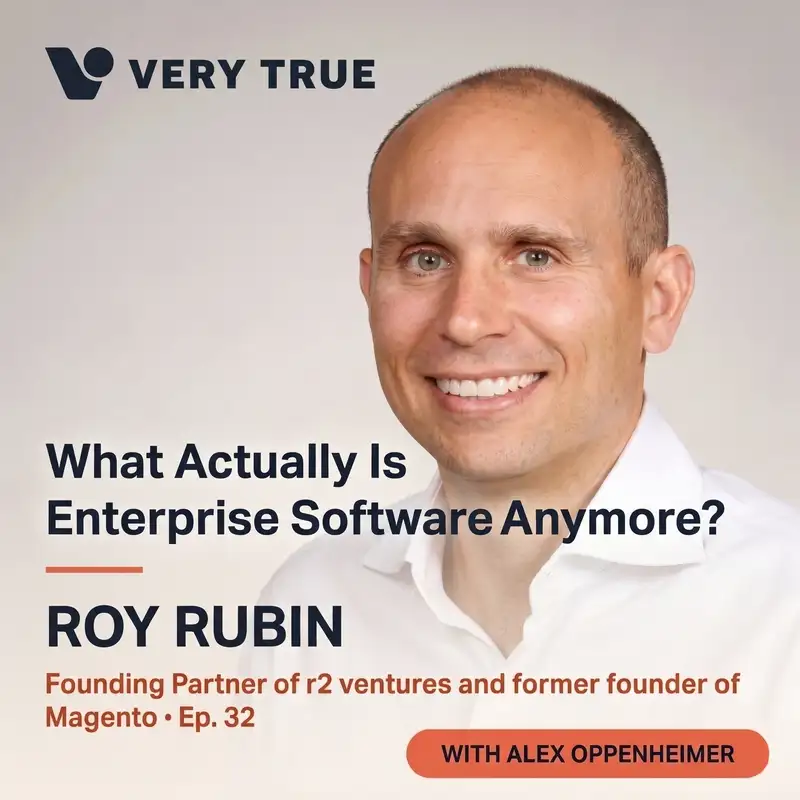
What Actually Is Enterprise Software Anymore? with Roy Rubin of Magento
Alex (00:00)
Roy Rubin built Magento out of a freelance shop while still a UCLA student, gave the software away for free, watched his customers fund his growth, and eventually sold the company to eBay. Today, he runs R-Squared Ventures, investing in enterprise B2B at the pre-seed and seed stage. When I sat down with Roy, I wanted to pull on a thread I've been wrestling with myself. What actually is enterprise software anymore? Because the old playbook, raise a ton, hire a small army, build the wedge, get sticky, ride the workflow, is getting compressed in real time.
Models are commoditizing the layer underneath, switching costs between Claude, OpenAI, and Gemini are basically zero, Anthropic and OpenAI are even spinning up their own service teams. And meanwhile, guys like Roy and I are sitting in our own funds asking why we just spent six months building our own portfolio management software instead of writing checks. And that maybe that was the smartest thing we could have been doing. We get into all of it, the history, where the picks and shovels money actually lives, whether vertical AI companies are just glorified system integrators.
and where a pre-seed investor can even be placing bets right now. It's one of my favorite conversations I've recorded. Let's get into it.
Alex (01:55)
welcome back. Excited to start another episode of the Very True Podcast. Today, I'm super excited to have my friend and colleague, Roy Rubin on. He has an amazing story, which truthfully, I've only gotten snippets of, but I'm enamored with. And so part of what I'm excited to do today is get a little bit deeper into it. I am going to pass it off to him to give a little bit of an intro.
And I actually anticipate that we're gonna run out of time before we finish the intro. I'm gonna interrupt you, but that's what I anticipate.
Roy Rubin (02:24)
Yeah,
please do because I can talk about things forever. you take control if you need to. So OK, so background. Well, today I'm an investor. I invest with R-Squared Ventures, a fund that Mike, a friend and I started in 2021. We're investing out of our second fund. Pre-seed seed is where we like to come in.
And, you know, enterprise B2B, that's, that's what we gravitate towards. We've done a few things in the periphery, but, ultimately, ⁓ given our operating background, I think we gravitate towards areas that we just understand and know well and have a lot of comfort in. fortunate to work with some amazing founders over the years, some great investment colleagues over the years as well. We love what we do. We love partnering with entrepreneurs.
and spending time with them and really rolling up our sleeves and doing what it takes to help out these young companies thrive and succeed and have the best odds at a successful journey. So that's what I did today. But my history, I'm an old guy now because I started my career ⁓ right at the dot-com crash.
Alex (03:28)
I'm not gonna let you start there. I want more.
Roy Rubin (03:31)
A
Okay, well, was born in Israel, but I moved to the States when I was nine years old. came to the US, not know a word of English and kind of stumbled my way through, elementary school and...
and ultimately graduated when I was 18 and went to private high school here in Los Angeles where I grew up and decided to go back to Israel and serve in the military and spend time in the IDF.
It was a remarkable period of my life, really grew, that period of time. after the military service, I spent two years in the South studying mathematics at Ben-Gurion University. I did not finish my degree. My girlfriend at the time, my wife now, graduated and we decided to come back to LA. So ⁓ spent five years in Israel, in total between 18 to 23.
and came back to the US I had a QA job for period of time, but this is the pre dot-com crash and was testing software, scripting. So that's where I got a little bit of sort of insight into some programming. And then I said, I'm 23, 24, I still don't have my college degree.
my mom's getting pretty upset about that and I have to go back and take care of it. So I went to a community college and decided to start just a small agency, a freelance business with skills that I acquired while learning to test software. And I did that for a bit and really stumbled on e-commerce at that period of time.
when I, this was like 2002, 2003.
Alex (05:06)
What year was this?
No one was buying anything online then.
Roy Rubin (05:12)
Very
little, but you know, there's a lot of interest.
Alex (05:14)
I would go so far as to
say pretty much nothing. This has been a theme for me lately is the best technologies in history are things that we just start taking for granted that they exist. And then we push the limits of how creatively and imaginatively we can use them. And so now e-commerce almost feels like wait, Shopify went public like 10 years ago, but, now we all live on Amazon.
But one of the things I'd love to get a sense of is like, was it even called e-commerce back then? Like, what did that look and feel like 25 years ago?
Roy Rubin (05:47)
Oh,
so, you know, 25 years ago, was happening online, right? It wasn't happening quite at the scale that we're seeing it today, clearly, right? But Amazon, you know, has been around since the mid nineties, right? And sort of continued to set a, yeah, yeah. You know, roughly around there, we were buying from Amazon at the time, right? We, I can't remember if we bought from anyone else, but at least Amazon.
Alex (05:58)
Yep. Went public in 1998, I think. Is that right?
Roy Rubin (06:10)
at the time. And I think there was a lot of interest by retailers to figure out how to bring their business online. But it was still very, complicated. So payments was a point of friction and shipping was a point of friction and all the integrations back into the back office and inventory management. mean, every little touch point you could think of was a point of friction. So it wasn't easy. And most of the big merchants out there,
some names, think, know, Toys R Us and, and, Tower records, And Barnes and Noble, right. All these guys were, they were selling online back then, but they, was very rudimentary and they were paying millions of dollars for these commercial tools, either by Microsoft or by Oracle or, you know, or other companies to be able to help them. So enterprise driven, very expensive deployments, typically needed a very heavy technical team to support it. ⁓
Alex (06:59)
Sounds like enterprise
software.
Roy Rubin (07:01)
So, but there was this really cool open source tool that I discovered and I felt like I could really help those smaller businesses that wanted to go and explore that online channel for the first time. So this was all greenfield, right? 95 % of my customers never sold anything online before. So that's how we got started and...
I was very fortunate once to have discovered this open source tool and to have the skills to be able to download it and to figure it out and to tinker with it and to find some help online with other freelancers that could come in and help me learn it and really customize it for our customer base. But at the same time, Google came out with Google Ads. And I started to basically put ads on Google.
open source e-commerce services. Like that was it. That was the ad. Here's my number, call me. And I would get enough business for six months after like three days. I would just close deals right and left because there was so much demand coming in. And I would shut the ad down. So I can't take anymore. I just didn't have the talent, the people. And I grew that to about 25 full-time people while still at school. I went to UCLA eventually.
Alex (08:00)
Thank
Wow.
Roy Rubin (08:09)
And yeah, I just grew that business. And that was awesome. Old school, you know? I didn't even know what venture capital was. I didn't know who to call. There was no one in venture capital. So I didn't really know how that was. No, there was no information online, right? Like access to that knowledge was only for the insiders. And I definitely was not an insider.
Alex (08:14)
Old school style. No venture capital raised. You just.
I still don't know what it is, but.
Roy Rubin (08:34)
I was a student that had this really interesting freelance business on the side that became a bigger business. I picked up a lot of skills along the way. I learned how sell for the first time. I learned how to really pitch for the first time. I learned how to recruit talent. All of this I had to learn on my own. Nobody gave me a playbook for how to do it. We didn't have YouTube back then for like the altus.
Alex (08:46)
you
And
so you're telling me that there were no tools for you to use. There were no guidelines for you to do that. There was no funding and you made money. It goes against the laws of physics of 2026.
Roy Rubin (09:02)
Yeah, believe it or not, yes.
Yeah, mean, old school business. How about that? Right.
Alex (09:09)
You sold
something for more than it cost you to make it, and you found a lot of people who wanted to buy it.
Roy Rubin (09:15)
Let me tell you the crazy part is our customers funded our growth. How crazy is that? Right? That's unheard of today.
Alex (09:21)
Well, and this is the, would love to actually turn this into, think, a conversation about what is enterprise software and what makes it challenging, unique and special. it's the greatest legal business model ever created. If you don't understand accounting, then it's hard to wrap your mind around it. If you don't understand.
inventory, accounts payable and accounts receivable as collectively networking capital. say, okay, accounts payable is when your suppliers give you a loan. Accounts receivable is when you give your customers a loan. And inventory is the stuff that sits on your shop floor in your warehouse or on your shelves that is either finished goods, unfinished goods, whatever. And that all either consumes or is a source of capital that you need to run your business. And so when you say it funds your growth,
Even though there's a lot of people who are like, yeah, yeah, yeah. I don't know if they actually know what that means technically. And then there's this fourth thing, which again, I went through, okay, you give your customers loans. That's accounts receivable, meaning you deliver your goods and services and then they pay you later or your suppliers, deliver their goods and services to you. And then you pay them later.
It was just in days and these are things are measured in days. Once you step into the world of software, accounts payable is no longer a thing except for the snacks in your office.
and inventory is obviously no longer a thing either. Accounts receivable gets inverted and it becomes unearned revenue or deferred revenue, which is your customers giving you a loan. And loans are dangerous because you have to pay them back. in the case of software, what you're paying back is a digital good.
Roy Rubin (10:48)
Mm-hmm. High margin. Digital good.
Alex (10:48)
That it's
high velocity, high margin, infinitely scalable, multi-tenant software. And all they need to be able to do is have access to it. Yes. There's, are these, you know, assurance, you know, how many nines do you have? Right? Like is it two nines, five nines, whatever, of, of uptime that you're guaranteeing, or you will have to give a discount or refund or whatever, but that's the magic.
What happened? Why do we need, why do we have enterprise software companies raising $500 million Series A rounds right now?
Roy Rubin (11:18)
It's a good question. mean, I think there's a lot of capital chasing deals.
Listen, think that historically it took significant capital to formulate a technology product, to piece it together, to build it. Today, obviously we can have a different conversation about what that capital need is.
But I think, you know, but I think, you know, historically it took, you know, it took a lot of money. And I think the industry developed around that particular need to be able to, to create that startup capital and to increase the velocity of growth, meaning spend more on marketing and go to market and sales, right? Push the product down into the ecosystem with the hope, the intent that the business grows and supports a cash stream.
that can repay that in terms of equity value over time. You play that long enough and that cycle becomes very dangerous because we're driven by economics that may or may not be there. We're driven by dreams, by aspirations. I often, when I speak with founders and they say, look, I'm looking to raise under 5 million or 10 million, I say, why?
Tell me like, what are you gonna do with it? Why do you need it? You know, we challenge them on that. Not because we question whether or not they need the money, but we really wanna understand how they're thinking about building the business. And it's important because, it's hard to, get alignment, right? With the founders you know, I come from an old school point of view where I love to have my customers fund their growth. I think that's the best way to build a business.
It's validation. It's organic, right? It doesn't feel manufactured. It does put a lot of pressure, perhaps, on the teams now to grow into evaluation, which may or may not be ideal. And oftentimes, the capital raised when you talk to founders and they pitch you and you ask them, how did you come up with this number? It's a completely fabricated number.
It's not based on the business need. It's based on whatever they can extract from the market. And that's a slippery slope. I think it's been a long while. It's you have on one side, the venture capital is pushing money down founders throats and founders having been conditioned to say, no, we'll take whatever we can get. The business is raising capital. It's not really building a business.
And that's why I say I'm a bit of an old school soul out there because I actually care about building a business. think those building a business can have the kind of outcomes we all expect.
Alex (13:33)
Yeah, I'll, there's a metric that I've wanted for a while. And then there's one that actually got invented. The one that got invented is David Sacks's burn multiple, which is the net burn over the net new ARR.
Roy Rubin (13:43)
Great.
Yeah.
Alex (13:46)
which I like it because SaaS magic number, which is first of all, the silliest name for a business metric ever, doesn't look at net burn. So it doesn't take into consideration the cash that's coming in and what that means in terms of favorable cash dynamics, but it also doesn't take into consideration the fact that things get buried in accounting, like bookkeeping, whatever.
And I always pick on Work Day Right. think that what you mentioned earlier, that it's expensive to build great tools. I think that application software should never have gotten as expensive as it did. I think there became like a hiring frenzy and it's like, got to have all these people. then the more I worked at a company with 400,000 employees, like you see that the marginal and utility of each additional hire actually becomes negative. But all of a sudden you need people for people for people.
everyone's in meetings all day and not doing anything. I think building hardcore infrastructure software and making it work is really hard and requires highly skilled, highly paid people with a lot of time and resources. But most application software, and I'll pick on Workday, Workday is application layer software. I don't have their financials in front of me, but they're spending like a couple billion dollars a year on R &D. On what?
Roy Rubin (14:52)
Yeah.
Yeah.
Alex (14:54)
Like this concept of R &D of like building products and investing in the business, like billions of dollars, it's application software. Oh, it's supporting applications. Oh, well, that's not really R &D. That also, that all of a sudden starts looking more like a, a cogs level variable expense, more like service implementation, that sort of world. Um, and so things get clouded by it, but going back to like, that's, that's why the burn multiple is good.
Roy Rubin (15:18)
But you have
to remember that at the time when we built out our product, Magento.
Our delivery to our customers was as if.
We literally just said, Hey, here's the attached zip. mean, you know, the FTP it or whatever, but we gave a zip file to our customers and we said to them, ultimately go figure it out. Right. So we didn't have, know, today, most businesses are going to be service-based businesses, right? They're going to have to provide assess offering, which has infrastructure associated with it, which has uptime, which has SLAs, right? It's a very, very different, business.
than the on-premise business I came from when I started. So there's an inherent cost structure.
Alex (15:54)
It's the best and it's the worst, right?
I think by the nature of SAS, this, this implication of you can churn when you want and we'll keep it up. We'll keep it up. The, the software provider, what you're doing is you're hopefully lowering your CAC, reducing the friction to adoption by, but you're, what you're saying is you're basically, you're betting on yourself and saying, we're going to keep you happy as a customer in more ways than one. And what that is, is expensive.
Right? Oracle is the greatest business model ever. It's the most evil genius company ever created. Like we're going to sell you something. going to be some, it become so ingrained in what you do. It's going to cost so much money to maintain, but you know what? It's going to cost you more to get rid of it. So you're stuck with us.
Roy Rubin (16:33)
Yeah, yeah, which listen, I mean, I think what we're seeing now with AI and the ease or an easier approach to migration off platforms puts a lot of threat, you know, into these incumbents that have traditionally captured, you know, a lot of, you know, a lot of that friction, right? That friction was enough for them to stay in business.
Today, for example, to move from one CRM to the next, I've got APIs, I've got MCPs, I've got Cloud Cowork, I can just have that run forever. And I can within a week, most of my data over pretty cleanly into a new system. Hard to imagine that world before... ⁓
before this paradigm shift that we've seen with AI.
Alex (17:15)
In my younger days, I used to keep a SAS metrics file, really like a SAS comps file. Basically when I joined NEA, I took really the same format that we had run at Morgan Stanley as a comps file and I recreated it at NEA with all the CAPIQ APIs piped in, calculating all these metrics, valuation, everything, trying to invent my own metrics.
And I'll tell you the metric that I wanted to invent was, how much profit had the company ever actually generated just on an accounting basis, cumulative net income versus dollars raised like primary capital into the business. And when did those cross each other, which is a head scratcher. But one of the things that I found was what we started doing in this, we started doing when I was in Morgan Stanley, you correlate.
Roy Rubin (17:49)
Mm-hmm.
Alex (18:03)
software company growth with revenue multiple. Now I've written about why we use revenue multiple and how it's really an output metric. It's not a way to value a company. It's only relative. But for this specific case, it's actually quite useful because you look at a company that's growing at the same speed as another company, you look at next year's revenue, and then you say, okay, why is this company above the line versus below the line? Right? You're on a correlation. Correlation is quite good.
But then you consistently see certain names above the line and certain names below the line. And you start asking why, and it becomes a very qualitative thing. Now, maybe we could throw this in AI and it would tell us, but I was running these numbers back in 13, 14, 15. And what became clear was that there were a few things that drove those premium valuations, meaning a dollar of one company's revenue is worth more than a dollar of another company's. One was scale. One was, you pitched us this TAM.
in your IPO S1 and now you actually have 500 million or a billion of revenue? Okay, I believe you. The second thing was either approaching or already EBITDA positive.
The third thing was gross margin, which really speaks to the positive, but then there were two qualitative things that mattered more. One was, is it a system of record? And two was, is it a work methodology? And if you looked at the companies that were both, they did the best. So as an example, Salesforce is a system of record and a work methodology. But as we discussed, it's file.
Roy Rubin (19:22)
Yeah.
Alex (19:29)
system is basically just CSVs. It's a pretty straightforward database. Once you start getting into Atlassian, which invented its own thing, or Adobe, which invented its own thing, it starts becoming much more green. Viva. And they all got the premium valuations for being a work methodology. So one thing that I think about now is to what extent those things used to be highly overlapping. To what extent now are they
breaking apart where if you're just a system of record, but you don't mandate, I wrote recently like having your software system on someone's resume as a skill means two things. It means that your company's worth a lot of money and your product probably sucks. And part of the reason your company's worth a lot of money is that your product sucks and they literally had to hire people to use it. If there is a job title that has your company's product in it, like Salesforce admin, you are doing great as a business.
And so I've been thinking a lot about this lately, like, does this break apart? this, does this go away? We lived with that for basically 20 years.
Roy Rubin (20:26)
I mean, look, and I've read extensively about this on LinkedIn, right? I think workflows are critical. So I absolutely agree. call it, what did you call it? A work engine or something or a work biology. But I mean, I call it workflows, right? And I think those can be very shallow and they can be very, very deep, right? Hard to replace a system that is deeply embedded in the workflow of your business. Hard, right? You don't want to take the risk. The value has to be so much greater. The friction is significant.
Alex (20:35)
There's methodology. Yeah.
Roy Rubin (20:52)
you know, the lens I've always looked at, you know, deals and, and, and opportunities as an investor is how deep are these workflows within an organization. And I agree with you, a system of record, a crowd database, right. Ultimately add, you know, with some, some screens basically to access the data. doesn't feel like it's very sticky, right. It feels like that revenue has potential to go, you know, to go elsewhere.
Alex (21:14)
And by the way, just to insert real quick there, that is fundamentally what software is. It's a bunch of screens on top of a database. Then we talk about the magical thing, but that's all it is. ⁓
Roy Rubin (21:19)
Correct. Correct. I mean, that's historically
what it's been. And there are some creative insights or a much more optimized UI UX workflow experience layered on top of it. That's where the value was created over time. Today, obviously, there's intelligence, there's data, a lot of automation. And now you can argue you're taking the interface away.
and exposing it via APIs and MCPs, where it becomes invisible. Hence what Mark Benioff recently said, that they'll be on all sort of three accesses and surfaces. So.
And by the way, HubSpot said the same. So I think software is changing, right? From a distribution method, we used to consume software on apps, right? As Windows apps, as Mac apps maybe, web, mobile, right? And now it's on any surface, And it's exposed sort of all over the place. So it's evolving, it's...
Yeah, it's very interesting. I can say that I think where there's a lot of value ultimately is in the packaging of software. How you tell the story, who you target, who's your ICP, as with any product exactly. Right, a shoe. Why do we buy a bike?
Alex (22:32)
within the product.
cool the bike is. It's just
one thing that says Parley right here. That's it. That's the Pac-Man.
Roy Rubin (22:40)
Yeah. Brand, right?
know, I, Magento was open source, right? We gave away the code for free. Right? Yeah.
Alex (22:48)
Talk to me more about that. So we, we, we, this
aggression from you delivered the zip files.
Roy Rubin (22:53)
Yeah. Yeah. We gave it away. So open source, we gave it away on day one, right? Initially, I thought the business model was going to be a services and support type of a model. my, you know, tuition was after five years of serving e-commerce customers and picking up their phone in the middle of the night when something went down. my intuition was it's mission critical.
Alex (22:54)
Then what?
Roy Rubin (23:15)
The customers are going to want to call someone. They're going to want to have a relationship with a vendor because it's mission critical software. But what I discovered very early on is that one, we're not really good at support. We're good at building product. We're not good at support. And that's a very different organization we're going have to go build. And two, you know, it's really good at support. The systems integrators that downloaded the open source product and service customers.
Those guys are really good at support. And they understood that. So overnight, we already had competition for support services for the product that we built by third parties who were servicing our customers and doing so much more.
Alex (23:49)
I have to,
I have to this out there. My good friend, Isaac Heller, who's the founder of Trulian. He posted on LinkedIn today and he sent it to me. says, vertical AI is dead. You are now in the VAR-tical AI business. He's saying that basically he says the model's caught up, right? Anthropic and OpenAI kept climbing the stack, stronger reasoning, native tool use, memory, longer context. Every mode got commoditized from, from below.
by the exact models these companies were reselling. Here's where I've landed. The model is a commodity and so is the wrapper. Is Harvey illegal AI platform or is it Anthropics enterprise sales channel for law firms? I'll there's he wrote more and it's very good, but I will pause there. I think we may be re approaching this. ⁓
Roy Rubin (24:34)
Anyway,
send that to me. It's fascinating to think about it in those terms. But go on, go on. It's very interesting thought.
Alex (24:43)
Yeah. So I think right now, we're, we're in system. You, you wouldn't remember better than I do, but I've going back to when systems, when you were working with systems integrators, they were all the rage, right? They were growing super fast. They own the customer relationships. They were SIs. were VARS, whatever. were they highly valued? Were they hot companies? Did people want to go work there?
Like I feel like it doesn't get talked about now, but they are still big. They just are valued at 0.5 X revenue. Anyone want to know what HP enterprise does this, right? how do they have their logo on F1 cars? This. So what I'm trying to figure out is that first wave, right? You've got that core tech that was developed. And then you had the VAR or the SI that was servicing it and making it work.
Now the core tech is everyone's limited only by your imagination and how quickly you can type into cloud code basically, which by the way is a huge limitation because most people are not very creative or imaginative and can't think through problems clearly and they need someone else to do it for them. And that's why great products are great products and are have created some of the most valuable companies in the world. Like iPhone. No one asked for that. Someone thought of it. His name was Steve. So what I'm seeing now though, and
I don't know if you've seen this in your portfolio as well. had a bunch of companies saying, Hey, there's all these AI tools. I'm mixing a few things together here, but there's, there's all these AI tools. I know how to use them. These companies don't know how to use them. They need AI in their workflows. I'm going to sell them a product because products are king from 2010 to 2023 products are king. Right. I'm going to sell them a product that is AI for what they need. But there was a.
What I saw in my portfolio with a bunch of companies banging their heads against the wall, the companies needed so much help implementing these products that people were building. And it ended up just being like, you know, an endless list of feature requests and education that was needed. And I was like, guys, you can just sell this as consulting and charge 10 times as much money for it. And you'll just make money. Like,
You talk about things not being scalable, you can sell something for $20,000 and have it not be scalable, or you can sell something for $250,000 and have it not be scalable. Pick your poison. Right? I remember, you probably remember this too, when service revenue was vilified on, you know, IPO S1 income statements. So what did a bunch of startups do? They just stopped charging for service. Oh yeah, we don't have that low margin, non-recurring service revenue. First of all, it's...
at worst reoccurring. And second, you still have to do the service to get people to use your product. I think that at the same time as software got super duper competitive and everyone rushed in and tried to build a quick tool that then they could sell and then hired salespeople in marketing and spend a bunch of money. The benefit was it's plug and play. Anytime you were in an RFQ for a tool, you're competing with other people, which means that your cack is going to be through the roof.
But it also means that it was actually easy to sell because people are looking for a solution and it was plug and play inside the organization. What we've seen over the last couple of years with AI and I've experienced personally in my own organization is like, how do we use this? So someone offers it, you're excited about it. You want to try it, but what these companies and these startups ended up needing to do was sell a systems integrator product. They needed to be Accenture, not Oracle. And
Roy Rubin (27:58)
Yeah. So
I'll tell you what, you know, when we, when we started, with, with our product, we, we immediately understood that there was a large services opportunity. came from that space, right? So we understood how big that opportunity was. I think we were largely influenced by our desire to build product and not build the services business. We came from the services business. We exited out the services business. In fact, our transition from service to product required us to fire our service customers.
so I can shift resources to build product. And we say that we intentionally left holes in the product so that third parties can come in and can plug those holes. Our intention was to build an ecosystem around our solution by allowing others to come in, service, plug holes, right? And ultimately win the customers, right? And I think what you're seeing now,
It's very interesting because ⁓ both Claude, Anthropic and OpenAI, know, at least them two, Google actually also had a press release this week. They're spinning up services teams directly as opposed to letting the ecosystem develop around the products on their own. And I think partly, so that's something new, right? Because I don't remember
a product company buying or spinning up or buying a services company.
Alex (29:11)
IBM came in SI, and so they bought Blue Wolf, which was the biggest Salesforce integration company in the world.
Roy Rubin (29:16)
Yeah. you know, it's not common, right? But what are we seeing now? I think we're seeing one, there's just a lot of money out there, These companies have a ton of cash. They need to move quickly to, acquire new revenue and protect the revenue because that revenue is fungible as we can see.
Alex (29:33)
This
is kind of a good thing. mentioned this earlier. It comes a little bit of a race to the bottom, but as consumers, we're the beneficiaries of this because the products that keep getting better are the switching costs between perplexity, open AI, Claude, Gemini are zero.
Roy Rubin (29:50)
Zero. Even now in my coding, when I embed AI in the systems that I'm building, I use OpenRouter because I want to abstract the actual model. I don't care about the model. So I'm already preparing for that world. mean, now, of course, I code with clock code and Opus 4.7. But when I deploy AI, part of what I'm doing is I'm using the auto model selection by OpenRouter.
And I'm having a test just to make sure that we're getting the same quality, but I want zero token costs, right? I want to reduce my token costs.
Alex (30:22)
I just had to ask, what have you built?
You're VC. What are you doing building? Tell me.
Roy Rubin (30:25)
So,
I'm building. First of all, that's who I am, right? I wake up in the morning, think about it.
Alex (30:28)
I know, I know. I just want to know what you're
doing. Are you building stuff for biking? Are you building stuff for investing? Are you building stuff, projects for on the side? You building for your companies?
Roy Rubin (30:37)
It's been a journey. For the fund, we now are pretty well into this process of building and being agent driven. our big stack piece right now is we've built our portfolio management system from scratch. So we used to this Excel file, as I'm sure many other fund managers have.
Alex (30:58)
If they will.
Roy Rubin (30:59)
And yours is probably beautiful. Alex just knowing you and how data driven you are and how Excel driven you are. We're not that right. And it just became a mess over the years. And it's very hard to track it. You know, it has both data and narrative all embedded into one. That's never a good thing. Right. we just built it from scratch and now we have, you know, every single round.
of our portfolio companies, whether we participated or not, before we came, after we invested, everything's documented. We can query against it. It's normalized. It's in a beautiful system that gets us now to tell whatever story we want to tell about our portfolio, which is something that we lacked. If you asked me 90 days ago, what is the average time between rounds?
of your fun to portfolio company, I'll be like, I need a month to figure that out. I have no idea. I'll come back to you in a month. You know, now it's going to take me 15 seconds, right? To come up with that.
Alex (31:53)
So
I'm in a position where that would take me about 15 minutes to answer that question based on, again, I built my own, I invested hundreds of hours building software about a year or two too early. I've always not been good at languages. Like it's always been hard to learn. So when I took computer science classes in college, I always got tripped up on the syntax. When I had to use MATLAB, I got tripped up on the syntax. So then.
Roy Rubin (31:57)
Yeah. Yeah. So for me, it's.
Alex (32:19)
Airtable, Notion, these other like no code, low code platforms come along. And by the way, I'm, good with Excel because it's formulas and you can see each step and whatever. most good is I'm very good. ⁓ but then Airtable comes along and I can now codify this and use reverse lookups, which is the one thing that Excel cannot. I've done it in Excel. It's very fragile at best. And I built this entire thing. you can check it out. It's the V C O S dot com.
Roy Rubin (32:30)
I know.
Alex (32:44)
I've like published it because people were asking for it. So I could structure that data in my head and then I could figure out how to suss it out and do all the relational stuff so that it all flowed through it, which I think is still hard. I think the AI can help there, but I think that's still the hard part of figuring out the schema of what relates to what, like what entity. I'll just quickly, like in my air table, which is really my OS for my fund.
Roy Rubin (33:05)
Give me an example.
Alex (33:09)
Right. I've got meetings. Those meetings connect to both people and companies. I'm not going to get into all the details. put like the meeting notes and whatever, but then you have companies. Those companies can be any type of companies, but there's a screen there for startups. Those startups. Once we invest, we create a holding entity for the specific investment or multiple investments in that company. That holding entity is also associated with a fund.
entity. So we have one, one, fun, two, fun, three, and then SPVs. Those fund entities are then connected to fund commitment entities, which are then connected to LP entities, which are comprised of companies and people. That's the flow. It took me a while to figure out how to tie all of that together. That is that easier now? Like we'll make more updates.
Roy Rubin (33:57)
So you have one system, right? This master
file, right? That has all these classifications, which is fine. I mean, that's just one way to think about it. We have disparate systems. We have a portfolio management system, which does one thing, which is to basically have a overview of every single funding ramp, every single one of our portfolio companies. So that's one. We have our CRM, which is an off the shelf product that we have.
And we have our LP management portal, which we also have through third parties as well. All of that is accessible via API and MCPs. And we have agents that understand the relationship between each of these systems, right? And give us the ability now for myself, and I'm technical, So my partner is less technical. We can easily build agents.
and collaborate. The agent I write, he can see, can edit. The agent he writes, I can edit, and I can see as well. And we have agents that go and capture this data and run reports. I'll give you example of just one very simple agent that we have. We have an agent that comes out every single week. We've got about 32, I think, portfolio companies right now across both of our funds. And we want just to understand, like, who have we not talked to in a while?
I couldn't talk to this week. So we have an agent that basically looks at all of our data, typically in a CRM in this case, but that agent knows it's portfolio company and it sends us a portfolio pulse. Here's who you haven't talked to. You know, you're through. Yeah.
Alex (35:13)
The reason I say that I did that too early
is that you could now use an off the shelf CRM or basically just Gmail and query that and have a simple Google sheet of like, here's my portfolio companies, here's the email addresses, that's it. And what I did instead was have every meeting categorized so I could do that manually. It's a lot of input work.
Roy Rubin (35:23)
Yep.
Yeah. So we don't have to worry. mean, everything that's fully automated, right? And it tells you, you know, this week you should talk to these two companies. You know, it's been, it's been, you know, 45 days, get a quick update. I've drafted an email in your Gmail that's already set, you know, to send that out, you know, go do it. Right. So, you know, and it knows our style. knows how we write. It knows everything. Okay.
Alex (35:53)
Yeah. So, so,
getting so super, super fascinating. We could spend a lot more time on, VC fund infrastructure. but going back to this, what is the modern SI versus what is equivalent to like a commoditized AWS Azure, whatever, where it kind of is all the same and the values in the apps built on top of it or, but they all have the same integrations, but the interface doesn't really matter.
You don't really have to actually move anything to go from model to model, right? Like, don't know. I'm trying to figure it out. Like, is Harvey just an SI that just sells Claude to law firms? And in which case should it be worth $3,000 or whatever?
Roy Rubin (36:30)
Well, mean, it's weak. can argue that it's not even that because
Aude sells these services directly to customers now, right? But ultimately, here's my point. My point is Harvey, Legora, all those guys, they've built brands, right? And they've built relationships with customers and they'll have to evolve. We talked about workflows earlier, right? Do I think these models are going to be providing
very deep workflows. I think the answer is likely not. I think they're going to be providing some tooling, some capabilities, but there's a lot of opportunity for startups to come and create very, you know, very sophisticated workflows that could really be value add for the customers they serve. And I think that's where the focus should be.
Otherwise, you risk being a commodity. If it's just a wrapper, we see what's happened now with what clouds release for the legal space. It's just one example. They're going to go and attack every single vertical they could.
Alex (37:24)
There's so many things we're touching on here. Some of it's just the supply and demand of capital. I just saw that like, what was it, Andreessen and Thrive just put $5 billion into Anderil. And I just said to my friend, like, I can't believe that they're clipping fees on that. Like that's sovereign wealth level investment dollars. Like they're paying Andreessen to sell to them.
I'm going to pay fee and carry leakage to these two funds when I'm a sovereign, because that's the only people who can invest money like that, right? Into a company that then I'm going to become a customer of. It's mind blowing. That whole thing on the venture world, we don't have time to talk about today, but
Roy Rubin (37:59)
That's about my
favorite Alex. I've got a lot to say about that, you know, it's like it's, it's wild.
Alex (38:03)
But I, again, the piece I published this week and I just can't kind of get it out of my head is like, historically when we've adopted these technologies, it's been, what am I supposed to do with this thing? Like, and then it just takes time for people to get a little creative. It's the art, right? It's like, you can build an app that does that. I mean, do you remember that in 2008 or nine or whatever when the app was done?
Roy Rubin (38:24)
I have this today. mean, I'm
bound by my lack of creativity. I mean, I, in fact, I've got an agent that runs every single day and sends me ideas to break through, you know, my writer's block.
Alex (38:37)
But that's already 0.1
% creative wise, because you're trying to use the AI to help with your creative process, which I've done too. So I got a message yesterday from a friend of mine who's a lawyer. And he said, latest post is dead on. I'm heading up on our AI task force on competition and the most meaningful approach for activating use and getting others to start using was when we did, it sounds like a drug, when we did a series of show and tells with attorneys taking 30 minutes and showing the group via Zoom screen share.
how they use AI day to day and walking through the use cases. Most people are not creative. And I think when we zoom out thousand year level, the wealthiest people in the world who created the most value, the people we remember now, by the way, they weren't the wealthiest, they were the people we remember now. The wealthiest people going back were just landowners that most people don't know their names, but Galileo, Da Vinci, right? Like these people were the creatives. And I think for most of our lifetimes,
and actually most of our parents' lifetimes, the people who made a lot of money were just the doers. And they didn't have to be creative. And even you could argue that, yes, oh, if you want to be a billionaire, you have to be creative. But if you just want to like have a nice retirement fun and live in a nice, big, comfortable house and drive a nice car, like, no, no, creativity is the enemy. Just get in line.
Roy Rubin (39:52)
Yeah, I mean, listen, the business owners, right? 99 % of business owners run pretty boring businesses, right? They run the same old businesses that you could find anywhere in the world.
Alex (40:03)
I always say like the
guy who sells the bollards, you know, to the city of Jerusalem, like I want to own that business. Because people run into you all the time and you need get replaced.
Roy Rubin (40:09)
Yeah. And those are great businesses.
You know, I used to, I know the guy, do you know those queue lines at airports? There's just like plastic things with strings or little whatever, right? Like little things like there's this one guy in LA, an Israeli guy that has a company here that manufactures it. I mean, this guy has a great life, an amazing life. Huh?
Alex (40:21)
belt. Yeah.
Someone's gotta do it. Someone's
gotta do I grew up in a world where, I I also went to private high school. I went to public school through ninth grade and then went to private high school. My friend's parents were CEOs, hedge fund managers, lawyers, doctors. They weren't inventors.
Roy Rubin (40:46)
I, you know, it's so fun you're saying this because when I left.
Alex (40:49)
And they didn't own
these cool, boring businesses either. Like they weren't.
Roy Rubin (40:52)
You know, when I left eBay, I sold Magento to eBay eventually and spent three years there. But when I left, I didn't start anything new. I needed a break. Anyway, I took some time off. It's a whole story on its own. But I came back. And for me, it wasn't clear that I'll come back and build a software company. Like, that seemed lazy in my eyes, because I know how to do that. Why would I do the same thing over and over again? Right? I said, well, should I completely take out of consideration an old school business?
Right? One of those brick and mortar businesses. Yeah. And I mean, I haven't started that, I've always said, why wouldn't it do the same thing over and over again? That seems crazy. That's not exciting.
Alex (41:21)
like allocating capital to people with crazy ideas.
It's, it's really interesting as people have expanded the definition of what venture is relevant to like starting a restaurant. So I don't know when the last time you were in Serona market was in Tel Aviv, but you know, there was a restaurant there called Piazza Grande Italian restaurant pizza place fine. Right on the outside of the market, not on the inside, on the outside of the market. It closed. It was never like so, so busy, but it was there for, I don't know, five years and it closed and they gutted the whole thing.
and I was just back there last week and now they're almost finished with construction with what's gonna replace it. Guess what's replacing it?
Roy Rubin (42:08)
a chain of some sort probably.
Alex (42:09)
Nope, just another pizza place. I got
an Italian restaurant pizza place. And it's like, wow, good thing you gutted that whole thing. so running the restaurant is a garbage business, right? Cause like you can do well for years, you have a bad quarter and you're done. But you know who makes a lot of money? The guy who comes in every few years when a restaurant dies, guts it and then rebuilds
Roy Rubin (42:31)
You're about
picks and shovels businesses.
Alex (42:33)
as if
like literal picks and shovels is that guy's, that's the recurring revenue. know, like this restaurant most likely is going to go out of business. And even if another restaurant opens up, that's exactly the same. They're going to want to gut the whole thing and do full like remodel because the brand and the ambience and whatever. it's like, bro, no one cares. Like is the food and the service good? You know, like it's a, it's a restaurant in a workplace. Like nobody cares. It's very, very interesting.
I know we only have a couple of minutes left because you got to jump. there like, this has been very fascinating. We got most of your story, which I love, these things are all just super top of mind. guess to complete it. My question is based on everything we've talked about. When we look at the history of enterprise software, which is 50 years, really closer to like 40 or even 35. And it's like.
Roy Rubin (43:00)
Yeah.
Alex (43:23)
modern-ish manifestation. And then we look at the next just 10, let's say. I don't know on one foot, what do you think repeats itself? What do you think stays the like is totally different? Is anything totally different? Is there nothing new under the sun? Yeah, this is the investor hat, right?
Roy Rubin (43:37)
You know, yeah.
you know, here's the thing, right? Do we, do we, do we think enterprises become product owners, right? Do we think the trend is that they'll take on the ownership of building their own software? I don't think that's going to happen. Right. Yeah.
Alex (43:51)
I wrote this piece too, which is why
do software companies buy software? It's always been Builder Buy since it was invented. Builder Buy, Builder Buy.
Roy Rubin (43:55)
Yeah, exactly. Right. Of course.
That's always going to be the decision. think even when I look at what I do in the venture fund, has been the last six months I've building, I catch myself sometimes and I'm like, well, what the hell am I doing? I should be sourcing deals. I should be on the phone with our founders. I should help them grow their business. Why am I spending 30 % of my time building software? It's stupid. I can just go buy it. Can I just write a check? Let me just go write a check and do it.
Right. So I think, I think we're in a, we're in a, we're in this phase right now. We're all excited. We've got all these new tools. And I think, I think that's going to come down and, know, very shortly we were saying, well, you know what, there's the guys that know how to do it and we're just going to pay them. They're going to be much more efficient. Maybe that those costs are being driven down, right. Because of, you know, efficiencies and gains and smaller teams, you know, but ultimately I don't think, I don't think enterprises are going to become software companies.
I just don't think that's the trend. think we're seeing in the periphery what happens when you have some creative people get access to these tools. So I believe these businesses are going to be around for, these software enterprise businesses are going to be around for a long time. I think the incumbents are going to get bigger. I have to tell you, this part of my concern of investing, they got the data, they got the distribution. They definitely have the talent, right? I want to believe.
Alex (45:06)
Long server panel, long workday, long Oracle, long SVP.
people who trust
them. like, like PWC just did my audit for my fund and they're like, is this right? I'm like, that's what you're supposed to be telling me.
Roy Rubin (45:22)
Yeah. So do I think startups in the enterprise space, are they going to thrive? I think they have to be very creative, right? And very resourceful. they're going to win on price, hopefully, when they go and compete in the marketplace. They're hopefully going to be able to win on speed and innovation. And as long as they remain small, they may have a wedge in. But if they're going to look like their competitors, which have the incumbents, which have data advantage, distribution advantage, compute advantage, all of the above capital advantage,
I think it's gonna be really, really, really, really hard. So I think the dust needs to settle at some point. And I don't know what that point is, but I think we're getting close to it. And then we'll see what shakes out on the other side. As an investor, it's really, really difficult. know we've had these conversations, Alex, because you don't know where to place the bets. And it's okay to sit on the sidelines for a little bit and let the market do its thing before committing.
Alex (46:11)
I'm 13 years into venture right now and I'm realizing that's what the best in the world do. So I'm right there with you. This has been fantastic. Thank you for the time. looking forward to continuing the conversation, hopefully in a month on a bike ride when I'm in LA. Thank you so much. Talk to you soon.
Roy Rubin (46:22)
Yes, be safe Alex, be safe. Yes, absolutely. All
Creators and Guests