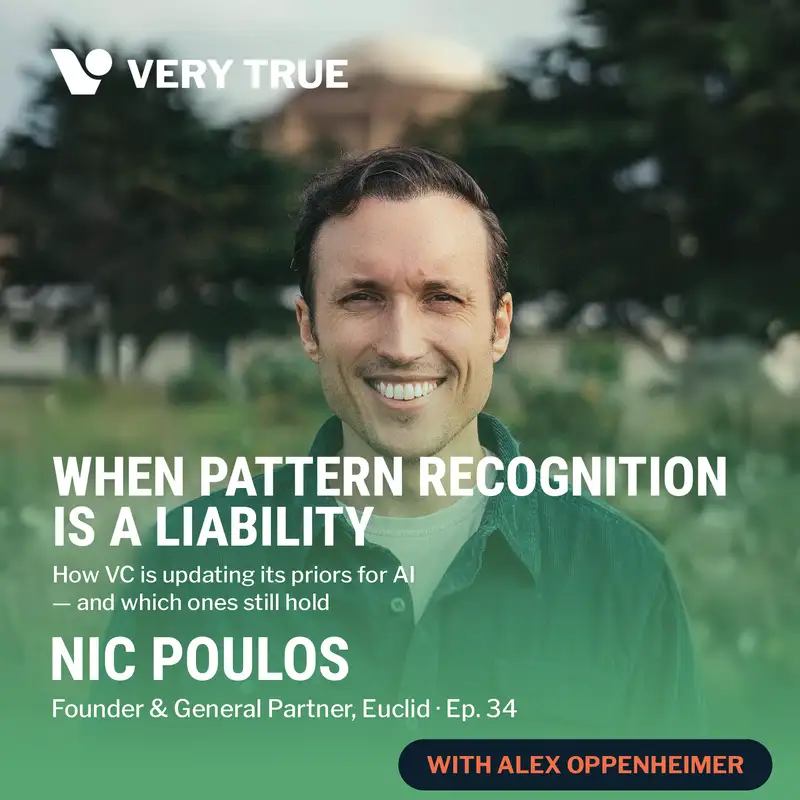
When Pattern Recognition is a Liability - How VC is updating its priors for AI and which ones still hold
Alex (00:53)
All right, welcome back everybody to another episode of Very True. Today I've got an old friend, Nick Poulos, on joining us from both of our hometowns. Nick and I actually went to the same high school in Marin. We almost overlapped, but I messed up and showed up a year late. that I knew his name. He was a legend, even even even after he he had graduated.
I'm excited to
Nic (01:16)
sí
Alex (01:17)
reconnect and catch up. we really met for the first time. I think it was in New York or maybe it was even in DC. you were at Bowery, I was at NEA, and we I think we like hosted like a SAS dinner together, which again was like a novel idea back then.
Nic (01:23)
Yep.
Alex (01:32)
I wrote a line recently that I said in two thousand fourteen I became like the SAS guy at NEA, which sounds just as ridiculous now as it did then, but for completely different reasons.
what is like who cares? Just like sell software. so you know, with that in mind, like, you know, you've been in venture for longer than I have. I'd love to kind of open up the discussion just about like where did we come from? How did we get to where we are? Obviously, we're not Arthur Rock in the room, but in the grand scheme of venture, I think we've both kind of been around the block in a few different
forms and iterations on our on our career path with a lot of shared interests and overlap. So I'd love to open it up there. take us back to where you got started.
Nic (02:14)
Yeah, absolutely, man. and thanks for having me on. Excited to to join for another ep of very true. You guys have done some great work here. man, just always a joy to catch up with you. Geez. so I think my my journey adventure started in, I guess about 2011 or so. as many of us did. I did the the banking stint out of school. was doing software MA.
At a you know, kind of mid-market boutique that focused on really the tech world. Savyan, then GCA, and now I think it's part of like Julia. But anyways, fell fell in love with the tech part. I even had a sense that I wanted to go and venture then, but I I talked with a couple of venture firms and they said, get out of your kid, go like work for some startups or something. Said, okay, I guess I gotta do that. So I did a couple operating roles, but
Basically, I found myself in a spot to kind of back my way into it. So I was at AOL. This was right after it spun out of Time Warner to date myself. we were like acquiring a bunch of media and ad tech properties. And the the CEO at the time, Tim Armstrong, had come over from Google and wanted to, I guess, reinvigorate the company, make it a you know, entrepreneurial environment again. So he wanted to launch a venture fund.
And so I found myself you know, working there with a guy that would become my later colleague at Bowery Mike Brown, early in the days of New York Ventures. So you remember how it was like seed or early stage back then. I mean, seed was even a new concept, new term at least. and most most of the rounds were like party rounds with four or five of these, you know, seed funds writing 250k checks.
did some good work there, got into some good funds. And long story short, parlayed that into you know, teaming up with Mike and launching Bowery. And you know, we were kind of one of the early B2B SaaS seed funds out in New York when New York was still considered you know, a little bit of a venture backwater. Like it was all SF back then. And yeah, I mean, that's kind of how the journey
Unraveled, you know. it was a really cool time. I mean, you remember it? That's when we were hanging out in New York. and the the world has changed a lot since then. I mean, way more funds, way more competitive, more sophisticated. I think in a lot of ways, a better but maybe more challenging experience for founders. And yeah, it's been cool to see. so I don't know. What is that is that align with how you you remember it?
Alex (04:32)
I came into it from a slightly different angle, but I I think that one of the biggest changes if we like fast forward today, I don't know about you, but a week does not go by where I'm not getting a couple of texts, emails, LinkedIn messages from people. Hey, I met this kid, they're really sharp, they're in college, they want to get into venture.
Nic (04:51)
Mm-hmm.
Alex (04:51)
I didn't know
like we both grew up in and around Silicon Valley. I mean, I know you're like your dad's not in the business. My dad is in the business. Like, I I never like I'll tell you, when I was 13, I wanted to be an investment banker. Like, like investment banking was it. Also, investment bankers back then made way more money than they do now, especially relative to VCs back then. That it's it's an interesting kind of flip of things.
Nic (05:04)
That's amazing.
Mm-hmm.
Alex (05:15)
Bankers were just printing cash. you know, I was thirteen in two thousand and one. So and and
Nic (05:22)
impressive man
I don't think I knew what banking was until maybe my like sophomore year of college. I guess that's what, you know, my dad was a doctor, so didn't have that. But yeah, it was pretty wild. And then I graduated in eight and then banking fell off a cliff. Yeah.
Alex (05:37)
yeah,
I'm I'm three years behind. And so that was a honestly a big difference, I think. Like of when I was in college. Like I was in like the Stanford finance group, and the seniors who were running it had just come back from their internships. That was the summer of 07. And there were a number of them who had worked at Lehman and Bear Stearns and then came back and were in this group. And
They didn't have jobs like when they graduated, or they did, and then it like they were gone. I was still just screwing around in college. I I like when I think back, you know, there was one guy that I was in college with who probably would have been the only guy who was like, Yeah, I'm gonna be a VC, and that was probably Sheil Tile. But he may he probably wasn't even saying I'm gonna be a VC. He was probably saying, like, I'm gonna be the governor of a state.
Nic (06:15)
Hmm. Hmm.
Yeah.
Alex (06:21)
Which I think he is still saying he's just a super impressive, like wide-eyed, ambitious guy. So yeah, I mean, I I also did the banking thing. it was a little, you know, and then I joined NEA, which when I got recruited and joined, I went to kind of do like growth. I like doing deals, I like growing companies. I never thought to do early stage. And then, you know, where we lined up was I hit the desk at NEA in August of 2013 and I told Harry.
Like, yeah, want to do early stage enterprise software. And he was like, Why? You weirdo. You're like, you're 24. Like, what you want to do that for? and I was like, Well, there's what to learn and there's who to learn it from. And he was like, Okay, you're with me. And then he had me like learning SaaS models, inside out and backwards.
and then I was looking at a lot of Series A deals. Like you were focused on C back then. I was living in DC, but I was in New York like at least once a month. The event scene was like small, but like just kind of fun. and it kind of was what you made of it. It wasn't an industry yet. And I feel like, as you mentioned, it's like has it gotten easier? Has it gotten harder? I think it's kind of always both at the same time. I think.
Nic (07:10)
Mm-hmm.
Yeah.
Mm-hmm.
Alex (07:28)
It kind
of just smooths out the curve and makes it like you've got to run faster on this curve, but the curve is smoother. So in theory, it's a little easier to run on that curve. one of the things that's like popped into my head now in the context of what we're seeing was I remember when I was at NEA and
we looked at like a bunch of series A's and B's, handful of C deals. We did a bunch. We passed on even more. Obviously, we actually didn't see that many deals. There just weren't that many. I feel like that's another huge shift. It's just so many, so many more companies now. But if I look at the companies that like we just met that are at Series A, so like back then that was like, you know, million-ish of revenue. They were raising like eight at 30. And
Nic (07:55)
Mm.
Alex (08:08)
Like most of those companies just like took off. Like, like most of them. I mean, I'm not I don't have all the whole list in front of me, but like so many of the companies that I met back then, it felt like Series A 2014-15 was like shooting fish in a bucket. By 2016, the like the later stage got a lot more competitive, but it also got like really compelling. NEA started doing like expensive, high-profile deals, but a lot of them returned really well, like Elastic, Mule Soft, MongoDB.
Stuff that people are like, those numbers are insane. Like, how could you pay that? And the way that I described it to a founder today was basically that I put everything in the context of a DCF, because I'm a I'm a big, big finance nerd. which is that you have like the growth period and then you have the terminal value period. And the longer the growth period is, and then the the more aggressive that little g like long-term growth term is, that's basically.
Nic (08:36)
Mm-hmm.
Mm-hmm.
Alex (09:01)
kind of how aggressively a company can grow and then how it can continue to grow once it kind of hits quote steady state. And I don't think if anyone looked at Salesforce back then, like 12, 11, 12 years ago, they would have thought they would have stayed in that kind of what I call the big G growth period of that DCF for so long. And then that their little G that they've kind of settled into in the last five, six years, I don't know, is still like five X GDP growth.
So no one really expected that. And I think what I chalked that up to is that technology was a sector. And I actually think about it now in the context of investment banking, because like I was at Morgan Stanley and we were the tech group. And we actually had capital markets and MA as quote, like products inside our office. And then we had the coverage. In New York at Morgan Stanley, they had.
Nic (09:27)
Mm-hmm.
Alex (09:51)
the coverage groups. And then there were different capital markets groups and different, and then one big MA group that like would work with them on everything. And I feel like now, especially again, I left banking in 2013, but I feel like now like tech has become like one of those product groups, not even like an industry coverage group. Like there was the financial institutions group, the transportation group, the healthcare group, like name which one of those industries doesn't is not heavily impacted by tech. And so
Nic (10:09)
Mm-hmm.
Alex (10:17)
The transition of tech going from being a sector to an entire layer of the economy just made things like much, much bigger. But it feels to me like like I was saying the number of deals that we looked at. I it'd be interesting to go back and like review pipelines. Like, but you can just kind of in your head feel how many companies you were meeting per week then. And again, you were a seed investor back then as well. versus now, I feel like it's probably close to 10X. And that's the ones that you're saying yes to meeting with.
Nic (10:30)
Mm-hmm.
Alex (10:43)
Because the demand is even greater than that now, I think. but that that's a lot of that is in like kind of again, this has shifted. I feel like twenty twenty to twenty twenty four was like a lot of down the middle software stuff. Now it's branching out and getting weirder, but the iteration cycles just happened faster and faster. So yeah, I don't know. That's my reflection on it, but like
Nic (11:03)
I mean I I think you put it well in the sense that look ultimately software, the application layer of technology has expanded drastically since when we started. It's a it's a bigger share of GDP. It's covers way more use cases. and at the end of the day, the opportunities are bigger, right? It kind of became
a darling of Wall Street, you know, especially in this AS era when, you know, as you know, subscription models are just excellent from a finance perspective, right? They're very visible for both buyers and sellers, right? You can just worry about a handful of numbers. and so I think as a result, like as as software expanded to capture more and more of enterprise spend, it could also specialize.
Right. And I think that's what I started seeing from my, earliest days at Bowery is that, does it make sense anymore that, an Oracle SAP, even like a Salesforce, is gonna serve the entire market? Or, are you gonna have solutions that are custom tailored to specific use cases or or verticals? Right. And I think that that process is is still going on. And frankly,
as I think we'll talk about in a second, like if AI, if you believe AI is expanding the market opportunity for technology, which I certainly do, we're gonna see that trend continue. and so I think from an opportunity standpoint, it's drastically accelerated, kind of what one can do. and I think the VC industry evolved hand in hand with that. So, many more funds,
many more startups, the role of a startup founder, in a way, like back when we started, very few people were founders. Even smaller percentage were serial entrepreneurs that only did this, right? It was kind of a rarity, especially outside of Silicon Valley. Now there's a lot, I mean, d when we graduated college, did you have any friends who are like, I want to be a founder, like that's what I'm gonna do right out of school. sh
Alex (12:56)
I I went to Stanford. yes, I went to Stanford.
Nic (12:58)
Shut up. No one wants to
hear about Stanford.
Alex (13:02)
I would say there there were two groups of people at Stanford. There were two groups people at Stanford who became founders. They were like the most elite of the most elite. So, like, for example, my my old roommate Quinn Slack, right? Like the smartest of the smartest. He did like a year at Palantir, and then he's been a founder of two different companies.
Nic (13:02)
I only only humanities y we I didn't
Mm.
Alex (13:21)
And then there were people who were like software engineers, but like weren't very like impressive per se. Again, that sounds ridiculous coming out of Stanford, but like, and they kind of couldn't get the job at like Google or Facebook, which didn't hire like they have hired. This was 2011. and they kind of started their own little shops. they weren't like, okay, I want to start a company, let me go raise VC money. They were like, I gotta start my own thing.
Nic (13:27)
Mm-hmm.
Right.
Alex (13:46)
I got no other choice. Like no one wants to hire me.
Nic (13:48)
Totally. I mean, I I think the broader point I'm trying to make is it was seen as a very it was like a an iconoclastic thing, a rarity. maybe outside of outside of Stanford. probably not many people really knew much about VC as a thing. And I feel like now if you go back and talk to kids that are in school and like, I I do and try to meet these kids and
People know what VC is. People see being a founder as a career path in a way where like it just wasn't historically, for better or worse.
Alex (14:19)
there's two elements there. And like one of them is a theme that I've been grabbing onto a lot lately, which is like there's the the business model, and then there's like the thing, like the product. And so I think that there's always been entrepreneurs. what percentage of them went to college and how far along kind of the path did they go before they like scratch that entrepreneurial itch. My definition of an entrepreneur has been.
Nic (14:37)
Mm-hmm.
Alex (14:43)
somebody who figures out creative ways to make money. And I feel like as VC became more of like this known, almost like a ATM for people with ideas, it was like, well, the margins are so good and the growth potential is so insane that like people will just give you money to like run around and figure stuff out. And in a lot of ways, that democratized people running around and figuring stuff out. You didn't need to be like either
Insanely hardcore and like live on top ramen for three years or come from like a super wealthy family just to explore. but at what point does like the career path aspect of this formerly very off-the-beaten path thing start to actually take away from its core tenant of figuring out creative ways to make money?
Nic (15:29)
Mm-hmm. like on the whole, I see this as a good thing. The more people that we can have in our society that are, you know, coming up with new ideas and trying to do things differently. I mean, look, I'm obviously like innovation built, if you will, but like that's a great thing. the only potential downside that I see is like.
Being an entrepreneur is like it's a career path. I think it'd be great if everyone aspired to, but it should be it should be driven off of you have that idea that is built upon some level of experience. And sometimes that experience, if you're like developing consumer product, like whatever, that could be your high school experience. But like if you're gonna build like a you know, AI revenue cycle for hospitals, you should probably have some experience in healthcare.
You know what I mean? I think that is the maybe the downside of the the narrative that has been disseminated is like, you know, you just graduate and go and be a founder, raise a billion dollars, and you know, it's like, okay, maybe maybe. And and some people have, and that's awesome. But like, you know, what we look for, Euclid, is like a true earned insight into whatever it is you're building. Sometimes that can take a year, sometimes that that takes ten years, right?
Alex (16:25)
figure it out what's hot right now.
Nic (16:39)
I feel like go out and do something to get that experience. And maybe the idea comes after a year, maybe it comes after a decade.
Alex (16:44)
that actually brings me back to banking. Like I remember when I was in banking and they asked me, like, you know, why do you want to do tech banking? And I was like, I'm not doing banking if it's not tech banking. And then people asked me, well, you studied mechanical engineering and like, why'd you go into finance?
And the advice that I always gave kids, like at Stanford, there was no finance major. I think you I don't think you guys had one either.
But I would always advise kids is like, you're gonna wanna do the finance of something. And so why don't you study that something? So like and I had guys that I was in banking with who like were went to Haas at Berkeley and studied business and finance. And I remember a guy being like, I can't believe I wasted, you know, three of five three of my four years in college like studying finance to get everything I needed to know about finance in seven weeks of investment banking training.
Nic (17:30)
Yeah.
Alex (17:31)
Like I should have studied something I
was actually interested in. And by the way, that friend spent many years at a probably the fastest growing PE fund in the last decade and then just launched his own PE fund. And turns out he just loves to love finance. He actually doesn't care what the coverage is. But like I feel like the same could be said for entrepreneurship broadly, which is like again, there are some people out there that are like, they just gotta fight the fight.
Nic (17:45)
Mm-hmm.
Alex (17:56)
The what I always tell people, the only reason to start a company is if you wake up in the morning every day and you're like, damn it, why doesn't this thing exist? Why does this problem still persist? And then you like look around and you're like, damn it, like if I don't start this, nobody else will. And a lot of that has to be earned.
Nic (18:13)
Yeah, yeah.
Alex (18:14)
So I feel like, but that's a that's a real insight there, which is like if you want to be a founder and be an entrepreneur, like go find the thing and spend time on the thing that matters. Like I know a guy who I met when he was studying abroad here in Israel, and he really wanted to do defense tech. And he ended up joining the US Marines. With that in mind, he was like, I'm never gonna be able to be like a real entrepreneur.
or operator in this space if I don't have that experience and that credibility. I would say that's a pretty extreme example, but I think it goes a really long way.
Nic (18:47)
Totally. to be a a good founder generally, because there's always exceptions. I feel like there are, a couple a couple threads and we could spend the whole podcast talking about what those are, but like being intellectually curious is obviously one of them. And if you just instill that in yourself and then follow your interests, like
You can come back to being a founder. But if you're always absorbing information, you're learning like the best way to absorb information is not sit in a hole and research it. It's to okay, do over that, but also like talk to people, absorb from the smartest people you can and like throw yourself out there, like get inured to hearing no and like running through walls. Like you can do that in every industry. And then when you have the idea, then then you hit it, right?
I'm with you. you gotta go out and build what a differentiated profile for yourself.
Alex (19:32)
Would you say that
I'll ask like a hard question, which is like if you went back 10, 12 years ago and you thought about the quality of I wouldn't say the quality of the pitch, but the quality of the companies, not just the ideas, but like their early execution, their strategy, the teams, everything. and compared that to the companies that you meet today, would you say that they've gone up on average?
And if they have, is that just a polish and coaching thing? Like we were talking about earlier, like the line is smoother. There's like, you know, YC coaches people like so well. Or are the people actually better now because it's become more socially acceptable and there's a whole swath of people that would have been afraid half a generation ago and now it's like this is an acceptable thing to go for and it's opening up the market. So I guess that's a two part question.
Nic (20:20)
Mm-hmm.
I guess if you were to judge it by modern standards, the average quality has gone up. I don't know if that's necessarily the average quality of the founder or the company, but certainly the pitch. And I think that's just because it's become, you know, you can actually go out now and find a thousand decks that raised great Series A's and that just didn't exist back then, right? You can go learn from YC startup school or whatever, right? I don't know that like
Alex (20:29)
Yeah, that's what I wanna Yeah, the pictures I've got.
Nic (20:47)
Percentage of founders that were truly great, and maybe this little retrospective has changed that much. but I do think maybe to get to the second part of your question, that like it's like again, being an entrepreneur or a founder is just a more widely accepted and kind of at least perceived to be viable path. And so you just have more people doing it, and therefore.
There are some people that wouldn't even have thought about it before, but who are qualified to do it who are now doing it. in a in a world where that's a a desired path, people like those cohorts of kids you went to school in Stanford, like back then, some percentage of them are like, I really want to be an investment banker or a consultant or whatever. Some percentage of those now are like, I want to do, I want to be a founder.
And I'm gonna go after that. so I think inherently you just get some more high caliber people in the mix that maybe you didn't before. the takeaways it's like this whole ecosystem. I mean, there's what five, six times the amount of V C capital deployed these days, three times the number of funds. So like the it's just bigger.
Alex (21:49)
It's a it's become its own, again, an industry. It was a cottage. It was this little like cottage thing going on. Again, I worked at like the biggest name in the room, which was like kind of a weird place to sit. And but it was still cottage. Like everything was so like familial and it's become like an industrial complex, which it's hard to it's really hard to say if that's like good or bad. Obviously, like everything in life, there are nuances and wrinkles involved.
But one of the things that pops into my head is this difference between an average and a median. And one way that I might couch this whole thing is that the average has gone up, but the median has gone down in terms of quality. Like we've seen bigger, faster, better outcomes, not just write-ups, but actually like what companies have accomplished in shorter periods of time. What that's enabled by, it doesn't really matter because you live in the moment that you live in and you do the best you can.
But there's a just a flood of people. I actually I posted about this on LinkedIn the other day that like Israel's ecosystem has two problems. The first is the current exchange rate, which is we have a very strong shekel. And so if your fixed costs are in shekels and your revenues coming in in dollars and you're a startup that burns cash, like your runway just went down by like 20 or 30 percent in the last six months. but the second thing really speaks to this.
And Israel's got a funky ecosystem because the way I describe it is it's that it's like it's efficient. You know, you have your Princeton and AOL network. I have my Stanford and Morgan Stanley network. Like fine. Those kind of overlap. And we've both spent time in San Francisco and and New York. And in Israel, like everyone's coming out of the army and everyone sits within like literally an eighth of a mile of Sorona Market.
Like everyone's right on top each other. Things are efficient. And that actually forget what that means for like VCs and investing and consensus and all of that. I think we all know how that works. Everyone seems to have the same novel idea independently of each other, which is obviously not how things work. but I've noticed this in my own portfolio where they like hire people and there's like a lot of tidal inflation inside the companies. There's a lot of
Nic (23:40)
Mm-hmm.
Alex (23:50)
Know there's the step below, like, I want to be a founder and that's a career path, is like I want to be a startup executive and that's a career path. And like, I'm gonna go work at like a series A company and get paid hundreds of thousands of dollars a year, and then treat it like it's climbing the corporate ladder and just like move diagonally every two years or so. And that attitude, I feel like just stifles innovation. and there's a there's a huge risk going on, but that's that's that's localized.
Nic (24:07)
Mm-hmm.
Alex (24:14)
But I'd I'd love to take it back to the the vertical idea. I created a presentation, I don't know if you saw it years ago called SAS one one. and I had a slide in there that compared vertical SAS to horizontal SAS.
Nic (24:18)
Mm-hmm.
I remember it.
Alex (24:30)
But basically, the idea was that if you compare vertical SAS and horizontal SAS, the idea was that the TAMs of the vertical players were smaller. Their CACs were lower. And that changed the entire dynamic. So, like they kind of couldn't and didn't grow as fast, but they grew much more efficiently into a smaller market. And I think that.
Whether it was horizontal or vertical, what we thought was small markets turned out to not be such small markets after all. And if you made those bets, people did really, really well. But I think that the like that that CAC dynamic changed a lot. And then you layer onto it competition. So it used to be like someone would build in and they would just compete, be competing with legacy, like just trying to rip and replace something. I mean, this was the entire SaaS 1.0 and 2.0, even.
Like we're gonna be workday, right? And we're just gonna replace PeopleSoft. Okay, cool. It's a better product. you can churn if you want to. That's another interesting thing about SaaS. You're always saying you can churn if you want to, which means this is something I noticed a long time ago. No matter what scale they get to, a SaaS company will never have as good of margins as a perpetual license company. Because SaaS companies, because they're saying you can churn if you want to, they're
Basically saying we're gonna keep supporting the product and you as a customer and pushing new updates and products and features to keep you happy so that you don't churn. Whereas if you're in a perpetual license, whether it's Oracle or Microsoft or whatever it may be, you're stuck. They're not doing anything more than the bare minimum to keep you.
Nic (25:48)
Mm-hmm.
Alex (25:57)
Do you think that still is the case? Or it's so muddled by competition that like that's just become a secondary factor of the sales efficiency versus market size?
Nic (26:07)
I think what what
The the realization that attracted me to vertical in the first place, or maybe led me to really lean into it and make it a specialization, was this concept of retrospective VC pattern matching. So inherently, all VCs, when you think about okay, can this be a big outcome? Like all humans, you're gonna look for historical patterns of stuff that's worked. And of course, everyone
All good VCs are trying to be good at their job. You know, you try to think in the future how that's going to change, but there still is some anchoring to what's worked in the past. And markets, I think, are the clearest expression of that, right? VCs, even early on, develop a pattern of like, that market's not big enough, or that market's hard to sell into, or whatever it is. And I think if you look at the first generation of
You know, vertical software businesses, mostly after cloud, save five or ten players like Autodesk that have been around for a really long time. these vertical SaaS businesses, when they started out, people did think the markets were too small. But as we've seen, software has just been on this steady march of capturing more and more of GDP of the economy and more and more of enterprise spend.
So therefore, those markets they turn out to not be so small. I think what's changed these days is that we have another watershed moment in terms of expanding the market potential in vertical use cases. And that is obviously AI. You can pin it on a number of different things, but certainly at the very least, tapping into or replacing services budgets and
So I think we're in yet another moment where VCs are anchored to, you know, at least a couple of years behind on what makes for a good market. And therefore, some of the winners of the future are going to be overlooked or at least less favored until they have traction. That's why that's one of the fundamental reasons we we believe there's a persistent opportunity in early stage vertical technology. And I think that's ongoing and it's it's I think been accelerating with AI.
I think the cat question is interesting. I do think that there are a lot of verticals out there that are still pretty early, even on their their SaaS or cloud adoption. there are markets out there where there's still only a couple percent SaaS adoption. there's an opportunity for some of those markets to to skip the whole kind of SaaS thing altogether and go straight to AI. So I think it really depends on your market there, because there are some that are hyper competitive.
Which is inherently gonna increase CAC. There are others where it's like, man, this feels pretty dang blue ocean. so nuanced answer, but
Alex (28:40)
That's that brings up a really interesting
point, is I'm sure you've started to see this and you try not to like make the mistakes of of others, but it's hard not to, you'll see a company. I recently saw a pitch for a company and I was like, I saw this exact same company nine years ago.
Nic (28:56)
Yeah. Yeah.
Alex (28:57)
And like it didn't work then. And here's why it didn't work then. But we all know that the biggest ingredient in in success is timing. Right. So a lot of it, like one of the things I say to my early stage founders is that your job at like pre seed is to survive to iterate. And this is where I find I'll just punch up for a second here. Like when the big funds come in.
At really early stages, like their advice mostly centers around scaling. And that mostly centers around hiring and like being aggressive around sales without really understanding like that the product's not baked yet. And if you're truly an early stage investor, the market's also probably not ready yet. And you've got to be there when it is ready, which means that you have to be there before it's ready, which means it doesn't look very interesting right now. And
I have this whole thesis around what I call the emergence of the millennial decision maker, where someone takes over their family business and is like, why are we still using this tool that looks like it's from this, you know, 1980s? I want my stuff to be like Snapchat, you know, that we run our business on. Like, why not? Now, now I feel like people are just like, I'll build it. Right. Like it was like, I'll buy it. And then it's like again, this buyer-build thing has never changed. I actually I wrote something on like why software companies buy software.
Nic (30:06)
Mm-hmm.
Alex (30:13)
Build or buy has always been a question. Like AI may have lowered the bar to build to what it takes to build something versus buy it. I feel like that timing is key, that survival for iteration is also key.
I guess two questions that I'm interested in your take on. The first is, do you yes, these markets were all bigger than they we thought they were going to be, but do you feel like the access to technology and that builder buy thing just gets kind of deeper and deeper into the market? Because A, the barriers to building have gotten down, and B, the population has like aged up and aged out. And like the again, millennials, Gen Z are now.
Running traditional businesses and are like, I'll just code this up myself using Claude Code. for a few years there it was like, I'll build it in air table, I'll build it in Notion, whatever. Now it's like those companies, those like low code, no code tools are like they're probably in the deepest trouble right now. but like how small does it get? I guess like like how small is small, and then if you map that back across.
Nic (31:00)
Mm-hmm.
Alex (31:14)
what it means to be a VC fund. I you know, I'll preview the next question is like what are the exits for these things?
Nic (31:16)
Yeah.
look, I think that there are some tools, like in any great technology revolution, there are gonna be some losers. And I think in this case, at least with the resolution we have today, what we can say is that if you did something that was relatively simple and you sold it for ten or twenty bucks a month to consumers or prosumers, it might be a tough time for you.
I personally have probably had three or four services or tools I've canceled because I've rebuilt it myself. And that that's not a unique experience to me. that's just the fact that unfortunately the technology has just made certain things really easy now. And if your product wasn't that complex, well, you know, you're gonna be exposed to it. That said, I would like to see somebody rebuild a
Very complex enterprise ready solution, vibe code it themselves as a non-developer, and then scale it up to be a billion-dollar business. Just not gonna happen. Right. Like people drastically underestimate, like I can build stuff for myself and it works for me. And I forgive myself for the like clunkiness of it because I built it. It's great. Now I try to scale that up to 10 people, way harder. Scale up to a thousand people, way, way harder. Like all just.
Everything, all the product knowledge that goes into making a like truly good, even just SAS product, like people sometimes underestimate because it seems so easy. And so I think that a lot of folks are thinking, well, like, is software dead? I understand where they're coming from. Like it's a natural thought. but like at the end of the day, it's just not gonna happen. Like, there's there's so much complexity, and let's
Let's also add in one other thing like
There's a reason why it makes sense to centralize some of these functions because they're economies of scale. So once you start, I don't know, like if you Alex or our listeners here today, I'm sure we've all been vibe coding stuff. You get to a certain point where you're like, I'm paying like a hundred bucks a month on Vercell or whatever it is. Like, like my bills are not like I've canceled a few things, but I'm probably paying more, like, would you?
Alex (33:17)
Where it's like I churned
my Salesforce subscription and now it cost me eighty thousand dollars a year to support it. I had to hire three developers instead of just paying Salesforce, you know, twenty-five grand a year and being done with it.
Nic (33:24)
Yeah. Right.
Yeah. Like there
is there there's a reason why that model works. And so like I think I I don't right.
Alex (33:35)
It it gets back to that builder buy question, right? Like that's always been the
case. Any company that employs software engineers on their payroll is asking that question, build or buy. So the the line moves, but it doesn't go away.
Nic (33:45)
Yeah, and like
Exactly. And it's the right question all companies should be asking it because there are things that you probably can in-house, but I don't see it as a question of like vertical versus horizontal. It's a question of big versus small. If it's a small, very tangible solution where you can write up a summary of what it's going to do in one page, that's probably something you can build. But like if this is something that, I mean, let's say you're a business owner, it's not your core competency as a business.
And it's important and it's complicated, that probably makes sense to pay someone else to do, whether it's a service or a software. And I don't think that that has fundamentally changed. yeah.
Alex (34:26)
It kind of reminds me of those
app studio companies where they just like push out apps and hope they go viral and charge, you know, ninety-nine cents. And if they sell a million of them, great. It's like four people sitting in a room coding up apps. you can vibe code stuff and throw it on a marketplace and you know, whether it's gumroad, whatever, and see how far it goes. I actually like I did that with my own, you know, VC CRM that I built in Airtable. And part of me is like,
Nic (34:29)
Mm.
Mm-hmm.
Mm-hmm.
Alex (34:51)
I want to take this whole thing down and vibe code the whole thing myself. But I'm like, that's probably a month of work. and it will probably work. There will be some edge case automations that will be better. And then there will be potentially huge holes in it that will like destroy tons of data and my own IP. and so I'd rather just wait for Airtables I AI to get better and like those integrations to be a little bit more straightforward.
Nic (34:56)
Mm-hmm.
Yeah.
Alex (35:17)
to add that intelligence layer. because for example, matching an entity in a CRM to like that has multiple email addresses to multiple email accounts and then tying meetings together is not trivial. and it's actually something that like AI is decent at, but also will get wrong. And so you need it to like kick out to you and be like, is this person this person? And then you need to be like, Yes, that's that person. And it's like, how much time did you really save? I don't know.
versus just typing it in for five seconds every time. That's I like I still go through that, but
Nic (35:48)
Yeah, our our society has evolved to where it is because of specialization of labor. And does it make sense for like some guy who owns whatever, a medical practice, an HVAC business to be spending 50% of his or her time on what is effectively software development? Probably not. Right. Like probably it makes sense for that function to be outsourced somebody who spends 100% of their time on that solution.
And they can do that because they sell it to multiple different people. So, like, you know, I think we're in this very unique moment where everyone's reconsidering everything and that's awesome and exciting. but what do we what do we got?
Alex (36:22)
You gotta see this photo.
Okay, so this is my barber. And he's he's like you if you zoom in, you can like he's actually like he's in in like chat GPT vibe coding. and he's like, I'm gonna I'm rebuilding he's French and he's like, I'm rebuilding my my entire like booking and scheduling product offering system online. It'll be much easier. And he builds it all himself and like you get those.
People, which is amazing. And I think one of the biggest opportunities is like for a guy like that who's in it, who's doing it, who's not going to stop doing it, because he loves cutting hair, but he also has this side hobby. And if he can monetize that side hobby, then that's great. And I think that that's something that I've seen in in vertical software since I started looking at it years ago, which was you want that crossover person.
Like you you guys are in transfix also, right? So I remember when that guy came in to present to our investment committee and he's like a trucker.
Nic (37:16)
Mm-hmm, mm-hmm.
True. True, McElroy. Yeah.
Alex (37:22)
Right. And so you gotta be the guy who's a trucker,
whose family is truckers, who knows that industry and can feel the ins and outs of it. Not like a kid who spent one year at Bain and like knows how to do user interviews, but who lives and breathes that and understands the challenges. And it takes a special type of like personality to have that type of deep empathy, even if you're part of it, and understand like which solutions are which which problems are broad and felt and like.
What's the real problem behind the problem? You know, the issue is not the issue. and then also be interested and excited enough about technology that you're like, I'm gonna go build this. And again, going back to what I said earlier, you wake up in the morning, you're like, How can this not exist? And then you look around and you're like, I'm the guy, I'm the person, like I gotta go do it. so
Nic (38:05)
Ha ha.
It's
it's an interesting point, I've actually seen
I've seen a slight change in that. look, I mean, me, Omar, I'm sure you in the past. we've done great with that sort of founder from industry. a profile I'll always love. But back then, like when we did Transfix, I think what made it a really interesting deal is back to the kind of retrospective VC pattern matching we're talking about. I mean, you've got a what trillion dollar industry.
And a lot of VCs saying, like, well, I don't know, supply chain's not going to adopt technology, like they're just a bunch of truckers or whatever. That was obviously an opportunity, right? Then, since then, I mean, how much money we had go into supply chain? So now you actually have cohorts of people who have built or been leaders at supply chain software companies. And we just didn't, not to say that there weren't pre existing supply chain kind of software businesses before, but you've got many more.
So what's interesting is like we we still see and love the from industry founder, but you've also got a whole new c cohort of folks who are vertical operators, vertical technology operators. Right.
Alex (39:05)
You have like these diaspora, like companies
that I've invested in, and whether they work out or not, they had a good run. And then there's like a diaspora of founders. And I've been lucky enough to like be tapped into some of those networks where, you know, maybe I only interacted with like the VP and above level, but there were individual contributors there who were superstars. And through those networks, some they're you got to meet this guy or whatever. And they're working on something interesting.
I wanna kind of wrap things up on what I mentioned earlier is like, where's the DPI gonna come from?
Nic (39:35)
Yeah. Steven.
Alex (39:36)
Back in the day it was like
IPO or bust. Now IPO is like off the table, right? And it's like either your financial acquisition or you're a strategic acquisition or you're a just cash flowing machine and you sell, you buy out, you know, you do buybacks or or dividends. Like, where do you see liquidity coming from for these vertical players? Because it was, they would, they would go public.
And then there was a big PE boom. What's what's next?
Nic (40:01)
Mm-hmm.
Yeah. God forbid we talk about DPI as VCs. I mean, I feel like, you know, you're some sort of bright, bright red line we're crossing here. No, man, I say it it is the question, obviously. look, I'd say a couple of things. One, I IPO as a source of of liquidity for venture is is not going away. we've been in a winter for it. I mean, I
Alex (40:10)
don't worry, we don't have any, but we'll talk about it. It's this imaginary thing.
Nic (40:26)
We'll be the first to say, I believe that s you know, some of the the hoops that we are now making people jump through to IPO. and some of those are regulatory, others are simply like the expectations of how big you need to be to IPO have gone overboard. I mean, if we look at some of the biggest classical returners of kind of technology investment in our in our lifetime, those are businesses that
Most of their appreciation came in the public markets that went public at, you know, 100 to a couple hundred million annual revenue that today just would would not be would be dead on arrival. And that's that's silly, right? I think we should bring it back to a world where retail can access this growth because like if you look at it in a pessimistic way, mid and late stage growth has been captured by private capital.
Retail, like if you can only IPO at a trillion dollars, what does that mean for retail investors? That means everyone with a 401k is not getting access to that growth. And that's just not that's not good. It's not good for retail. It's not good for founders, it's not good for early stage investors. so I think that will change. I think we've seen we've it's been an interesting year in terms of IPOs. I think it'll continue to be. I think as people are getting some more liquidity.
Alex (41:15)
Which is expensive.
Nic (41:41)
Maybe that will change some viewpoints. but that said, you asked the question specific to to verticals. I was obviously at Euclid, we we invest specifically in vertical AI. you know, there are there are a couple other paths outside of IPOs. You know, one, as you mentioned, is secondaries. I mean, that secondary market has become much more sophisticated and mature. And I think it only makes sense that that becomes an increasingly mature market.
especially if we don't get movement on the bar to IPO for smaller funds like ours, that is a legitimate you know, option for liquidity. I think you also, have traditional, obviously, technology MA. Vertical from a vertical specific perspective, you also have a much wider array of strategic acquirers.
my bet, my prognostication. this could be like traditional non-tech strategics. I'm thinking more so like kind of vertical incumbents who they don't have an AI strategy. They're not gonna move fast enough to launch a lot of these things, and they don't want to cannibalize their own products.
Maybe, you know, they're gonna they're gonna need to start acquiring some of these companies. And they're not gonna be able to all do it at, you know, kind of low multiples, right? I think we've started to see a few of these. I was talking about like evolution IQ and the insurance space is as a great example.
Alex (42:56)
like
that's already tech on tech, right? It would be like, but if you look at you know, DevCon is one of the biggest construction companies in the Bay Area, like what can they actually afford to pay? What's the accretion dilution math that they have to take or they have to justify around from a strategic standpoint? I think it's an open question. my view is, and I had this conversation with a founder today, like as an early stage investor, I mean, really through series B even.
You probably shouldn't be too focused on the exit. You should be be focused on like absolute value creation, not perceived value creation. And like it will write it, it will write itself. Like, yes, you can get lucky or you can get unlucky in terms of market timing, liquidity options. You you just can't know. And so what I always go back to is like just build a valuable business that's valuable from no matter what standpoint you look at it, and be aware that.
Nic (43:27)
Agreed.
Mm-hmm.
Alex (43:46)
If multiples collapsed because of geopolitical stuff and fiscal policy and whatever, just know those you have these hurdles in place and make sure you have a little bit of like a rainy day breathing room. yeah, I I don't know where it's gonna come from. Hopefully it comes from somewhere.
Nic (44:00)
Mm-hmm. Yeah.
I mean,
I think there's a there's a side of this question also that like there is a certain amount of liquidity that comes into the market every year through MA and through IPOs and through secondaries. And that liquidity needs to support all venture returns. Now, if you're asking how do I return a let's say someone has a 10 million dollar of
Venture fund one, you don't really need to think about how am I going to return the like it's pretty easy, right? Well, I I should rephrase, it's not easy. It's very hard, but it's easy to see how the math could work to return a $10 million fund.
Alex (44:31)
A lot of ways to make money.
And that's
I actually had this conversation with a friend where he was like, My fund too is twenty six million and I have thirty companies and my average ownership is five percent. And I was like, I don't need a five billion dollar outcome. And my friend who's an operator and an angel investor was like, Again, he's heard what his friends have said, who are his very, very successful friends. And they're like, Yeah, I don't see how the math works. Like, show me the math. And I just sent him my fund model. And I was like, I have nothing exiting planned for over a billion dollars. Like
Nic (44:46)
Mm-hmm.
Alex (45:04)
And this can generate a 5X return based on ownership, expected dilution, and like and more than half the company's going to zero. And he was like, okay, I guess the math does work, right? Like
Nic (45:16)
Yeah. It's
the thing. It's like if you if you have a small fund, the math can work. but you know, let's compare that ten million dollar early stage venture fund to a ten billion dollar fund. Now, albeit there are no ten billion dollar funds that are only early stage, but you get my point. Now you have to consider, okay, I need to get I need to get yeah.
Alex (45:36)
There are there are half a billion dollar funds that are, right? Like
that are tr seed funds tagged as seed, half a billion, right?
Nic (45:43)
Exactly.
And so now you need to assume you're gonna get some fairly substantial portion of all liquidity in technology for a certain number of years in your active life as a fund. I mean, we are in a world right now where like so much capital has been raised by large VC platform funds. That I think if you're an LP you you're probably asking yourself, like do I really believe
that their this fund is gonna capture, I don't know, seventy percent of all venture liquidity. Like it's not like just
Alex (46:13)
They're also
playing just they're playing a fee game at this point. And I think at some point people need to, like you were saying, like public markets basically became free to access. You know, 50 years ago they were not free. And now they are either free or close to free. And a lot of the growth has been sucked out of that. I remember one of my partners at NEA, Patrick Karen, said years ago, he said, I'm this was 10 years ago. He's like, I'm worried that we might be funding companies through their golden age of liquidity.
Nic (46:17)
Right.
Mm-hmm.
Alex (46:40)
And that's that's really what that is. Like most companies operate on an an S curve and we're investing kind of what I call pre-inflection, which you don't know when that inflection point's gonna happen. Then you ride the inflection. I think most VCs right now are trying to like just buy into some any point on that inflection and then hope that there's not a second inflection point. Or if it is, it's like way, way, way in the future. And again, they're gonna stay in that G period for a long time. You could actually map that S curve to
Nic (47:04)
Mm-hmm.
Alex (47:08)
This DCF, I'm not gonna bother bore everyone with that. The finance nerd them. But you know, you want to sell like it used to be that companies would IPO right when they were about to like start growing slower. And then practically speaking, that's what we all thought as VCs. That's why we like sold them and then put like sell down plans or distribution plans for those stocks. And then sure enough, like the growth in a bunch of those accelerated.
Nic (47:10)
Yeah.
Alex (47:34)
I I actually what I did an analysis once at NEA. that wasn't meant to do this, but what it proved that was that we were basically the worst hedge fund ever. And like that every company that we sold like right after IPO ended up being a ripper. And every company that we held after IPO ended up being a dog. And it was just like, it's a different job, yo. Like it is a different job.
Nic (47:43)
Ha ha.
Mm.
Yeah.
Alex (47:57)
Yeah, there's so many more aspects of this that we could
Nic (48:00)
It would be great if the you know IPO markets could support enough liquidity to see many successful trillion dollar IPOs and and and that sort of thing. But that is the fundamental question I think that we've all needed to ask in venture is like there's a certain amount that goes in.
That we invest that is entrusted to us by our LPs. And there's a certain amount that comes out in terms of liquidity. And those two things over a period need to square. Right. we've seen a lot of more come in. now a lot of LPs rightfully so are saying, okay, like, so you know, hmm, what's come back? You know, like
Alex (48:28)
In theory.
Well what's so ridiculous
about it is is like we basically tell them, I don't know about you, but when I pitch my LPs, especially like high net worth and family offices, I'm like, you're never gonna get this money back. that's what you need to be thinking. just I was like, this money needs to be literally burning a hole in your pocket for you to want to put it into a venture fund. and that's fine, but just know that going in,
My plan, okay. You want to know my plan of how I think about liquidity and secondary. Fine, I got a whole strategy there. But now if I put myself in your shoes, like this is how I need to be looking at it. Meanwhile, these like pre-IPO SPV funds or whatever are pitching that they're gonna have liquidity in like six to twelve months. Three years later, they're still holding the damn thing. And then these LPs are like, Yeah, we can't allocate to you, we don't see any liquidity. I'm like, we never sold you liquidity. Like those guys sold you liquidity.
Nic (49:18)
Mm-hmm.
Yeah.
Alex (49:25)
Stop giving them money. Like I told you you weren't gonna get your money back for a really, really long time.
Nic (49:29)
Yeah.
The whole SPV thing could be a different podcast. I mean, I I I feel like it's it's very popular right now. The challenge I have with it is there are no repercussions. as managers, like sure, we c we we well, there's there's there's fraud, but also just like, okay, let let me let's say Alex has access to
Alex (49:43)
I just want to think about modulent SPVs, like
Not a lot. It's just not a lot.
Nic (49:53)
you know, ten million dollars of the next hot whatever, Frontier Model Lab. Like there's a lot of demand. Why would you not spin up an SPV? Regardless of what your view on this, like you could have an inside view that like this this thing's not going to do anything, but you're gonna get fees on that thing. So and then and it and it might and it might, but you have nothing to lose and you have something to gain and there are no repercussions if it flops because
Alex (50:11)
And it might. And it might. So you might as well just throw it against the wall. Like
Just hide away.
Nic (50:21)
You know, it's like well, okay, it's not like it's not like you
Alex (50:22)
Doesn't cost you anything. This is like being
a junior VC at a huge fund, right? Like at a as a junior VC at a at a huge fund, like your incentive is actually just to put your name on as many deals as possible and try to get as many done as possible. And if they fall apart, you're like, hey, I didn't make the decision. I'm just a d twenty five year old. Like, don't blame me. There was adult supervision. And then if it works out, you're like, I found it. I'm the best. Everyone credit me. So I like I that's
Nic (50:36)
Mm-hmm.
Ha ha
Yeah.
Alex (50:49)
I mean, when I've talked to junior people who join funds, I'm like, just dude, just do as many deals as you possibly can. Because also, I mean, you gotta get reps and there should be adult supervision. But yeah, the SPV thing, it's always tempting. I'm sure you've been tempted by it as well. I know people that work at this company, that company, like I can get access to this or that. I've done a couple of SPVs in my own like early stage portfolio follow-ons and stuff, and like they're such a hassle. But even besides that.
Like there's so much misalignment, it's crazy.
Nic (51:18)
But if if you're like if you do an SPV, there are repercussions to you if you bring your LPs in SPV and the the deal doesn't work out because you have a core fund, right? I think the difference is that now you're seeing a lot of just like hired guns doing SPVs. And look, don't get me wrong, I'm sure some of them are just crushing it, and maybe that they'll turn that into a fund or something. I just think it's worth taking a step back. Yeah, exactly. Or Yah.
Alex (51:44)
I I think that the
the one other kind of thing to pull on there is you know what what has this game turned into? Right? Like PE in the 80s was putting up 10x funds, 20x funds. It was like shooting fish in a bucket. And you could argue that, early, like late 90s was hard VC stuff, but like
When we were early in the game, like you could argue that era was shooting fish in a bucket. And all the work that those people did back then, I'm not crediting myself because I was just some junior schmo, but like all the work that Harry Weller and Peter Barris like these other guys that I got the chance to learn from did back then. Everyone's riding their coattails now and saying, Yeah, we need a two billion dollar fund to do early and mid-stage just to be competitive. we only have like seven people on staff though. And you're like, do the math on that. You're like,
2% times $2 billion, like, and you have seven people on staff. And like, wait, like, like why? Like at some point, doesn't supply and demand need to hit this market? or will it not? Because again, this average median question stays the same, where it's if you're the one who gets access to anthropic at seed, none of the fees, nothing could matter. It just doesn't matter. But
Nic (52:40)
Mm-hmm.
Alex (52:53)
As a whole market, it does matter, but everyone has to believe that they are the exception and they're investing in the exception, both at a fund level and a company level, for it to work. So then there's still justification for like just pay what they ask you to pay.
Nic (53:05)
I mean, no, it's a great question. I do think look, if you if you believe that like cloud did, AI is expanding the opportunity and outcome set for technology, there should be more money going in and there should be net new funds because no one fund is gonna capture the opportunity. But like
Alex (53:23)
There
isn't, right? Like, this is the crazy thing, right? Like you and I are trying out here trying to fight the good fight, right? And we're trying to say, okay, normally when a bunch of money floods a market, you know, the rising tide lifts all boats. But I'm sure you've got companies out there trying to raise series A's and series Bs right now. That market right now is as brutal as I've ever seen in my career to try to raise a series A or series B. Like you're either the hottest thing since sliced bread, raising money at will.
Nic (53:29)
Mm-hmm.
Very polarized.
Alex (53:50)
Or like just nobody has any ability to get conviction because no one gets conviction and they're just, I don't know if you saw my piece about curves versus lines. Like a lot of the people that have been trained in this market just connecting dots and drawing lines, not thinking about those S curves and other such curve. you would expect that a rising tide lifts all boats, but the sea is split.
Nic (54:03)
Mm-hmm.
Yeah.
Alex (54:10)
And it's like you can raise money on a PowerPoint slide on like three slides or a notion memo, you can raise 10 million bucks at a 50 or 80 million dollar valuation. And then if you're growing from 20 million to 50 million, you can raise at a three billion dollar valuation or 10 billion dollar valuation. And then if you're like anything in between, it's like death valve.
Nic (54:31)
Yeah. But I I I would say there are two things here. One, like we've seen a lot of capital concentration in VC in the last five years. So you've got a lot of money in the hands of few players. And I think what that drives is, you know, this like consensus engine in which you do get these kind of polarized outcomes where these sort of funds they need to put a lot of dollars to work. and they can't look at every every deal.
So, you know, they they they pick a small category of ones that get way bought up. Right. And you know, like
Alex (54:59)
This is Thrive Strategy, literally Thrive Strategy, right? They charge the same
fees on everything, whether they're incubating something or they're putting a $2 billion check into strike.
Nic (55:10)
And you know, look, in coming off of the twenty-two downturn, like in most downturns, there was a flight to quality. emerging managers deprioritized a lot of money went into platforms. I guess what I'm getting at with all this is like the market will right size it. And I think the market is right sizing it. feedback cycles are long in this industry.
Might take a few years to show up.
Alex (55:30)
Yep. Well, I certainly hope they do. And it's been great catching up. And I look forward to catching up more often and remember to stay true.