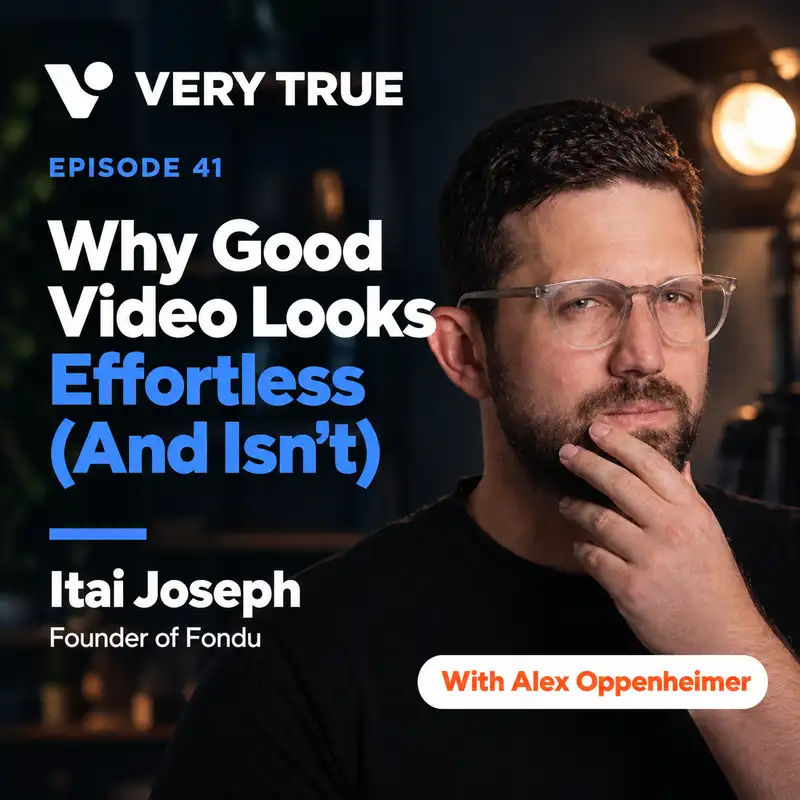
Why Good Video Looks Effortless (and Isn't)
Alex (00:00)
Welcome back to another episode of Very True by Verissimo. Today's guest is someone I've known for a long time, Etai Joseph. And he comes from a pretty different world than a lot of the guests we've had on. Most of the people on this podcast are operators or investors, tech people. And Etai's coming from the classically trained artistic side of things. He's a filmmaker by training, and now he runs a creative video agency called Fondue. what I wanted to get into with Etai is something that I think a lot of people underestimate.
which is how much actually goes into making content look effortless. You watch a good video and it feels natural, easy, like anyone with an iPhone could do it. It's kind of like watching Federer play tennis. He makes it look easy and that's exactly why it's so hard. Etai walks through the whole thing, the concept, the audience, the shoot, the edit, and how AI is actually changing that process now. Whereas before, once you had shot something, you were locked in. Now we're much closer to being able to just delete and retype like you would with the written word.
but the part of this conversation I liked most wasn't about video at all. It was about running your own business with no boss.
Figuring out what actually energizes you versus what just needs to get done And when to delegate the stuff you're good at because it's pulling you away from the stuff that actually moves the business forward. Let's get into it.
Alex (01:59)
Welcome back to another episode of Very True by Verissimo. Today I'm excited to have an old friend, a colleague, a like-minded individual joining me to tell his story and talk about some of the things that we do that are really similar, some of the things that we do that are really different.
He actually comes from almost more of the, I would say, the artistic side of the world in his classical training. I'm excited to dive into a few topics ranging from what it's like to run your own business and not have a boss to building a unique business model and bumping into all the challenges that come along the way and all the learnings and everything in between. So I will pass it over to Etai to take us back. I always say take us back as far as you feel comfortable.
Itai Joseph (02:41)
Awesome. Thank you, Alex. It's great to be here. And I appreciate that intro. It's it's also fun to kind of see your podcast journey evolve and your creator journey evolve. I know we we worked together on an AGM for Verissimo a couple of years back. And I think that was a great opportunity just to get in front of camera and create some short form content. And you've really taken it and run with it as your team has has grown here. So yeah, a little bit about my background. I grew up in a small town in Ohio, Zanesville, Ohio. the capital in 1812. That's sort of our claim to fame.
And I kind of just grew up like in in it wasn't totally rural, you know, it's 25,000 people, but there wasn't much to do except for football and you know some schoolwork. And so I was running around with my friends making movies. I got my hands on like a digital camera, probably around 10 or 11 years old. And I was literally shooting to tape and then uploading that to like my Windows computer and editing on Movie Maker. And I just was really fascinated by like image, sound, storytelling. And I had some friends who are.
Who are down to just like shoot stuff, you know, on the weekends, weeknights. And we actually launched like a prem, we we premiered our first 45-minute feature film around a a beverage that gives basketball players like super athletic abilities. and that that was fun. But we also made commercials for like the local pizza shop, for in the local car insurance agency. And and I I went to Northwestern for film school, and that's where I sort of developed a little bit more of my.
commercial kind of expertise of how how to actually light a you know a shop properly, how to work with a broader crew. And that sort of evolved into freelancing after college. And you know, we spent some time together in Yeshiva, which was really a transformational couple of years. But when I finally ended landed back at the in the States, I I was freelancing and then working for a small agency. And then finally during the during the pandemic, I saw a bunch of like brick and mortar stores going, you know, online first and trying to sell their
you know, the retail inventory online. I was like, okay, there's a there's an opportunity here for me to start my own business, lean into those that's kind of that new world of, you know, pandemic era digital storytelling on on social media and you know, video. The the internet, I almost felt like the internet fast forwarded like 10 years during during the those like nine or twelve months of the pandemic when everyone was on lockdown. And that's really what what Fondue was born out of. And so we're we're sort of a small boutique, agile, creative agency, focused on video on branded video content. We've evolved from like
Doing stuff for for retailers, you have chocolate brands and other you know, physical goods into more technology products. we've Eric Reiner and Vine kind of invited us to to build their AGM in 2021. And that sort of jump started this whole, you know, VC AGM storytelling streak that we've also sort of been doing. So it's been a mix of like ad campaigns and product explainer videos for tech, as well as AGM storytelling geared towards L LPs and.
and fundraising.
Alex (05:21)
Very cool. so
I very much resonate with it felt like the internet accelerated 10 years. And a big theme that we've been talking about on the podcast recently is just taking a snapshot in history and what did the beginning of something feel like? What did it actually feel like beforehand? Now everyone's used to some other reality. The fact that we're doing this virtually, like I don't think we're on Riverside. I don't think it existed, you know, pre-pandemic. this would have been really.
Difficult, everything was in person. obviously Zoom took over, but there were so many other things that changed and how much went online. and I think that also kick-started like just the digital experience and you know, short form video, like being able to capture people's attention and then do that efficiently. And then obviously AI editing, like just lit that on fire. but as you've
been through the journey over the last, let's say, 15 years in or really 20, probably 25 years in film. I also remember, by the way, making
Itai Joseph (06:13)
Yeah, give or take.
Alex (06:14)
videos with my friends on like, what was what was the thing after like high eight? What was like one better than that? I remember we had these like little Canon
Itai Joseph (06:21)
Yeah.
Alex (06:22)
video cameras that had like these tapes that you would put in, but they were actually
Itai Joseph (06:25)
Right.
Alex (06:25)
like digital.
Itai Joseph (06:26)
I don't know what the next level like eventually I switched to an SD card, but yeah.
I I had some sort of like
Alex (06:30)
Yeah, but that was already years later.
Itai Joseph (06:32)
there was like a machine that you actually pop the tape into. It it's connected through like a USB to your computer and like you you have to like do some sort of transfer from the tape into like an MP4 format.
Alex (06:41)
Yeah, I actually need to know this now.
Mini DV. It
Itai Joseph (06:45)
There you go. Mini D V.
Alex (06:46)
was there was Digital 8, and then there was Mini DV.
Itai Joseph (06:49)
Yeah.
Alex (06:49)
And I remember I had this, like, I think it was like a Canon Z50 or something. And like, yeah, we used to make like skateboarding videos and stuff. But then there were guys that I went to high school with that made some really funny, like short clips, like OG stuff back in like 04, 05. And then a guy that I went to high school with.
For his senior project, he made a a soap opera. And he had like
Itai Joseph (07:13)
Yeah.
Alex (07:15)
the juniors act in it. It was hilarious. and he and then he went to film school at Chapman. The final
Itai Joseph (07:20)
Yeah.
Alex (07:21)
episode, it was, I don't even know what this is called. You would probably know what the technical term is, but the whole episode, it was like eight minutes or whatever, and it was Bohemian Rhapsody acted out.
Itai Joseph (07:31)
Interesting. yeah, that's that sounds like a cool project. I you you're you're reminding
Alex (07:34)
It was it was excellent.
Itai Joseph (07:36)
me you're reminding me of I like I was pretty good in high school and academically, but Spanish I was terrible at. And I would like sit in the back and like play Pokemon or something on my on a Game Boy, like while Spanish was happening. So I was I was basically failing my senior Spanish class and but there was an opportunity to do like a special project at the end of the year. I think this was senior year, and I decided to make a telenovela.
like this four minute, like dramatic, you know, you know, sort of love triangle telenovela. And it there was there was murder. It was like very Quentin Tarantino inspired, it was very intense. And also like we're all like I I grew up in southeastern Ohio, so everyone has like Appalachian accents. So like our Spanish sounds like very rugged and not authentic at all. But anyway, it w that that telenovela premiered during the last week of my senior year, and that basically boosted my
grade to an A to a passing you know, s respectable grade to end out the year.
Alex (08:27)
Amazing. I I wish I could find this old episode of the Bohemian Rhapsody.
Itai Joseph (08:30)
I I can probably dig
it up, although I don't know. I don't want it to get me canceled. I don't I don't I have to I have to
Alex (08:34)
All right.
Itai Joseph (08:36)
I feel like that by the way, not not to like put any, you know, put anything out there, but I do feel like half the work that I would have made in high school was, yeah, like could be bad for my reputation today. So hopefully it's buried somewhere deep in the chambers of YouTube. I can't I but I can't access my password. That's the thing. Like I actually can't get into those accounts and take down videos. There, by the way, there's nothing crazy here. I know I'm like alluding to something, but there's not there's nothing crazy. They're just on the margins. Like I would rather that not be public.
Alex (08:59)
Ha ha ha.
Itai Joseph (09:00)
I'd rather that be like reserved for private screenings with
friends.
Alex (09:03)
These are the olden
days when we actually could be silly and didn't have to just worry about offending people as our top priority all the time. Yeah.
Itai Joseph (09:07)
Yeah, there's z zero zero worries. Zero worries.
Alex (09:11)
okay, very cool. So I I think let's let's talk about Fondu, what it is now, and and your business model, because this concept
Itai Joseph (09:19)
Yeah.
Alex (09:19)
of remote production is I think it's becoming more popular.
Itai Joseph (09:22)
Hm. Yeah.
Alex (09:24)
I it's not trivial. Like
Getting teams to work together who've never worked together before and create that system. It reminds me of I have a good buddy who spent a several years working at McKinsey. And the magic of McKinsey, besides that they have a brand and a recruiting machine, is that they can train people well enough so that, as he told me, he can step into a room with four or five people that he's never met before on his team, never spoken to them before. And within 30 minutes, they are at full operating capacity.
Itai Joseph (09:52)
That's really interesting.
Alex (09:52)
You know, so everyone talks about, the McKinsey brand and they can charge a million dollars a week and all this stuff. And like that's the magic of the business. But like, no, that's the output of the magic. The input of the magic is this culture and this training and this common language and communication. So, so walk us through what Fondue is now, how it got there
Itai Joseph (10:08)
You're Yeah.
Alex (10:10)
and how this all works.
Itai Joseph (10:11)
You're you're hitting on a really interesting point that I actually haven't totally thought about because it's just happening in real time. But traditionally, you know, I'm I'm a live action, you know, film director and producer. So I'm used to like filming on site with the camera, with with talent in the space. And and to be fair, we are still doing a decent amount of that at Fondue. So we, you know, we're based in the New York area. A lot of our clients are here in the in the city and we do like if there's like a testimonial video or a recruitment film.
Or even like with you know something with actors that needs like a proper location and and you know on-screen talent, we we will shoot that. But I have noticed increasingly that we are working with more remote editors, remote motion artists, remote gen AI artists. I'm I'm I don't even know what to call the Gen AI like role yet. It's probably just video artists because we'll take AI out of the title once it's ubiquitous enough. But I I do see Fondue like becoming more and more. I mean, we were a remote team.
From the outset, because we were born in the pandemic. So we were always, you know, on Slack from the outset. We ne we I did have like a co-working space, but we never had like a proper office. And and there's so many like awesome location rentals around this around New York. Like, depending on the client shoot, we'll cater the you know, the the shoot space based on the client's brand and and their unique needs. So we never really needed like a full-on studio, but a lot of my payroll and a lot of my talent roster is becoming increasingly remote. And honestly, that's also opened up like offshore talent. So
We do have like a core team of you know really high-level creative talent, you know, writers, directors, producers here stateside, but we we also have unbelievable graphic artists and animators that we've been able to source abroad because we we aren't constrained by sort of the physical boundaries. So I'm not sure exactly I can't remember the the end of your question. from a process standpoint, yeah, I think you know everyone's role in this space is is relatively defined. So
You know, we're actually working with Claude, right? We we've based we've baked Claude into as much of our process as we can. And right now we're just trying to nail like the creative brief. So like w when when we hand off let's let's say a project goes from like script to story high fidelity storyboard to animation. That's just you know, let let's let's talk about like an a gen AI script, which we're doing more and more of those. So you we usually write those in-house, so we're not really handing that off to someone, but but then once we bring in a designer.
We'll have a full-on brief built out based on our, you know, our Fireflies notes, based on our Slack correspondence, based on our team meetings with the client. So that that freelancer can sort of download the the full process, but we'll also walk through walk through that document with that person on a 30-minute sort of briefing call so we can kind of go back and forth and talk through the visual direction and the creative kind of direction and timeline expectations. But it's all sort of systematized into this.
document and then they're they're all like a lot of our freelancers are already baked in they're already a part of our Slack workspace. We're working with them consistently. They understand the process. So they might get assigned to different projects depending on bandwidth and who's available and who's the right artist for a certain type of project. but they they can kind of plug in and just start start working immediately. You know, we we have just from a system standpoint, we have we have time tracking set up. We have like I said their Slack account. We we we have we we give them access to all the you know design tools and AI tools they need to get started.
Alex (13:16)
So I actually think would be really interesting is to hear you walk through two things. The first is the different roles that are involved start to finish in production. And and then just like that process of what that looks like. So laying out who those people are and what skills they need, and then why some of them get combined or don't get combined. Because the reason I asked this is like everyone's consuming tons of video content.
Itai Joseph (13:39)
Mm-hmm.
Alex (13:40)
And I think there's
A little bit of a myth that it's like easy to make good content. And truthfully, the it feels like the best content feels very natural and easy, but
Itai Joseph (13:50)
Mm-hmm.
Alex (13:50)
it's a tremendous amount of work. Having worked on this with you, like it's a tremendous amount of work to make it look effortless. It's almost like watching Roger Federer play tennis. Like he
Itai Joseph (14:00)
Yeah.
Alex (14:01)
makes it look easy, and that's like an insane amount of work. That's way harder. And
Itai Joseph (14:03)
Mm-hmm. Right.
Alex (14:05)
And so I think a lot of people are like, well, why can't just like pick up my phone and like I can record a video like that? But in
Itai Joseph (14:09)
Mm-hmm. Yeah.
Alex (14:10)
terms of everything from like script writing to lighting to the cinematography to editing, like all of that, like what is what is that process? Like who's involved
and what's the process?
Itai Joseph (14:20)
Yeah. They
they they say when you go to a movie and you didn't notice any of the edits, it was there was a great editor behind the film because you didn't notice anything. It's only once you say, that was like a weird cut or that was like a weird transition. Now the editing, you know, has some flaws to it. So it I think it's the same thing with content creation. there's really there's really a couple of different quote unquote product lines that we have. So we have sort of our AGM kind of like virtual AGM meeting that we do for investors.
And then we have sort of like our commercial ad campaign where usually we're creating one hero asset with cut downs or like a set of different assets that you can run on paid media. And then we have like kind of, I don't know, product explainers and testimonial videos. So there's really four lines. They all share the same basic steps, which is concept development slash storytelling strategy, is like where we want to start. Like who is the audience? What is what do they care about? You know, forget about your product and your service and and your feature set.
What is your what does that end ICP actually want to know? What's going to compel them to either be entertained or to take action or or both or to be educated? Like let's really get into their head. And now we can connect your brand, your product, your service to to that person. Cause we if we're not looking at it through their lens, like and we're just looking at it from like your perspective as the client or like the company, it's probably not going to strike an emotional cord. So anyway, so that's sort of like our first step as a team is like.
Let's really workshop like what what do we want them to take away? And and then we can then we bring multiple kind of like script angles or messaging angles to the table. And then we sort of land on, okay, this is the core story. That's usually a very collaborative project between our team and and your team. And then for an AGM, that means we're landing on the run of show. You know, who who are the founders that we want to feature? What are the topics as a firm? What you know, or about your thesis that you want to convey to your LP audience.
You know, on a brand campaign, it's like, okay, which what what do we want to highlight about this project? What's the killer feature? And like, how does that change the life of the end user? But ultimately it's all storytelling strategy. And then we sort of finalize a script that can be more creative and out of the box and weird and wacky if it's like that type of brand that's willing to take that risk, probably more on the startup side. If it's more of an enterprise grade brand or a more mature brand, they might want to play it a little bit safer, but they still want to do something with some edge, like they still need a good hook. They still need
good storytelling structure to like create something that's engaging. And then once that script is sort of set, then we move into you know, in a live action context, it's pre-production. So like we're not just going to show up and like film the script. Like we need to map out what what's the shot list, what are the angles, what's the lighting. We do, we do like a pre-call with our, with our film crew and like make sure we're all on the same page. Like our our producer in-house is building like a storyboard so that our crew can start to visualize what that, what each shot is going to look like.
And that allows everyone to be on the same page when we show up on site the day of production and film. And in production, it's just like, you know, we we bring in specialists. So we we bring in cinematographers who are like expert cinematographers. They don't do anything else. They literally just they light and shoot beautiful work. And that's and and they work with different agencies. So they work with Fondue, they all they might split their time with some other agencies. We sort of have our go-to roster of production talent. And then once that footage is captured, then we'll bring it back to the editing bay.
And first we build like a a story cut, which me meaning pre-graphics, pre-bells and whistles. Like we just want to get the pacing down and just the overall structure down. We want to get that in front of our client, get that approved. And then we'll bring in a colorist to to really beautify the color. We'll bring in an animator to add, you know, beautiful UI graphics or visual overlays to really enhance what we've captured with live action. and then, you know, they're the kind of the final touches are sound design and and music licensing. But I think like
I I didn't really go through the roles at each stage, really to to just kind of break down the roles. It's yeah. Yeah.
Alex (18:03)
Well that that's a that's a fantastic breakdown of like the process. So it starts with
concept, audience, like understanding the audience, writing the script, then there's the cinematography and the actual shooting of it, and then there's the editing and then the post-production bells and whistles. I think one of the things that probably intimidates people, I'll just say, is the fact that like you can't really iterate through that.
Right. It's like, or you can, but it's like very expensive. Meaning if once you've shot it, like once you have the script and then you go to shooting, it's like it's gotta be good. And so it's really not easy to know like the various things that you need to do and be able to imagine how it's gonna look at the end when you're writing it. Because right, if I'm writing a substack piece, for example, like I who cares, right? Like I can just delete, delete, delete, type, type, type. Right.
Itai Joseph (18:49)
Just re re rewrite it. Right.
Alex (18:51)
Like
There aren't like these other parties and these other steps that are contingent upon earlier steps. And I think that's what makes it unique and challenging. It's not as simple. And that is probably the part that you left out is your job, right? Is is stringing this all together and saying, that concept or like the way you're talking about your audience, that d that's not gonna hit, like that's not gonna come through in the video. Or like, well, we need this shot, but I think we might also need that shot. And then once you're in editing, going like, well, this is what we have and
This is what really the original concept was about. And here's what we can do now. And then here's where we draw the line on a reshoot or whatever those different pieces are.
Itai Joseph (19:27)
Yeah, for sure. It it's true what you're saying. It is a skill. It is sort of a muscle that you build if you do a you know a few reps of these. You start to anticipate two steps ahead and see what's not going to work in the script. So you can already fix that from an earlier stage in the process. So I do think there's an element of of of repetition, but I I also think Gen AI is allowing like we've started building out storyboards using Gemini or other just simple like image generator tools to start to just visualize where what this is going to.
sort of look like obviously in a in probably like a lo-fi or a half you know quasi-baked way up front but that way the client can sort of see where we're going with something especially a more just conceptual script that's that's less just just hard to visualize from from the pure copy. that that's really po powerful and that can help I think novices or or just people who are aren't like don't have a film production background to to see hey does my script actually
translate into into an end clip if I can see all the images strung together.
Alex (20:25)
Sure. Yeah, that's it's not trivial.
Itai Joseph (20:27)
but it might be worth I wonder if it's worth talking about like the AI workflow. Cause that that that is ch that is like on the iteration point, that's actually that is changing things a little bit. Where and we we have multiple AI projects right now where like, okay, we've built the script and and we build like high fidelity kind of visual style frames. And we we're like we're it's funny because we're now we're like AI instead of using stock footage, we're just like, let's just customize the footage, the exact footage we need.
it does take compute and it does take iteration. So it's not like as easy as hitting a button, but it just gets a it gives you a more customized look. And then we'll, we'll, we'll go into in some cases, like we'll build out the full like motion, you know, video component of that. And then we'll see in the edit, hey, you what, that shot isn't working as well as we expected it to. Now with AI, we don't have to go and reshoot, we're not reshooting anything, right? We're just redrafting the style frame from the earlier.
stage and then re and regenerating it and playing with that. So it actually is becoming more fluid, almost, I mean, not quite to like substack level where it's purely the copywriting. But
Alex (21:27)
Yeah.
Itai Joseph (21:28)
but it but it it I think the dynamic is changing. I think the the the expectation from clients I mean I still think there's there's a place for live action stuff that you can't just fully you know AI if I but for AI project native projects clients are going to expect like just quicker quicker turnaround, quicker iteration, like more deliverables. You know, if you have a
a a campaign, maybe you maybe you have multiple ICPs who you're speaking to and you kind of customize it for different different states or geographies or or if you if it's related to sports, different sporting events, wh whatever it is, like you can kind of tailor the creative around or personalize the creative around different audience segments in a unique way.
Alex (22:04)
Have you ever have you spent any time talking to Aaron Lieberman? 'Cause he's gone I think all in on like AI video production.
Itai Joseph (22:11)
He he just texted me this morning actually with one of his latest, latest pieces. I haven't looked at it yet. But I I've I've watched, I mean, he's he's an incredible example of someone who was not a filmmaker at all, went all in. I mean, he's like a hardcore personality. So like he's really double depth. Like he'll he'll like spend like 80 hours a week just like laser focused on one project. But he's really self-taught, like some of the I think he might be at the forefront of some of the core systems behind creating like Chen AI video, which is really crazy, like over the last year and a half.
And his work has become really good. Like I've I've watched it evolve from like the first few months to today, where he he looks like one of the top, you know, AI, you know, filmmaking pros out there. And he's he's doing some really cool stuff.
Alex (22:47)
It's interesting. It's my friend had a line recently, which was that if you wanna build a big business, it's better to not know anything about the market that you're selling into because there's a certain amount of naivete and lack of understanding of the existing limitations that will open things up for you. But if you want to build a small business, you better know your market really, really well. because you're just gonna be in a kind of more navigating it way rather than trying to disrupt it. And
It's not so simple as like build a big business, build a small business. It's really swing for the fences versus like build a nice business. Like if you want to do something consistent and nice, like you better know it really well. If you want to like take a shot, which probably will fail, like then yeah, don't know anything. I just go for it. so
Itai Joseph (23:30)
Yeah. Yeah. I was gonna
it's it's interesting. I mean, this is not an exact not an exact parable, but like what's interesting, I I I work with a lot of like, you know, we work with CMOs and advertising folks. And I did not come from the advertising world at all. So I'm coming from like the the kind of like DIY filmmaker world, which might be more closely to advertising than like coming from commercial real estate. But it's I I still don't really know like I I kind of feel like an outsider when I go to like these ad club events and
in these like social circles, like I I I don't know. Like I'm I'm not sure what your you know, what your org chart looks like or how what your client interactions are like. Like we just try to show up with a smile and serve our clients and make our clients happy and and do cool work that like we're all gonna be proud of. And that just doing that consistently has has driven a lot of traction with Fondue.
Alex (24:16)
Amazing. so it yeah, it's a really interesting overview. I I I guess the last thing to wrap that up would be like if somebody wants to dabble, right, is the standard so high right now that like don't waste your time? Or is there a way that like you can get a setup, do something, create something, like control what you can control and get yourself out there and build engaging content?
on like a shoe shoestring budget before you wanna before
Itai Joseph (24:41)
Mm-hmm.
Alex (24:42)
you figure out if it's really like worth, you know, investing meaningfully in.
Itai Joseph (24:46)
I I'd be curious to hear your perspective. I feel like it's it is, it's not, it's it's becoming less optional and more mandatory, I think, to be top of mind in whatever industry you're in, from you know, an inventor or a tech founder or a pizza shop, like you have to be producing content consistently. And I don't think everything has to be high fidelity. It can be scrappy. But that said, I think there are some stages. I think everyone's good at different things. So some people might naturally like.
Editing the footage they shoot, but maybe they're not as good as like writing the con the content. Maybe they're better at the concept, but they're not, they don't want to deal with like the editing. I think one interesting angle is like if you can find like an editor on like Upwork or Fiverr, and you just like, especially if you're the founder of your company and you understand the space, you have the insights, you have valuable ideas to share publicly. Like if you can just get an iPhone, get, you know, if if you're shooting on your on your desktop like we are, just get like a $200.
Sure, microphone and like now your audio sounds great. And just and honestly, I think you can have like my mind's going a million directions here, but like if you're doing the thought leadership style content, which I do think is a little bit like people have seen enough of those like podcast style videos. But like I I if you have someone on the other side, a teammate, like it could be your I don't know, your your your your marketing director or your product manager, whoever just asking you questions to like kind of facilitate, get the juices flowing of like what you want to say and talk about.
And then you ship that off, like find an editor on Upwork, ship off the footage to that person, like give them some light direction and find someone that you like working with, then that could be a way to kind of get rid of that like just very intensive, like technical side of the process while still just being able to rapidly generate content. You'll still have to put some money into it. But as it like you have to kind of think about where is your time the most valuable. If your if your time is better spent create, you know.
Coming up with the ideas and just getting on camera, like forcing yourself to get on camera. Get some find someone on your team, find your spouse, have them flip on a phone and like I and I thought I think I think the more motion the better. So like instead of just posting up at your desk, like get outside, get into your like walk through the halls of
Alex (26:45)
Yeah.
Itai Joseph (26:46)
your office, like walk through the market, you know, the shook or or whatever you know, corporate compound you're in and just like make it more interesting. I think the more angles people just wanna see like, you know, d variation
Alex (26:56)
Yeah.
Itai Joseph (26:57)
on social media. That's what kind of catches the eye.
but then like offload the stuff that is less fun and is more of a waste of your time to someone who can do it more efficiently.
Alex (27:05)
Yeah, it's
rem it's reminding me now because like I I was posting some like YouTube shorts and it just becomes like too many channels where it's like my biggest following is LinkedIn by far. Twitter
Itai Joseph (27:14)
Hm. Yeah.
Alex (27:15)
is like a bonus, and then I have very little on like Instagram or YouTube, but I have all this video content that I've created and like Riverside auto clips a lot of the stuff. Then you can kind of cater it exactly how you want, throw the captions on the branding. And I haven't posted anything on YouTube since March. Like six months
Silence and like, you know, one of my best videos that I posted was I was riding my bike and I was going up a hill and I just had this idea. And I just pulled out my phone and started just taking a selfie video while I was like huffing it up this hill. And then I just took it back, edited it, and threw it online. And like it didn't go like crazy, but it has over a thousand views. I don't know.
Itai Joseph (27:52)
Yeah. I mean
that that that's I the like the biking footage that you've been shooting. I don't know which video. I've seen a few of them on across LinkedIn and WhatsApp, but like those are so unique. I mean that that like I wanna it's like I get the GoPro, you know, mountain biker kind of first person perspective, but I also get to hear your ideas about like venture and like the how AI is evolving. It's just it's just like
Alex (28:13)
I appreciate that.
Itai Joseph (28:14)
ri I mean it's really cool. I think if it like that kind of is a is a good lesson for everyone, like
If you can find something that is uniquely you and sort of person humanizes you and personalizes you, is also just kind of interesting to to watch. Like it's it's kind of funny, you know. I I my understanding of Gen Alpha, I don't hang out and like watch Twitch streamers just like, you know, talk about politics all day. But but I think that is that is becoming like the thing is like you're you're watching someone just play some random game and like talk about something completely unrelated. And I maybe that just means we're like super ADD like as a society. But but I also think you wanna you wanna
You wanna find new ways to stimulate your audience as opposed to just talking to a camera. So whether that's overlaying B roll or whether that's doing something interesting, going, you know, while you're on a boat, while you're d doing something with a friend and just like popping up in camera and and giving, you know, giving a little shout or you know, presenting some quick ten sec second thought that comes to your head, I think the more differentiated you can get the better.
Alex (29:06)
Yeah, and think that like most things in life, it's a matter of consistency, iteration, like pushing the limits, get building skills, just getting better at it, realizing like, if I hold the camera like that, it doesn't look as good as if I hold the camera like this. And like, okay, on to the next one. there will always be more ideas. You know, I I I have not had an issue with that. but I'll tell you something that's kind of interesting that happened is like I was publishing these.
videos while I was on bike rides or runs And I totally stopped. And I bought I bought like a Insta360 So
Itai Joseph (29:38)
Yeah.
Alex (29:39)
the reason that I stopped was I didn't get good enough at using those cameras.
Itai Joseph (29:45)
Mm-hmm.
Alex (29:46)
and editing a 360 camera is a lot of work. I just don't have the
time or the interest in doing that. But even the Go 3S that I have that's just a micro camera. I found that it took too much away from the activity for me. the reason that I'm biking and running and I published a bunch of content about this is to get away, Like I mountain bike, I road bike and I gravel bike. And there's something so special about gravel biking.
which I did today, like mountain biking, it's like 100% focused, like locked in. it's
Itai Joseph (30:13)
Yeah.
Alex (30:14)
intense. Yeah, there's some like more chill moments, but the the kind of like core reason that you're doing it is a certain level of intensity and like rowdiness.
Itai Joseph (30:22)
Mm-hmm.
Alex (30:23)
I tweeted this out. I was like, there's different kinds of music for different type of biking. road biking, you listen to electronic and techno music. Mountain biking, you listen to rap and
Itai Joseph (30:30)
Hmm. Okay.
Alex (30:33)
Gravel biking listen to country music. And there's something
Itai Joseph (30:35)
interesting.
Alex (30:36)
to be said for that where it's just like a more chill vibe, like today. I'm just like out on these fire roads. Like they're big, wide dirt roads,
Itai Joseph (30:44)
Mm-hmm.
Alex (30:45)
and you're in nature, it's quiet. Versus like being on the road, you're like constantly checking for cars. It's like a
Itai Joseph (30:50)
In here.
Alex (30:51)
whole different thing.
it it felt to me like no, I'm doing this to just get out of the work mode and I whatever, not to go down this whole rabbit hole of social media and creating it and being involved in it of like where do you draw the line? And my friend said this not that long ago. He's like, All of a sudden everything you're thinking of, you're like, that's a tweet, that's a LinkedIn post,
Itai Joseph (31:08)
Yeah.
Alex (31:08)
that's a blog post, that's a video, and then you're never off and you don't just get to like marinate with your ideas anymore.
The thing that I've done as well, which I'm still in the process of doing, is just doing a ton. And then at a certain point you have to sit back and be like, okay, what's worked, what hasn't worked. And then you ultimately I think the goal is to pare it down.
Itai Joseph (31:27)
Hm. Yeah.
Alex (31:28)
in the podcast world, you know, the guys at Acquired have just done such a good job where, yeah, they did launch Acquired Two, which is more of an interview show, but they do one episode a month.
You know, when they're talking about their own business model, like that's their skew, that's their
Itai Joseph (31:42)
Mm-hmm.
Alex (31:42)
business model. and you gotta be really good at it.
Itai Joseph (31:45)
Mm-hmm.
Alex (31:45)
And you but and you gotta focus on it. But like there's something that's like the level you want to get to. and you gotta but you gotta throw a lot of stuff at the wall to like figure out what works and what sticks, and then you know what suits you and what do people want and where do you sound good and where can you get better and all of that. So
Itai Joseph (32:00)
Yeah.
Alex (32:01)
go ahead, yeah.
Itai Joseph (32:01)
No, I feel like we're talking we're the first part of this convo was like just how do you get started? You know, how do you how do you try to put something out there? But I agree, once you start to observe what works, then focus. I mean, focus is just some one of the hardest things. We were talking about before we start recording, but just figuring out what to prioritize and what is a distraction. That that's that's something that I find myself like the the longer I go on this Fondue career path, it's like, yeah, like what is actually important.
and you have to create boundaries to to be able to assess what's important. If you don't if you don't have a moment of quiet and of like reorientation with yourself, then you're just constantly in this own your this rat race with yourself. but I I am curious, Alex, like I did want to understand your your rap artist of choice for those gravel runs. For the mountain biking. For the mountain biking.
Alex (32:44)
For the mountain biking. So the truth is I haven't I
I crashed my mountain bike a little over three months ago and I broke my hand. And
Itai Joseph (32:51)
no.
Alex (32:51)
I mean it was like a s it's like I broke what's called the hook of Hamate bone in the base of my hand. I still finished the 50 kilometer ride. I I crashed like three. I I crashed
Itai Joseph (33:00)
What mile did you break it on? wow. That's great.
Alex (33:05)
20 minutes in to a two-day 50k per day like group ride.
Itai Joseph (33:09)
my gosh.
Alex (33:10)
I crashed twenty minutes in.
Banged up my knee. I was wearing knee pads, but I banged like above my knee, shoulder, neck, which didn't hurt until the next day, and then my hand, which didn't swell up. So I thought it was a soft tissue thing for a while. And then I still finished the ride and I could barely hold the handlebars. It was just like excruciatingly painful. Probably shouldn't have finished the ride, but you know, I raised money for this ride. So
Itai Joseph (33:28)
Right. That's just your personality, isn't that?
Alex (33:31)
I'll give you an example of this, and then I want to get back to like the entrepreneurial journey.
Itai Joseph (33:36)
Yeah.
Alex (33:37)
while I was up north for this two-day mountain bike ride, I was hanging out like all these guys, and like the energy the night before the ride when we're all at this hotel up north was was just
electric and everyone's meeting new people and schmoozing with the people they already know and it was great. And I was like talking about my dad. My dad's been a cyclist for the last 30 years. And he and his friend decided to ride their bikes up Haleakala, which is the volcano on Maui. And it's the longest continuous paved climb in the world. It's 36 miles and 10,000 feet of vertical with no breaks So like
Itai Joseph (34:08)
my gosh. Hmm.
Alex (34:10)
it's a five percent average grade for 36 miles. Good news is it never gets super, super steep until the very, very top.
Itai Joseph (34:17)
Mm.
Alex (34:18)
it's a beautiful ride. It's hard to hit the weather right. But anyway, I'm telling these guys, and then I was like, Yeah, I'm going to California in a few weeks. And they're like, You're gonna be California, like, you gotta go and join your dad and like do this ride. So I crashed my bike, and then in three weeks.
I gotta fly from Israel through LA to Hawaii and then do this five hour, 10,000 foot climb, which I did and I it required additional training and stuff. but my first thought when I was crashed was like, my gosh, I hope I didn't like blow this. But in that conversation, I just like I was like, yeah, I'm booking it. Screw it. Like I land in LA and I book the next flight to Maui.
Itai Joseph (34:49)
Can't believe you still do it, yeah. Yeah.
Alex (34:52)
but going back to the content piece, it's like.
I was, it was me and my dad And you get to the top of Haleakala, it's 10,000 feet. You're above the clouds. It's very surreal. It looks like a moonscape. You're at the top of a volcano. And first of all, I was exhausted, but it was so surreal that I like I I it almost felt like.
Too sacred to like pull the camera out and start like taking a video of like, here's what's going on. I don't know. I maybe should have pulled up a video and just talk. Like, don't try to make content. Just express myself to the video and like, what am I thinking? What am I feeling? And like probably something good would have come out of that. But it also felt like, yeah, it just it felt just like intrusive. Like it's a very special
Itai Joseph (35:28)
You're still doing it for an audience then. You're still not like living for yourself. Yeah.
Alex (35:33)
moment. Like I'm 37, my dad's 69.
We're able to do this together, which is pretty cool. It was definitely the biggest athletic achievement of my life. still is, you know, two and a half months later. it's interesting. So, but in terms of rap artists' choice of getting rowdy on the mountain bike, honestly I just go back to what I listened to in high school, which
Itai Joseph (35:52)
and Yeah.
Alex (35:53)
I grew up in the Bay Area, and so we listen to Bay Area rap, the hyphy culture, it's its own world. If you know, you know. If you don't know, like
Itai Joseph (36:00)
I don't know. I don't know.
Alex (36:02)
it is the weirdest, most fun. It's meant to just be fun. It's ridiculous, it's outrageous. and that's that's where that goes. But when I'm on the gravel bike, it's always country music. And when you're on a road bike and you feel like you gotta just like
go faster, faster, faster, faster, faster. Like you need that techno vibe. Yeah. It's
Itai Joseph (36:21)
I hope
you I hope you have some Spotify playlists that your fellow bike enthusiasts can can tap into.
Alex (36:26)
So, so many. so what you were saying though, about building the boundaries, figuring out the direction. You know, I started my own business like six years ago and you have your own business. Not having a boss, not having like a specific role, like you were talking earlier about like figuring out what you like, what you don't like, and delegating it.
I always say that like the CEO job is the one job that actually scales because every other job is defined by what the CEO can and wants to do. So the example I always give is Mark Zuckerberg, right? Like arguably he should have been the CTO or whatever. But then, you know, you hire Sheryl Sandberg to be the COO and she handles a certain part of the business. He can be more of like the visionary style CEO. So there's different functions and roles, but how you define that from the inside out, not from the outside in.
It's just a very different experience of prioritization and running your own business and figuring out not just what makes money, but like what gives you energy and kind of doesn't drive you into the ground.
Itai Joseph (37:22)
Totally. Totally. yeah. I'm trying to think of like where where to take that 'cause I there's a bunch of things like floating around for me right now. Like I think who who who yeah.
Alex (37:29)
So so let's start with like,
you know, like I mentioned earlier, like your role as the producer, right? You're the glue that pulls us all together, that manages the vision.
Itai Joseph (37:37)
Sor
sort of. I mean to be to be fair, just to give you like a sense of my role at this stage, it it really is more in like it's split between like sort of high level account management, just like making sure like our clients are having a great experience. But I really have tried to delegate a decent amount of like the the production side to my team. I still, you know, call myself the creative director, which I I do I I have creative input on every project that we do, but I'm trying to delegate
That to the extent possible because that really does pull me like into the we, it's really hard to focus on the other like higher order things that I think are gonna drive the business forward, which is like how like AI transformation. How are we like, what what new offerings are we opening up because of AI? What how can we tweak our workflow and our process, both on a creative standpoint, but operationally also, like to kind of lean into these tools and position ourselves for the future? And but but then just like raw, like,
You know, business development, new, you know, new relationship building. I mean, I think that as as a founder, you're kind of until you have a sales team, you are the salesperson. So I I'm I'm taking all of our new inquiries and I think there is a strategy part of that of like, hey, this based on you and and your company's needs and where you're at, this is what I think you should do from a content standpoint because of XYZ. So the I think sales and strategy are actually pretty intertwined. but then being able to like,
kind of build the help my client build the blueprint and then hand that off to my team who is super talented in their own right for for production execution while having some like kind of high level touches along the way. yeah, I'm not I'm not sure I'm going with that, but like I yeah.
Alex (39:09)
So so what
I'll what I'll what I have experienced and relate to and I what I'll kind of push you on is really two ideas. One is drift and the other is the origin or the the the source of inspiration. And like for me, I'm kind of a natural analyst. And so in a lot of ways, I feel most comfortable in front of a spreadsheet.
Itai Joseph (39:30)
Mm-hmm.
Alex (39:30)
Like when I get my hands around data and I can start modeling and and I haven't necessarily needed to do that in a long time. But when I'm having kind of writer's block or I'm feeling unmotivated, that's what I go back to, like that
Itai Joseph (39:44)
Yeah.
Alex (39:45)
function, that analyst function, that
Itai Joseph (39:47)
Mm-hmm.
Alex (39:47)
that thinking, writing, you know, analytical function, which if what I just said confuses people, like
Building a model is just part of it. Being able to express and communicate what's going on in that model and why it matters, that's the more interesting part of that or why building the model even matters in the first place. Otherwise, it's just a cute spreadsheet. and by the way, when you see one like that, you know when that's the case, like when someone bought a template model online and they don't really own it and understand it. But
Itai Joseph (40:13)
Mm. Yeah.
Alex (40:15)
that's what I come back to. And, you know, just to be transparent, like I felt like I've drifted.
Right. Cause like I'm running a small VC fund, which is unique because like it doesn't really scale up like personnel wise.
Itai Joseph (40:29)
Yeah.
Alex (40:30)
and so I've had to do a lot of work to figure out like, okay, what energizes me, what drags me down, and where is value accruing to the business? That's probably like that's probably a good way to frame it of like, okay, where's where do I need to
Own this and do this. You know, for me, it's like relationships with founders, relationships with LPs. What's going to drive value to the business in the next five years? Which is like
Itai Joseph (40:53)
Yeah.
Alex (40:53)
thinking through again, right now, it's like, how does AI affect everything?
Itai Joseph (40:57)
Right.
Alex (40:58)
and then, but then always like not forgetting that I gotta also do what energizes me. Like, why
Itai Joseph (41:04)
Yeah.
Alex (41:04)
did I get into this business in the first place? I I'll just come out and say it. I did not get in this business to
try to convince LPs to like put money in venture funds. Now that is a part of my job and I do it and I've found enjoyment in it, but it's not why I got in this business.
Itai Joseph (41:19)
Yeah, I like that
framing that it's like, okay, that might be a decent amount of your time of how you utilize your time, but like that's just that's more of maintenance and sustaining the business. But like you, your passion is the analytical side and and be and living in that spreadsheet and and drawing out the insights from the models that you're building. I mean, for for me, when we have a challenge for our client, like what how are we going to communicate this product? And we just land on like,
A banger creative idea that's like, wow, this I I will laugh watching this concept brought to being brought to life. Like that is the best part. And honestly, that's the best part of our clients' day also. Like our we we've had multiple clients tell hey, the our meeting with Fondue, our weekly sync with Fondue is like the our the highlight of our week because especially in the concepting phase, it's like we just have so much fun throwing ideas at the wall. It's like it's almost like a writer's room where like we're just like, you know, pit pitching ideas, hashing it out, get it getting feedback, generating new thoughts in in real time.
And and then I that's like on the sort of the pre-prods element of things, but then in post like actually seeing things come to life, like coming up with creative solutions on set to like how do we film this super unique shot or how do we tie these shots together through an edit? Like those those cr those moments throughout the week and throughout the month are definitely the passion drivers for me.
Alex (42:31)
Amazing. yeah, I'm like, I'm kind of like grinning in jealousy because I mean, I I worked with you and I enjoyed those moments too. because then you get to see it come alive. And and the creative part and just ideating and brainstorming is fun and then seeing it come alive and like that result, it's almost like immediate gratification, or not immediate, immediate, but like short-term gratification. And like in my business, like what I care about.
Is the same thing that my LPs care about. It's the same thing that my founders care about. It's like making a stupid amount of money. Like, if that's just it, that just takes so long. You know? So like you have to find all these proxy things in between that like.
Itai Joseph (43:07)
Yeah. That's interesting.
You guys you guys have a long payoff in venture.
Alex (43:11)
Yeah, I always say it's a get rich slow scheme.
Itai Joseph (43:13)
Get rich slow That's a great way to pitch it. Yeah, that that that'll like take some competition out of the lands out of the landscape.
Alex (43:19)
I mean, truthfully, if you can just generate a bunch of hype and raise a ton of capital, then you can get rich fast. It's just on fees. and then if you can
Itai Joseph (43:26)
Right, right. It's not it's not an outcomes.
Alex (43:28)
Yeah. and then it's kind of like, hey, I just came here to play in the market. Anyway, I could go down that whole rabbit hole of like what's what's changed there and why.
Itai Joseph (43:34)
Yeah. Mm-hmm.
Alex (43:37)
but yeah, it sounds like you have a great, those kind of core tasks of like what brings you up.
Making sure that's incorporated in your day, what drags
Itai Joseph (43:45)
Isn't it
Alex (43:45)
you down, figuring out how to delegate that and do as little
Itai Joseph (43:48)
Yes.
Alex (43:48)
of it as possible. And then staying connected to what's going to drive the business forward, both in the moment, like with your clients serving their needs, and then from a visionary standpoint of like what's going to drive the business over the next several years. that's what everyone's got to do.
everyone's talking about startups, right? Like my clients are startups, your clients are startups in a lot of cases, like
An entrepreneur, the way I define an entrepreneur is someone who figures out creative ways to make money. And that can be on a large scale, it can be on a small scale, it can be market-based, it can be technology based. There's
Itai Joseph (44:18)
Yeah.
Alex (44:18)
just so many different variables and ways to do that, but it's really about that creativity and
Itai Joseph (44:24)
Creativity is at the core.
Alex (44:25)
yeah, and and finding yourself in it.
Itai Joseph (44:27)
Mm-hmm.
Alex (44:28)
yeah, it sounds like you've, I don't know, you've you've you've done a pretty good job of it.
Itai Joseph (44:32)
It's a work in pro I mean I
always look at it as a work in progress. Like, you know, whatever there's I I don't know if you say chazals on your podcast, but like whatever whatever you accomplish, you always you always want two X, you know, wherever wherever you're at in life. So like there's always more there's always more to to strive for.
Alex (44:46)
We can definitely we can definitely say chazals. and if you don't know what a chazal is, that's fine. Just know that it's a source of infinite wisdom. I mean, that's healthy motivation, right? Like that's that's all that is. It's not driving yourself nuts,
Itai Joseph (45:00)
you gotta be at peace with with where you're at and like with the the stage of life you're at. And it's like I you know, we thank God we have a a growing family. And like I it's almost I mean, this is like a slightly different angle here, but I I feel like I can't do work, you know, I can't work a hundred percent the way I want to like lean into my business, but then I can't lean into my family a hundred percent. But then I also have extracurriculars. I'm trying to to learn Torah on the side. I can't lean into a hundred percent. So it's like everything's sort of sitting in this like eighty percent zone and I kind of have to just like
Be at peace and thank the creator that I have the opportunity to to be in this position.
Alex (45:31)
I I've had a lot of gratitude recently around a very similar idea. And one of the themes across I think a lot of the podcasts that I've published is this kind of like career advice angle. what you're getting at is really important to understand, which is as you get older, you get busier, and that's a good thing. I I still remember when I worked at NEA, my old boss Harry.
He took the three junior guys aside one day. It's like 2014, maybe early 15. And he was like, all right, guys, no work on Fridays. Right. And we're all like out of banking, like, want to work hard. Like, also, our jobs were like fun as heck. Like we were traveling, sitting with CEOs, like fancy business card. and and we're like, What? And like, what you want us to like, we're not working on Fridays? Like,
He was like, Yeah, no office, like, no, just and this was, you know, 12 years ago before, like, you know, everyone was on 24/7. and he was like, Yeah, I'll tell you why. He was like, Because right now you're not busy. Your life is not busy. You guys are all single. Like, you need to figure out now, when you're this age, to build that muscle of prioritization and figure out what's important and just focus on that instead of like.
Boiling the ocean at all times. So just do it as much as possible. Like figure out what's gonna move the needle and what matters and learn that skill now because when you're my age at the time, he was like 45. He was like, you and he had a couple kids and he had all these other responsibilities and hobbies and whatever. you're gonna, hope that you did that. And as I look back on that conversation, obviously it's clear to me now, you know, married, hobbies, wife, kids, travel, whatever.
running a business, figuring out all this stuff. that that's really important. But it wasn't easy to figure out in the moment how you actually do that. yes, it was a great idea, like artificially limit what you do and create friction, create time boxes, You gotta figure out what suits you. so that's one thing that I would say. But getting
A little bit back to what you were saying is like you feel like now you're like 80% max on all these different vectors. And when I think back to the beginning of my career, the first five years, especially, being at Morgan Stanley, working in investment banking, being at NEA, working in, institutional venture capital, and like busting my butt in those jobs and learning a tremendous amount, that allowed me, to be in the position I'm in now where like I can go on a bike ride at it.
8 30 in the morning on a Tuesday for two hours.
Itai Joseph (47:48)
Mm-hmm. Yeah.
Alex (47:49)
that 80% that I'm giving to work, let's say,
Itai Joseph (47:52)
Yeah.
Alex (47:53)
is more than enough because I
Itai Joseph (47:54)
Mm-hmm.
Alex (47:54)
got far enough ahead and I built those fundamental skills and relationships and whatever that like that's enough. I feel really bad for people who are like our age, like mid 30s and like needing to.
figure out their career for the first time or figure out like a meaningful career pivot because a your brain plasticity is not the same at mid 30s as it is in early 20s. And B, you just don't have the bandwidth to go headlong into something. And I look, I've seen people do it, but I'm looking at them like, whoa, that's that's wild. And I don't
Itai Joseph (48:22)
Mm-hmm.
Alex (48:22)
know, maybe maybe the New York City culture is just not like this. They're like they're listening to this being like, what are you talking about? I still go 110% at work and I'm married
Itai Joseph (48:29)
Right.
Alex (48:30)
with five kids and live on the Upper East Side. Like
Yeah, maybe. to each their own, like you figure out what works for you.
Itai Joseph (48:35)
the the point you made about relationships is really interesting because I do feel like relationships really carry, carry you throughout your career. Like those those core connections and the in the more it's almost like compounding because people intro you to other people. And a lot of our clients have come through very early relationships, even dating back to like college and how those have spread out through this ripple effect. And yeah, if anything, if I take away anything, it's like if you want to free up time later in life, like build
great relationships earlier in your career because you know that that's how you find new opportunities, new jobs, new clients, new, new partnerships. So great, great call out.
Alex (49:07)
Yeah, a hundred percent. Like front load this stuff because your advantages will compound for the rest of your life, basically.
Itai Joseph (49:14)
Mm-hmm.
Alex (49:15)
yeah, it's amazing. We covered a lot. I think it was it's fun, interesting
Itai Joseph (49:18)
Yeah.
Alex (49:18)
stuff.
Itai Joseph (49:19)
Yeah. Hope hopefully it was solid.
if you're a VC and you want to step up your AGM storytelling and just really position yourself in a very kind of sleek and polished way as a as a firm, especially if you're like your first fund is is sort of in motion and you're raising that second or third fund and you're trying to take it to the next level. We really help with just high quality production, A LP communications, beautifully produced AGMs. Alex, you know, what has has been one of our clients.
Alex (49:44)
Happy customer
here.
Itai Joseph (49:45)
Happy customer in the past. And then for founders, you know, if if you're making a big announcement, whether that's, you know, post Series A raise or, you know, in the process of being ready to announce your Series A or doing your first big brand campaign, you know, TV is becoming more, more possible with, you know, C C T V connected TV. it's almost like running meta ads. You know, you can you can get in front of your customers on TV. We do really cool out-of-the-box storytelling for.
TV ad campaigns, or if it's on the recruiting front, you know, higher hiring new talent, showing showcasing your culture in a really dynamic, engaging way. We can help with that as well. We just do really fun videos for tech companies. So we like to we like to bring the human storytelling into highly technical products. I think that's our value prop. You can check us out on fondu.co. That's f o n d u dot C O. I'm sure if you reach out to Alex, you can you I'll just give you my email.
Sorry, I clearly haven't done a lot of plugs with shop myself. I'm like, what should I say next? My email is Itai @ fondue.co. That's i-t-a-i- at f o-n-du- dot co.
Alex (50:45)
Okay, amazing. fantastic.