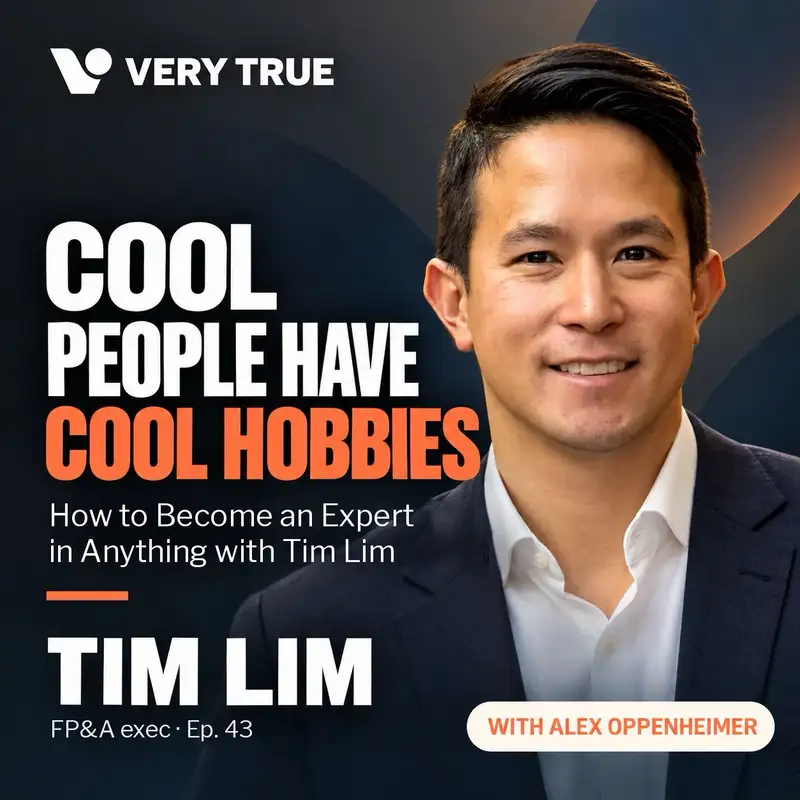
Cool People Have Cool Hobbies - How to Become an Expert in Anything with Tim Lim
In this episode of Very True, Alex sits down with his college friend Tim Lim, FP&A exec, whiskey connoisseur and Executive Director at Edgewood Companies, for a conversation that has nothing to do with FP&A. Tim and Alex both built careers in finance, and both go unreasonably deep on the things they do outside of work: bourbon, watches, wine, bikes, snowboards. This one is about what happens when you take that seriously.
They start with a question Alex gets asked constantly: what should I do with my career now that the well-trodden paths are gone and every college senior wants to be an influencer? Then they use whiskey as the worked example for how anyone becomes an expert in anything. Figure out what "good" means. Figure out what you actually like. Cut the world down to a slice you can learn. Find the people who are already ten years ahead of you. Along the way: the pitfalls (buying at the top of a hype cycle, not slicing thin enough, chasing rarity instead of taste), why a $500 microbrand watch is consumption but a steel Rolex is an asset, how the bourbon crash made the hobby fun again, and the John Mayer test for what a real maven looks like. They close on the harder question: should you turn your passion into your job, or does that ruin it? Tim, who moved into food and beverage for exactly this reason, has a more honest answer than most.
Episode Highlights
[06:22] Hope for America, via bourbon: Alex on why whiskey Facebook groups, with members from Kentucky to Hawaii, are the least polarized places on the internet.
[14:20] What "good" actually means: Tim on the bar for straight bourbon, the cult bottles, and the 1980s Wild Turkey Japanese export that retailed for $50 and now trades near $2,000.
[21:58] Cut the world: why the fastest way to build taste is to narrow the field. Weeded vs. high rye, two years of only Cabernet, and using AI to map the dimensions of a new hobby before you spend a dollar.
[27:24] The pitfalls: not slicing thin enough, entering a hobby at the top of its market, and why the middle of the whiskey market fell out, not just the bottom.
[44:32] Knowledge over stuff: Tim's rule for restraint. Learn on the way up, buy the one thing at the pinnacle of what you value, and let the secondary market tell you what's real.
[1:02:32] Hobby or job? Whether turning a passion into a business ruins it, why Tim moved into food and beverage, and the safer path of working at a company built around the thing you love.
Full Chapter List
[00:53] Welcome: career advice when the well-trodden paths are gone
[05:06] Tim's intro: engineering, FP&A at Netflix and Twitter, and the hobbies that stuck
[06:22] Bourbon Facebook groups and hope for America
[07:47] It runs in the family: growing up with collector parents
[11:28] Two different questions: what is good, and what do I like?
[12:30] Reddit reviews, Hard Water, and the friends who became a pandemic pod
[14:20] What "good" means in bourbon: the $50 Wild Turkey that now sells for $2,000
[18:27] Where a beginner should start: low proof, primary notes, learn from people
[21:58] Cut the world: weeded vs. high rye, two years of only Cabernet, three kinds of bikes
[27:24] Alex's mistakes: not slicing thin enough, and entering a hobby at the top
[31:45] Why the whiskey crash made the hobby better
[33:41] Buy low, sell high: the John Mayer Daytona test
[35:17] Should your hobby become your job? Plus safe bets vs. weird bets in watches
[42:13] Disposable income vs. assets: the $500 microbrand and the retail Rolex
[44:32] Knowledge acquisition over physical acquisition
[46:32] Limited releases, bots, and the six-month rule
[51:30] "Cool people have cool hobbies": the Dumoreau story
[54:07] Intentionality: the makers worth obsessing over
[57:36] Being the wine guy, and buying watches for other people's weddings
[1:02:32] Should you turn your passion into a business?
[1:06:43] The safer bet: work somewhere built around the thing you love
Links & Resources
Edgewood Companies: https://edgewoodcompanies.com/
Verissimo Ventures: https://verissimo.vc/
Tim Lim on LinkedIn: https://www.linkedin.com/in/timlims/
Alex Oppenheimer on LinkedIn: https://www.linkedin.com/in/alex-oppenheimer/
Verissimo Ventures: https://verissimo.vc/
Tim Lim on LinkedIn: https://www.linkedin.com/in/timlims/
Alex Oppenheimer on LinkedIn: https://www.linkedin.com/in/alex-oppenheimer/
About Very True
Hosted by Alex Oppenheimer, Very True by Verissimo Ventures explores the honest, unvarnished stories of founders and the real problems they are solving. We look past the hype to find the truth in technology and entrepreneurship.
Creators and Guests