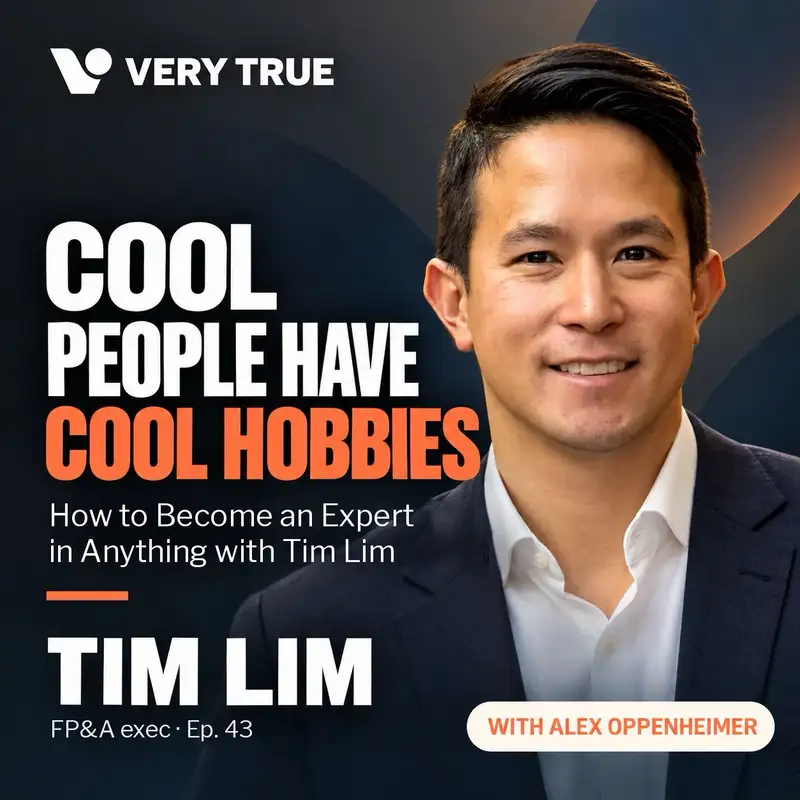
Cool People Have Cool Hobbies - How to Become an Expert in Anything with Tim Lim
Alex (00:00)
Everyone's got a hobby. The question is how deep you go and how long you stay down there. My old friend Tim Lim and I both go deep and we stay long. Bourbon, watches, wine, snowboards, bikes. When I don't feel like working, I actually use the exact same skills on my hobbies, same AI tools, same thought processes, same analytical mind, and even the same air tables. Today we get into how you actually become an expert in something, how to avoid overspending and get the most out of your hobby, and why the people you meet along the way.
matter more than the stuff. If you spend some time in a Facebook group about bourbon, it'll restore your faith in America. Then the hard question, should you turn your passion into a job? Or does that actually kill the thing that you love? Welcome back to Very True.
Alex (01:37)
welcome back to another episode of Very True. And today is going to be a little bit different. I have my old friend here, Tim Lim, who, like several of our other guests, has spent a career in FP&A. But that's not what we're gonna talk about today. even though we have a recurring theme of talking about operational and transactional finance and valuation and all kinds of nerdy VC stuff on this podcast. we're actually gonna
Focus on a whole different world. and it's everything outside work. But in order to get into that, something that I've been thinking about a lot lately, and what I see come up is people come to me for career advice. And they've been coming to me for career advice since I was zero years out of college. I think even when I was still a senior and I had gotten my job offer, people were coming to me for career advice. And then I helped run recruiting at Morgan Stanley and all this other stuff. And
What I've noticed over the last 15 years is that career trajectories have changed dramatically. And I think that the trajectory itself, that concept of there being a clear trajectory, is gone. I think from the baby boomers until 15 years ago, 10 or five years ago maybe, there were a lot of well-trodden paths that were kind of, I don't want to say guarantees, but pretty close to it. If you just do this and stay the course, then all will work itself out.
And I just think that now everything's come into question. And a lot of that's good. I think there's a lot of kind of lazy entitlement. and yeah, like people get sick of overpaying for lawyers and accountants. And so people are coming after those professions with technology now. And that's I think the natural progression, of capitalism and economic forces at play. You could say the same thing about you know, labor unions and then
The massive push towards automation and in inside factories. these things are not independent of each other. And then the other trend that's going on right now is like everyone's an influencer. Everyone wants to be an influencer. Apparently, they're asking kids on college campuses, what do you want to be when you graduate? And they're all like, I want to be an influencer. And then it's like influence about what? Right. Like, and a lot of it is they don't know. They just want to be a personality. And
I'd like to try to bridge those today. And I think that's generally what we're hopefully going to be able to successfully do in our conversation is bridge that difference, that that world that we graduated college into, which was like stay the course, do the career path, maybe you'll get some upside. Great. and then on the far end of the spectrum, there's like a you know, ASU apparently just launched a major, which is like content creation. which again, there's nothing wrong with like it used to be called journalism, media, whatever. We're just in the next iteration of it, but.
it's what a lot of people want to do now. And I think that what I'm telling people when they come to me for career advice is like, what do you actually want to do? You can kind of do anything now because it's so easy to set up a business to gain access to things, to gain knowledge. Like the world is your oyster. And so one thing I've mentioned recently is this concept of what does the world need? what are you passionate about? And what do people want to pay you for? And that's kind of the three-pronged.
career discovery conversation. and I just think it's changed a lot. And so one of the other things that Tim and I have in common is that we are, for lack of a better term, hardcore hobbyists. And I know it's a common thing for like men in their 30s to just go down rabbit holes. The question is how deep do you go down and for how long do you stay down there? and I think that he and I both go pretty deep and stay pretty long.
He might have me beat on a handful of these things. In fact, I know he does. And but these these passions, these hobbies, these things that we do outside work, I think there's a the the broad question that we want to explore today is turning that into a career. and then also one of the things that I've talked about with frankly, like my executive coach is when I don't really feel like working, I find I'm using the exact same analytical skills to
Go down these rabbit holes deeper and more efficiently. I'm using the same AI tools, I'm using the same thought processes, the same, you know, I run my business in an air table CRM that I invented, but I also have air table CRMs for watches and for whiskey and for wine. And I actually have a spreadsheet that I haven't moved to air table for all my air travel for the last 13 years. and so the crossover in both directions, I think, is is really, really interesting. So with that, I will.
Turn it over to Tim for an introduction. as I always say, take us as far back as you're comfortable taking us. And
I'll I'll hand it over to you and we'll we'll run with it from there.
Tim Lim (05:50)
Sounds great. Well, Alex, thanks for having me you know, on your podcast. And it's it's, you know, great to reconnect. And you know, I met Alex in college. We shared a lot of shared interests back then and you know, even as through the years we've we've continued to connect on as as Alex mentioned, the various hobbies that we've both picked up and there's a fair amount of overlap. so my background, we both were in mechanical engineering and
pursued like finance careers. I was an FP&A working in some early internet companies, you know, like Netflix and Twitter and Credit Karma and have kind of progressed through and tried to find careers and companies that really align with my interests. And you know, through those times, really a core part of my identity and as well as you know things that keep me
going have really been a lot of the hobbies and the people I've met, through these hobbies, I would say a big turning point would definitely be, the pandemic and and the community and the people I've met. I would I would really single out you know whiskey as as one of these communities that we really have built great friendships in. and Alex, you know and I share that common thread. But no it's
Alex (07:01)
I have to just throw this in here. I apologize for interrupting, but if you go
Tim Lim (07:05)
Probably.
Alex (07:06)
on some of the big groups on Facebook for whiskey, especially bourbon, you will re-energize your hope for America. I don't know how
Tim Lim (07:15)
Ha ha.
Alex (07:15)
else to explain it. You've got people in New York City, Kentucky, Texas, Seattle, LA, North Dakota, Hawaii, from all different walks of life.
all different socioeconomic levels, all communicating peaceably about a shared interest. And so there's a like
Tim Lim (07:32)
Absolutely.
Alex (07:33)
there's a bigger picture here. It's like, how do you kill this polarization that we're experiencing? It's like, it's through shared interests that just don't care who you voted for.
Tim Lim (07:40)
Definitely. No, I've you meet people from all walks of life from different backgrounds, different stages of life. and yeah, that common thread, it really does it keeps the conversations grounded on really interesting topics and no, I've I've really enjoyed it. I I will say there is a there is a ceiling and I I feel like I've reached something close to that, which has been an incredible journey. but I I really
have met some, fantastic people and learnt wonderful things, not just in terms of what is produced today, but, historically and and like learning about the industry as well as snippets of history as well.
Alex (08:17)
Absolutely.
Tim Lim (08:17)
so yeah, I we we can dive right in and talk about and
Alex (08:20)
Does I what I what I want to ask
Tim Lim (08:22)
dig into the topics that you
Alex (08:24)
What I want to ask is, does this go back to your childhood?
Right. Is this a lifelong
Tim Lim (08:27)
It definitely does.
I
Alex (08:29)
Not whiskey, hopefully, but
Tim Lim (08:31)
Yeah, no, it's a great question. I will say, I grew up in a in a household with with parents who were very much you know, I it come the apple doesn't fall far from the tree and I definitely learnt a lot of this hobbyist, enthusiast, deep diving enthusiasm and curiosity definitely comes from both of my parents. they're both avid collectors of many different things. And, you know, it's funny, growing up I never really realized it, but when you kind of look back and you
you
realize that, my for example, between the watches as well as wine, like that those are two hobbies that I certainly picked up from my my father. So and and you kind of make things your own and yeah certainly there are a lot of common frameworks that I've picked up and you know with technology nowadays the the the curve to kind of ramp up and learn has become
significantly steeper, I will say. and then there's the community, and there's no kind of discounting the fact that like I will attribute a lot of my growth and knowledge acquisition and even physical acquisition to many of the friends that I've I've made you know through the years, through the things that I've been passionate about.
Alex (09:39)
So I think the best way to kick this off and make it a little bit more relatable for people is probably just with one example. And maybe it's whiskey, maybe it's snowboards. I know a little bit more about whiskey, so maybe we can maybe that's worse, maybe that's better.
Tim Lim (09:51)
That's
Alex (09:52)
I don't know. but I think just kicking off with an example, because part of what we want to talk about today is the methodology. Like, how
Tim Lim (10:00)
Really?
Alex (10:01)
do you become an expert? How do you become a maven? How did like
How do you become, as we say in the in the Jewish world, a bucky in anything? And I think it applies to work, you know, whether it's learning AI tools and or learning enterprise software or learning how to cook or learning about whiskey. Like I think that these skills, like I mentioned earlier, are highly transferable. And so yeah, I think.
I'll let you pick which example you want, either one that I know a little bit about or one that I don't. It actually might be better to do one that I don't know about. And and you just walking through the process of just how long it takes, the tools you use, the mistakes you made, where you started, where you ended, and how you build up that, you know, that expertise.
Tim Lim (10:44)
Definitely. No, I I mean I think whiskey would be a good one just because, you know, it's something that a lot of people talked about. I also think there are a lot of resources and commonalities within that space that translate to many other other like more recent hobbies that I've picked up. But we can start with that and kind of dive into you know, other other areas as well. So, you know, for me, you know, I've always when I when I think about
this
bourbon in particular, like you know, the origin of the story for me. I I've always been interested in kind of like the the different facets and the different variables that exist within different hobbies. And for me whiskey was always one about like learning about the different producers, different eras, and then just like thinking about how it translates to you know,
friends I already had and what they're interested in. And honestly for me, I was always like a interested in making cocktails in in both in college and post-college and the experimentation then almost think think of it like cooking where trying to find unique ingredients, unique combination to see what works well and come up with, you know, very interesting combinations that I thought would resonate
Alex (11:52)
For
Tim Lim (11:52)
with my friends.
Alex (11:53)
the record, and we can cut this out if you want me to, but for the record, Tim does not get hungover. so
Tim Lim (12:00)
Yeah.
Alex (12:01)
if you're scratching your head, like, how does this guy do this? he has
Tim Lim (12:06)
Yeah.
Alex (12:06)
this magical thing where he doesn't get hungover. I cannot say the same for myself. but the the
Tim Lim (12:11)
No
Alex (12:11)
the other thing that I would I guess one framework maybe to start it is
We'll we'll actually get to like the higher levels where one is you figure out what actually good is. Right. I think in most of these areas, there is an agreed upon like this you're in the realm, you're the conversation. This is a universally respected good thing. Then there's what do I like? Not just like you're not just solving I this as if it's a closed end problem. It's what do I like? How do I understand my own tastes? How do those change over time?
And that applies to whiskey, watches, bikes, whatever it is, all the same. And I think that's that's probably what makes this interesting relative to maybe some of the more career-oriented skills out there is that it feels like there's like an answer, right? Even if you're gonna become a doctor, there's like a handful of specialties and like you kind of pick one. But that process of discovering, like, okay, you did med school and now you gotta figure out if you want to be a heart surgeon or a dermatologist, and
What are those things that help you figure that out? There's a certain level you have to get to. but anyway, I'll I'll hand it back to you.
Tim Lim (13:13)
No, I I think that's a great call out where, you know, when just going back to the original, you know, to talking about whiskey, for me, the initial prompt was, you know, my wife, when I met her back in 2014, like I she was she loved bourbon. I was pretty new, or at least considering it to be something that you dive into and just wanted to explore and learn more about the space. And to your point,
you you think about the framework and how do you understand what good is. And then you leverage resources. And for me, you know, initially it it comes you go to stores, you go to like purveyors of of the product. And and for me, honestly, Reddit was a really good resource early on. And I met some incredible intelligent people, and I would start writing reviews. A
Because I think it just helped to reinforce and build my confidence and understanding the hobby. But B, then you meet people that are like minded and, have that same passion for the hobby as well. And, you know, I I I learned that a few people were also in San Francisco. They actually saw my reviews, saw that I was actually one of them was writing a review at Hardwater, which was a a great establishment in San Francisco that is no longer open.
But I wrote a review of some bottles that they had that are honestly historically incredible and connected with them in in person. And this was right before the pandemic, they became really good friends. And, you know, through that time of being you know physically isolated, like we became we we pretty much shattered every day. We spent more time with each other than I would say most people do, you know, even even in work environments. So it was really, really incredible to connect with that community.
And yeah, I think what I learned from that process is you have like your your kind of standard definition of good. Then you really find people who are upset.
Alex (14:59)
So what is that
for bourbon? just just give it over for bourbon. What is good?
Tim Lim (15:05)
I I think the bar is pretty high when it comes to bourbon just because of the standards that that are required to call something straight straight American b bourbon. and I think you know you you have your your big producers, you know, your Buffalo Trace who makes your you know Pappy Van Winkle, your your Weller, and then you have more niche products, you know
I kinda have my some of my collection up here, like right next to me, where they're more specialized but have cult following. So, you know, one example right here is it's a a wild turkey bottle that was produced in the eighties and early nineties. And it was back when there was a bourbon glut when it wasn't quite as popular in the US and they s they sent these over to Japan. So like the specific bottle actually
Is a Japanese export that made its way back to the US and into my hands. but you know, I I think you you meet people who just like catch on to very specific niches within the hobby, and then you learn like what makes them what makes them so obsessed with it. And and sometimes, you know, thinking about ways to learn about good the secondary market and looking at what put people are willing to pay versus what are
what
is it originally, what is the original MSRP of these products? And you know, for that wild turkey bottle probably retailed for about fifty bucks back in the day. And I think that specific release now goes close to $2,000, you know, on the secondary market. And, you know, I then then you say, okay, what's the hype? Like why do people love this bottle so much? And and it you naturally then try to track one down, whether you go to a bar that might have, you know, pores by by the ounce or you find a friend or even
yourself acquire a bottle and then you you open it and you learn, okay, what what really makes this so special? And, in many of these hobbies, sometimes it comes down to just rarity. And sometimes rarity doesn't really give you good. It just gives you collectible, right? And then you have bottles like the one I just showed you where there are facets that are just so special, so unique that you really can't reproduce today, the way in which it was distilled in Cypress tanks, there's
back then because it was a glut era, even though it has a twelve year age statement, some of the the whiskey inside is close to the sixteen to eighteen years old. And you just try things that are so incredible that you realize why people chase you know, why there is such high demand for these products as well.
Alex (17:27)
So
I I would say we are now talking about not good. We're talking about excellent. and so what I what I think would be interesting is just let's let's go back. I think it was, I want to say it was May of 2019. And we met up in San Francisco and you took me to Hardwater. And I had gotten into bourbon a little bit just like drinking it at at Shul with friends and and you know.
various Jewish events with a couple of my buddies who were into it. And you were like, Let's go. And you you started walking me through
the actual methodology of here's what you're tasting, here's what this is, here's what that is, here's how this actually works, what is this thing? because I think that the experience that people have is they'll try something, they'll like it, they'll hear people talking about it and they'll like that part too. But then there's the connecting the in between. Like what are people actually talking about? you know, as an example, you know, when I I took out some whiskies that I hadn't opened that I had for years,
weeks ago when I some friends over for Shabbat dinner and I was explaining that like you know I have these simple things where I'm like for under a hundred dollars it's very rare to find a bourbon that has an excellent and noticeable nose palette and finish for for under 50 you're lucky if you get one for under a hundred if you're smart you can get two but
Trying to find all three for under a hundred is very, very uncommon. So that's one of my hacks that I through all the years that I've narrowed it down to. So how would you walk like again, someone who's obviously of age, but is like, hey, I've been I was at a thing and someone had some bourbon and it was good. And I I could see, I could start to see that I might like this. What should I, what should I do?
Tim Lim (19:10)
Yeah, that's a great question. I think certainly first understanding where you fall in the both the price and commitment range is is important. But I think under Yeah.
Alex (19:20)
And then double it. It's sort of like doing construction on your house. It's gonna take twice
as long, and you're gonna spend three times as much money.
Tim Lim (19:26)
And exp have your expectations and and be flexible, right? But I
Alex (19:30)
Ha ha
Tim Lim (19:31)
think I think, you know, with with bourbon specifically, you know, I've had many friends who've like to your point, they are interested, they want to learn, they you know, they come to me and they say, Hey, I want to I want to basically discover what good is or what like how do I think about a framework in this hobby? And the way I think about it is you
You set what is important to you, and you whether it's value, whether it's whether it's quality, whether it's you know uniqueness or rarity. And then you you come up with a baseline. So there are several big producers, you know, like Buffalo Trace, Wild Turkey, Heaven Hill, you know, and you kind of sample each one and you you learn, okay, what is universally regarded as good, and there are
many resources, whether online or people you know that can tell you what they like and and you understand what other aspects, whether it's palate, whether it's nose, whether it's finish, that you enjoy about it. And I I find, especially when someone's diving into spirits for the first time, there's there's a there's a hump to kind of cross with like the proof and and really being able to taste beyond, you know, the initial alcohol burn.
And so I I typically introduce people to know bourbon or whiskey that is relatively low proof so that you know the the focus is on flavor and not how much it burns your the top of your you know your palate. and then you learn, okay, what what notes do you like? So there's kind of like the core framework and the primary flavors you get. And then there's like the tertiary things that make some the secondary and tertiary notes that make something special. And I will say the good ones.
Have very strong foundational primary notes and nothing that's secondary and tertiary that puts you off. And then you learn, whether it's the influence of the barrel or the influence of the corn or the other components of bourbon that you like. And then you then learn, okay, what made this, what elements made this bottle something that I like? And then you kind of go down that channel.
So
whether it's the way in which it was produced, whether it's ingredients that were used, the way it was aged, how long it was aged, you then take that and you discover. And I will say for me, especially with something like whiskey, it really was so helpful to learn from other people. You know, I've I've like for example, there was one guy who I would write reviews and it was about a producer
named Barrel, Barrel Craft Spirits, and he would always comment on my on my reviews and kind of give me additional feedback and nuggets of wisdom. And I I would really learn so much from his approach to reviewing whiskey to the extent that you know he is now part of well like we we created this Slack group that we we use to really talk and and like develop our knowledge of
of not just whiskey but of many other hobbies as well. And I I think like that's one example where we would learn about the k the key components that I really liked and what made it appealing to me and then really dive deep and then learn a lot about that specific producer, what I liked, and then see, okay, are there other producers that have similar kind of like qualities that
that translate that also I'm interested in as well.
Alex (22:41)
Yeah, that's awesome. So I would add, I guess I would add two things. One at the very beginning, which is, you know, like I said, I started drinking bourbon with some friends in Jerusalem. And then I don't remember maybe it was like something you posted on Facebook where I was like, Tim does bourbon. And like Tim goes deep on stuff. Next time I'm in San Francisco, like, we'll hang out. And I think one of the first steps is figuring out which of your existing networking friends forget new people already. Like
Who of your existing networking friends is already into this thing and you just didn't know that they were into it yet? And that's always a fun discovery when you figure out people that you've known for a long time are on something and then like you figure that out on a Facebook group, you figure that out on Strava, whatever. but that's always I think a valuable place to start. and then the second thing is I I'll give like a very tactical example of that. So you're talking about producers, but
For example, one of the things you might learn early in a bourbon journey is I like wheated bourbons or I like high rye bourbons. and that's something I think that really helps with the problem that you run into right after you scratch the surface and then you realize there's a whole ocean underneath it. You're like, how could I possibly ever get my hands around this? You need to figure out ways to cut that.
the whole world. So you say, okay, I like wheated bourbons. So then you just start saying, you know what? I'm just going to focus on wheated bourbons. That's not to the exclusion of everything else, but it at least provides some limiting factor which will help you avoid getting completely overwhelmed and say, let me go try five more wheated bourbons and try to taste the nuances there. I'll give a I I guess a story for myself. Like when I started getting into wine like 10 years ago, I
was like, I'm gonna do this with a method and focus on small differences. So for like two years, I think I only bought Cabernet Sauvignon.
That's it. And I would buy bottle after bottle, within a couple year ranges of each other. Because I was like, you can't actually figure out what a bottle's about until you've had three different actual bottles of it. And then if you can start tasting the difference between the 18 and the 19, or the 16 and the 17, then you can start to actually get a feel for it. And you you you form a more nuanced basis for what to use going forward. So that when you drink a Syrah,
You can actually appreciate it. And you're not one of these memes where you're people like, what do you think of the wine? You're like, I think it's red, but I think one of the things that happens is you you start getting overwhelmed. You're like, I don't I I can't even wrap my arms around this. There's just too much out there. So I think one of the first, I guess like tips I would give is like figure out how to cut the world. Like, where are the cuts? Like if you want to get into biking.
Okay, there's a few kinds of biking. There's road biking, there's mountain biking, there's gravel biking, or you can be a psychopath like me. And behind me, I have all three. and they each have their place. And then there's different kinds of road biking. and you can cut the world that way. And you can say, now I can cut the world. And I think, I guess part of the process, what comes out of this, is that ability to make those categorizations. And frankly, I think AI is quite good at this. So if you're getting into something, you can say,
Give me a couple dimensions through which I could cut through an entire area. use a bikes and say, okay, Gemini, Claude, whatever. Like break it down for me. You know, give me how to break down bikes. just at like a couple different dimensions at a high level. And it's like cheap, expensive, really expensive. there's again the three disciplines that I mentioned. There's group versus solo.
there's so many different you know, there's short rides, there's long rides, there's there's racing, there's, you know, there's so many different angles on it. And I think that trying to get your hands around that early is probably one of the best ways to frankly avoid a lot of pitfalls. So I think
that's
Tim Lim (26:22)
Yeah.
Alex (26:23)
where we'll go next is some of the pitfalls.
Tim Lim (26:25)
absolutely. No, I think everyone know, when they start a hobby, there are many pitfalls that that you can you know that that come up and I think having a very clear framework going into it is very important. You know, I think I love the the wine analogy, you know, and obviously talking about bikes as well. You know, for me I think you know, living in Tahoe, snowboarding is absolutely one of those where
There are so many variables, right? There's camber profiles, there's materials and board construction, there's the the the design of the the the different topsheet materials. I think it's it's it's really easy to get lost and not know what you like. So setting those parameters and understanding, okay, how can I understand exactly what I find most
interesting and most important to me in this in this hobby is really important to do early on so that you as an individual understand. And I think as as you pointed out, AI is a very helpful tool and certainly it's helped me and some of my more recent endeavors to really accelerate the learning and the the structuring and of of learning about new things that I've been interested in. But then once you
understand what's important to you, that's when you then tap into into what you know you find engaging and what you what you really want to build knowledge in and I think that's where the community and your friends become extremely important because you know they've probably gone through that experience and they've and many of them have have had those pitfalls and you know you kind of learn from lack of a better word their mistakes and
And so you don't fall into those same mistakes, into those same pitfalls as well.
Alex (28:05)
So should I start with some of the mistakes that I've made?
Tim Lim (28:07)
Let's ahead.
Alex (28:08)
so I would say actually with wine I did a pretty good job because I cut it to a certain range of wines. so another another thing that you you get is until you've gone deep enough in something, especially where it's like taste, you're not gonna be able to appreciate over a certain price. Like the marginal utility just crashes. And you might be able to say, wow, that's really good or whatever. And that this is frankly more for I think consumption based hobbies than
Tim Lim (28:32)
Knowledge.
Alex (28:33)
watches, but maybe also for bikes. you get on a $15,000 bike, if you suck at biking, can you really tell it might feel and look cool, but you you haven't earned the right to appreciate it yet. And so you can waste a lot. And so I think yeah not slicing thin enough. So when I did it with wine, it was like cabs only, Israeli only, and within a narrow range of prices.
And then I really started to taste the nuances and develop a profile for different wineries and other flavors. And then then when I started drinking blends and other, you know, actually have a basis to go off of. So I think that just randomly trying a lot of stuff without any rhyme or reason is probably a pitfall where you're like, I haven't accumulated anything. Unless you're ridiculously disciplined and like after every time you try something, you're like,
Taking notes, writing reviews, and then you can basically throw all that into AI now and have it distill, no pun intended, something that's actually useful. But that's already a stretch. So I think that one would be not slicing thin enough early on. Another one, frankly, for me, is not taking time into consideration. And it's hard to know when you enter a hobby.
If you are actually in a moment in that hobby that you just ran into it and it's it's like on fire in a good way. So I'll give another example like micro brand watches. like two years ago, I got into micro brands and I just started buying a bunch of them because they're cheap and they're cool and the value is very high compared to a lot of other things. And
I still am not totally sure if it was a moment in microbrands. It felt like it was, but because I wasn't in the watch game and in the microbrand game for like years before that, it was really hard for me to contextualize it. And I think this is where like the more venerable friends come into play because sometimes you're at the top of a market, sometimes you're kind of at the bottom going up, sometimes you're at the bottom going down. sometimes you're nearing the peak. And there's so many different factors that.
in that. And without the historical context of how these markets have behaved, I think it's really hard to know. And so the answer might be that right now is just an amazing time and you should be going headlong into it because this is a unique moment in this market. But more likely than not, if you're actually going to get into this, it's probably better to figure out early how to like pump the brakes so that you can maintain whatever you're doing for a longer period of time and start to see these waves go up and down.
And obviously we've seen that with whiskey. I was just in the US for a couple of weeks and I was texting Tim as I often do when I'm like in a liquor store, being like, Hey, like I never used to see this on shelves. Like, what's going on? Should I just be buying this? And because the whiskey markets have kind of crashed, the demand is just down that like stuff that was ungettable is now highly gettable. And now you've got to actually be buying something because you actually like it.
Not because it was just hyped up and you, I'll store it and it'll be more worth more later because guess what? It's not. And by the way, it might have been six years ago or seven years ago, you bought something, you're like, I'm gonna store this because again, whiskey doesn't age like wine does. but it does, I don't know what the right term for it, it it accrues. I don't know, it it it gets a certain,
Tim Lim (31:43)
Yeah.
Alex (31:44)
you know, I like for example, a few years ago.
I bought a handful of bottles of a blended American whiskey called Yippie Kaye, made by High West, based in Utah And it's like the a rye bourbon blend, which is just excellent. Not particularly expensive, but it's excellent. And I had like I had drank one bottle over the summer. I was like, this is amazing. And I bought a few more. And it's like, I'm gonna save these for later. And like nobody cares about this bottle now. And and part of that's because maybe no one was ever gonna care.
But part of that's maybe just because whiskey just ain't what it was. people always care about the papies. Like there will always be liquidity in that super high end of the market that like any most laymen know. but you got to know that like the middle can fall out, not just the bottom.
Tim Lim (32:28)
Yes. absolutely. No, I I think t to to reinforce that, I think, you know, with many of these hobbies, you can get lost in the chase, in the hype and looking for things that are allocated that have high secondary value. And I think that it distracts you from like the real value, which is like understanding what you like and understanding what's important to you and
for me, the thing that's really I've found the most rewarding has been understanding what I like about it, understanding what the people I care about really enjoy, and sharing that sharing that that knowledge and that passion. I mean, for me I think the thing that gives my hobbies the most oxygen is is the community and and understanding like
developing my own personal knowledge 'cause if you if you chase things just to try to chase value or even, God forbid, like you're just trying to, you know, flip and and make money from it, then then you you know, when if you as you say, if you enter the hobby at the wrong time, whether it's at a peak or on the on the decline, you end up you know, leaving with a with a bad taste in your mouth where you you kind of are disappointed by the experience that you have and
I almost like I really like where whiskey is right now because you can actually enjoy and learn, what you like not having to navigate this, you know, the these the secondary market dynamics where you can actually find a bottle of say Weller or like Stagg on the shelf and and and get it at a good price rather than having to, you know, pay someone two to three X what the MSRP is just to just to try it, right?
And I think it's it's really made it much more accessible, which I think is fantastic. And I think that really is it it really is what makes a hobby great. It's like being able to to experience it for yourself and not feel the barriers that, you know, when when there's a lot of hype and and like people who are in it for different reasons rather than just to learn.
Alex (34:25)
Sure. I think it comes back to one of the oldest adages in business, which is like buy low, sell high. And if you enter a hobby when it's obviously super hyped up, you're high. So, like it might it go higher, yes. But most of these things that have been around for so long tend to fluctuate. I I would say that the if you look at a lot of people who've become like mavens in certain things, like I'll I'll give an example, like John Mayer and watches.
He had an interview 20 years ago. I think it was 20 years ago, where he started buying watches. He just got into watches and they asked him why. And he said, I bought a fancy car, I crashed it, I almost died. I realized I need a new hobby. That's not gonna kill me. And he got into watches. And he is now known in watches as like the king. he's getting, he has things named after him. I think the previous
Daytona Rolex that had a name on it was like Paul Newman. And now there's a John Mayer. and
Tim Lim (35:16)
Yeah.
Alex (35:17)
it's because he wore it on stage and it was a watch that like was in the collection that was buried that nobody cared about. And it's basically the a yellow gold Rolex Daytona with a green face.
Tim Lim (35:25)
With a green face, right.
Alex (35:27)
And that's that's a John Mayer. And that's not because he got into watches when watches were hyped up. Like if you look at a bunch of rappers and actors wearing super fancy watches now.
They got in when it's hyped up. And look, if you're Mark Zuckerberg and you have effectively infinite money and you want to get into watches at the top of the hype, go right ahead. I always say, relatively speaking, I'm more into watches than Mark Zuckerberg is, even though he has s one of the craziest collections out there. Why? Because a larger portion of my net worth is tied up in watches than than that that's equivalent metric for him.
Tim Lim (35:58)
When
the base
is that big then Yeah.
Alex (36:01)
But
yeah, I think again, we we started off with this idea of what's your taste versus what's considered good. And I think that there's a there's a blend there. There are brands across every discipline, right? I I'm the ones that pop into mind. It's the first thing that pops into mind. So talking about bikes, you got specialized, right? Talking about snowboards, you Burton, right? Talking about whiskey, you have the entire Buffalo trace line, right? if you're talking watches, you have Rolex, you have Omega, like.
These things that have been around for decades, if not centuries. And you kind of can't go wrong there. And I would say that when you're in that world, I I I think another area that's worth kind of talking about is and that'll foray into our kind of like next area turning this into a business. Like we k like we started off with like how do you you learn all this stuff, you get really smart on it. Two big questions to ask is one.
Do you actually want to make your hobby into your vocation? Or does that ruin the hobby? I I feel like I have to tell a little bit of a story here. So when Tim and I were in college at Stanford, we I'm trying to think of the best way to tell this story. we drank a lot of beer. And we used to play games, beer games.
Not like cute at a party, in a basement on a Wednesday night for two hours. And you get so good at these games and you become so competitive and so idiosyncratic and so superstitious that it actually kind of takes the fun out of it. Right. And like you hear this with professional athletes too, where they're like, you know, they like basketball players that are seven feet tall.
And they retire basketball. And they're yeah, I haven't picked up a basketball in a decade. it's sad because I'm sure when they were a kid, they had some joy in it. And so I think that's before we get into any of that, I think that's important to recognize. do you want to save this as pure hobby, vacation, escape, whatever you want to call it? Or does it start becoming, in college it for us, it was socially competitive, but nonetheless.
It took some of just the broader joy and replaced it with like this competitive joy, right? Like everyone at Stanford played some form of throwing ping pong balls into red cups. we did it on a completely different level. I mean, like it's the difference between like I was in Cape Cod over the summer and I sailed around the cove in my friend's Hobie Cat. That's cool.
It's like there's between that and America's Cup. they are completely different activities. And yes, they're overlap, and but it's like, can you still enjoy it? So that's the first question. And then the second question is like before you go like deep, deep, deep and you develop like really refined taste, how do you kind of play it safe? And I'm just gonna call it out because we both are wearing very different watches right now. You are wearing, I would argue,
the most classic, safest bet, cleanest watch in the market. And I don't think it's novel for me to say that because it's a stainless steel black Rolex Daytona. And it is like
I'm trying to think of something to compare it to, but that's the thing that people compare other things to. and on the other hand, I've got this watch called a Ming Bluefin, which is a dual-crown diver that is made by a former watch photographer turned watch designer. And it is weird. I mean, it's got a sapphire face, and the markers are etched on the inside of the domed glass.
Crystal and it's got a crazy shape and a weird strap, and it's unique and it's cool. And it's hard to know when something like that is actually cool versus just a gimmick for like a few moments. Whereas a stainless steel Rolex
Tim Lim (39:33)
No, I love that you discovered that one.
Alex (39:35)
Daytona is I I'm trying to think of an example to compare it to for people who might not know watches. yeah.
I I can't even think of a good example. Why can't I think of a good example to compare it to?
Tim Lim (39:45)
Yeah. No, I it's no it's it's great that that you know I it was amazing it was funny when you shared that picture of that that Ming Watch, you know, the he's actually a Malaysian who's good friends with my my older sister and you know, someone who I I know is extremely passionate and just an i an incredible hobbyist and decided, hey, I'm gonna take go into this and go like
extremely deep into that and it's it's really cool to see that, the Ming brand has become something that's you know, globally, globally known as well.
Alex (40:16)
I I have to imagine as a watch photographer, he wasn't he was either taking photos of watches for fun and then realized there was like a market need for that. Because by the way, you see these beautiful images of watches. That is not simple. Taking good pictures of watches is quite difficult. or he was some other type of photographer and had a passion for watches and blended those two together. that has to be the case. So
There's a I I would love to hear his whole story and and hear how that developed. And then it was like, again, let's he was making money as a watch photographer. That was his main job, I believe. And and then started designing watches. And it's a really interesting, I think, case study where you have someone who is taking photos of watches. So he understands how they reflect light, what angles look good, how they look on the wrist, all the detailed nuances that a a a a glance
even someone working in a jewelry store handling them would not notice. He noticed, and that goes into his designs, which is very unique.
That probably applies to a lot of other things. I know for example, again, this probably isn't quite as novel, but there's a cycling brand called Q36.5. It's very expensive stuff. It's like $400 for a pair of bib shorts, $600 for shoes, like crazy expensive. And the founder is just like the former like head of engineering at ASSOS, which is one of like the OG high-end Swiss.
Cycling brands. So it's like he already knew what was up. And then the question is, can he put the rest of it together? he was on the technology side of it, the actual product side, and then turn it into a marketing sponsor, a team. Like that whole world, is there something to be built around it? but anyway, so we talked a little bit about pitfalls, and I let's just kind of wrap that up before we kind of keep going. But I would say the one one is like,
Trying to do it all yourself. you know, not seeking out existing friends, finding new friends. the second is not pacing yourself and just going too deep down the rib rabbit hole too quickly. And, you know, I I there's gotta be people listening to this going, like, well, you guys are just like, you know, wealthy and you just have money to spend and whatever. And like, I think it's all relative, right? Like there's a large swath of people that can spend some amount of money.
And so where you fall on that spectrum, fine, so be it. everyone kind of can do this at their own in their own way, in their own budget. I think, you know, maybe not every hobby works like that, but a lot do where there's like large gradient. but at the same time, like you've gotta set a market, set a budget, talk to someone who knows, who's been down the rabbit hole and
Be like, what's what's reasonable? Like, this is how much money I actually think I might spend on this. And then know that it's it's gonna change because you're gonna start to understand. For
Tim Lim (42:55)
Definitely.
Alex (42:55)
example, that with watches, when I buy a $500 microbrand watch because it's got a very cool, unique design that is not just an homage to something else. that is what I call disposable income. That's a discretionary purchase that comes from disposable income. Like that.
As a resale, it's irrelevant, maybe you get your money back. But that's not really why you're doing it. You're doing it as as almost consumption based. Whereas when you get into some of the higher end stuff that is actually known to hold its value, that's not just on a hype train, you can actually start pulling from other sources of capital in your life. you know, if you're buying Rolexes at retail, you could.
Again, I don't want to go so far as I'm not gonna give not giving financial advice, but if you're buying Rolexes at retail, you could take that money out of savings, out of investment accounts, because it's actually an asset. Now, I would not say that about almost any other brand. even like I would say yes about Patek Philippe, but I wouldn't even say it about like out of RPK, because over the last 40 years, they've been up and down and up and down and up and down and changed a bunch of different things. And so right now in the last
Seven years, it's one of the hottest brands out there, but been a lot of ups and downs. and some of the older stuff they made is like just nobody wants it. so
Tim Lim (44:10)
Yeah. No, I well
Alex (44:11)
Figuring out that
is probably a very large piece of it. And it's like I it at some point in your network, you find like I've found I've like my person that I feel aligned with that gets it. So like frankly, in in whiskeys, like that is Tim. in watches, I have another friend named Josh, where like he's in the watch business. Like he runs an auction house for watches. And I'd love to actually have him on too. And he's also a hobbyist. And
I'll something new will come out and I'll just send it to him. And he'll be like, that's really cool. Or he'll be like, you don't need this. And it happened today, right? Like there's a a micro brand watch company based out of New York called Brew, which is run by one guy. He's the only employee of this company. It's called Brew. It's a little like coffee themed. They make very cool, unique stuff. There's you know, kind of a theme through the whole range. And he just did like a limited release.
For the US Open, 250 watches that are tennis themed. And it's based on his like standard design, called the metric. And I just sent it to Josh. He's like, Yeah, it's kinda cool. You don't need it. Like, don't buy it, dude. Don't like, don't do it. so anyway,
Tim Lim (45:15)
a really good way to understand whether something is worth investing in is is to look at the secondary market and you know, are other people trying to get this and you know there's the f there's kind of artificial scarcity where they say it's limited edition, they say it's one of s you know, f fifty or a hundred or whatever that number might be.
But I think the secondary market really gives you that indication of value where you can understand is it worth diving in or am I just gonna be academically interested and then learn about it and then move on? And and certainly the more I've picked up new new areas of interest, the more I I say, okay, I'm gonna focus more on knowledge acquisition rather than physical acquisition of things. And you have to to enjoy something you also have to
buy a few things just to really experience it and have that kind of tactile and physical like connection to to the hobby. But I think mo I'm more and more I I really try to be more restrained with how I approach you know the acquisition side because otherwise you end up with too much and whether your constraint is is money or space or you know having like
know where to store these things, you know, can definitely c kind of dive too deep. And then you look back and you're like, why did I get all these things? And the approach I've taken is like learn on the way up, like figure out what you really like, kind of going back to the the specific, you know, variables that really value, find the thing that is kind of at the pinnacle that, that is within your price range and that you really value, like get that, enjoy it and you know, experience it. And then, you know,
maybe maybe you keep it, maybe you s maybe you sell it, you trade it away, but ultimately like I think that's a a good way to to learn where you're you know you're leveraging forums you're you're leveraging online groups or forums or friends to really to really build your your expertise or your your knowledge in a in a space.
Alex (47:10)
And I think
a lot of it, it does come down to taste and developing your taste. And your taste may align with the broader market and it may not. And I don't think I think you reach a certain point where you're like, this is my taste, and like I just don't care. And the market may come my way and it may not. And one thing that I will call out, because when you do see these like limited releases and stuff, you know if a brand has staying power, but some of the newer brands, like,
You don't know how good the thing, how how how the community will respond. One mistake that you find is like people just using bots. So for example, there was like a Seiko limited release recently. And I was like, you know what? It's a $350 watch. I think it's pretty cool, suits my style. I'm just gonna grab one. And they sold out in less than five seconds. And that's because people hack Shopify and figure out how to use these bots and like.
Do all these hacks and then they're all gone and then everyone's just flipping them for 2x or 3x immediately on the secondary market. Now, with those, usually the answer is they made like 2,500 of these things. It's not like that limited. Give it six months. If you still like it in six months, then one of two things will happen. Either it's not going to be at 3X anymore, right? Andor it's going to be below, right? It's going to be at like 75%. Cause all these people bought these in like,
Just because it was limited and it just didn't go. And maybe it got previewed and some magazine picked it up and said it was going to be like the release of the summer. I you never really know. but what I will call out, and I'm sure you've experienced this as well, is when you see something that's limited to 250 pieces, and it pops up, you happen to be there, you grab it, and then you go back five minutes later and they're sold out. That is a great feeling. there is just something that's
That it if you've experienced that, it's a great feeling. And I think that there's probably a way to split it. That's again, I'll I'll talk about just the emotional feeling of like, like I got something people wanted. I had that experience. I remember the first time I got like a watch email from a blog to watch. And there is a micro brand company that's not such a micro brand anymore called Christopher Ward. And they did a collab with a jeweler that does a lot of collabs out of the Netherlands called Ace Jewelers. And
They make a watch called the 12. And in Hebrew letters, 12 is Yud Bet. And so they made a version of this watch that had Yud Bet on the top of it. And it's called the 12 and it's Hebrew. And I was like, that is so cool. And I clicked it and I and they made 50 of them and I immediately bought it. And my view on that was like, I don't care if it's worth nothing tomorrow because like I don't think I'm ever gonna get rid of this watch. I just think it's like a really cool watch, Hebrew, like awesome.
And I think that that is a version of affinity taste that it's important to be sensitive to. and again, that might change. I might be like, you what? I haven't worn this watch in years, I don't really care. Like, I'll just move on. But it is, you know, a special piece. There's the other side of it where when something does sell out really fast, even if it's a small volume, like I bought a Baltic, they have a watch.
Called the Hermetique, probably not pronouncing that up to French standards, but it's like a field watch style. I have small wrists. I was like, that's a nice watch. And I actually was gonna buy one of their like regular ones. And again, I actually was getting on a plane. I was checking my phone. They released this like special edition one that has like dual time zone with two crowns. Again, they sold 200 of them. I bought one, it sold out very quickly.
And then again, for the time after that, those people who missed it or they discovered it a little bit later, the prices go up on it. And I I think that going back to like this curve of like the upward stroke and the downward stroke, as a market's getting hotter and hotter in general, like bourbon got or like watches have gotten. and as people get into it, they go, I really like this one and I missed it because I just wasn't aware.
then they're likely the ones who are buying that secondary at a premium. Because otherwise, who and why? So there is a little bit of kind of like, I don't, I don't want to go so far as to call it like the greater fool theory, but it's like the next best buyer. I don't know what to call it. But if the market is not going up and to the right, then that won't happen. And my general view is you can also put these things, again, I'm mostly thinking about
I I guess a lot of these things. Not the maybe take out the pure consumption based stuff.
But you
Tim Lim (51:18)
Yeah, yeah.
Alex (51:18)
could put it on a on a daily rate. I I saw a funny meme recently, which was a Rolex submariner costs $11,000. And if you amortize that over five years, it's like $5 a day or something like that. And then it was like Starbucks, like $7 a day for five years is like $14,000. which one would you rather have? And so that's a dangerous game to play. but for something like a bike.
Right. there are collector bikes out there. That's a very niche, very small market, basically antique road bikes. but bikes they depreciate and they depreciate fast, and that's how the industry designs it. Like they they just become obsolete, they wear out. And so when you buy a bike, like if you're not using it, get rid of it. Because it's just sitting there losing value every day.
Tim Lim (52:07)
yeah.
Alex (52:08)
Whereas watches, you can do what I call you can have it for free. Right. knowing that you could sell it, you bought it in a place in the market that you, again, once you learn where you feel like there's stability, and know that you could sell it kind of if you need to, or if you just are over it and want to buy something else and not take a loss or not a meaningful loss, that matters. Right. There's there's a very niche watch brand. I gotta tell this story.
So I tried to get this guy on the podcast, but he was like, I'm very private person. So I'm trying to just respect that, not say too much about him. But there's a watch brand that's like a niche, like Swiss California collab called Dumoreau it's D-U-M-O-R-E-A-U. And they just make like a couple different watches. They're very nice, very elegant, understated. And I just
never like they don't sell out super fast, but they have older versions that they don't sell anymore, different color colorways. And I was just like, I could never like if it was one of these things where it was if it was 25% cheaper, I would have bought it, even if like that was the retail. And every once in a while, once you kind of you find yourself, you continue to come back to something, I'm I'm still checking that watch. I like I it still is catching my eye. It's it
Tim Lim (53:17)
Mm-hmm.
Alex (53:17)
it's not just like an instinctual thing.
Six months later, nine months later, a year later, that watch is still catching my eye. And you go search eBay, you go search Chrono 24. I see it for sale. I negotiate it down a little bit. I grab it for about 30% below retail. which again, this is like a $1,200 watch retail, it's like $900 I spent on it. And you're chatting with this other person, which again, this is kind of like it's not always like this. It doesn't always happen, but like.
Cool people have cool hobbies. I'll just say it. Like that maybe that'll be the title of this episode. Cool people have cool hobbies. The
Tim Lim (53:50)
Ha ha
Alex (53:51)
guy who was selling this watch had one of the coolest roles. He was the CEO of a company. Cool, unique company. And I'm like, you just don't like, I would never have met this guy. I mean, when we haven't met in person. Maybe I'll see him when I'm in New York in a couple of months, but like, you know.
We connected over watches. He comes from a totally different world. He's not like a tech guy. it's in a totally different business. But he was moving on from it because he went down the microbrand rabbit hole and was like, I'm not wearing some of these things anymore. Like, let me get out of them. And for him again, did he get three hundred dollars of value out of owning this watch for a couple of years that he had it for? Yeah, probably. You know? so anyway, I think there's so many different, you know.
Some some people might be listening to this wow, you've really convinced yourself that this isn't a terrible way to spend your time and money. and I don't know, maybe that is. maybe that is the case. But there is I I I mean, I'll I'll hand it back to you, Tim, but we can sort of take it to the to the next step here.
Tim Lim (54:45)
Yeah, no, I I I think you you kinda hit on a few points that I think are usually important to me, which is there is an intentionality with some of the details with some of these products, whether they're micro brands or even in with some of the the larger brands where you relate to them and you you you see the intentionality of why they make certain decisions in in the product and how they you know what they express through that product. And I think to me
that's always been something that's been magnetic for me where, you know, there's this there's this intentionality that they have that that you know every single little detail was was thought out and and intentional. And I I've I tend to find when I engage with those types of creators or producers, that's really where have you have those magical moments and I mean certainly
in some of the recent things like in in knife making or in boot making, you s you see people who are just so meticulous and so intentional about every single detail that it's just really impressive. And I think I I I just have so the utmost respect for those people, just because, you know, the amount of skill and knowledge and experience that comes of that is is just extremely impressive. And you know, that
that translates to any hobby, like with any with any production
Alex (56:02)
Mm-hmm.
Tim Lim (56:03)
of any good. And you know, sometimes the the broader market, as you say, it values it and there's there's, you know, secondary dynamics there. But sometimes there isn't and and you are one of a few people that appreciate that attention to detail. and sometimes, you know, there is a you discover that through whether it's auctions or through larger markets, but sometimes you go to like a more niche
blog or a y niche w community that that really values a specific micro brand because of those details and they have similar interests and similar tastes to you and and you you build this kind of community of people that that share your tastes, right? Like ultimately, like the example you just gave with this watch, this CEO, he shared the same interest and
like connected with that that watch brand, that Dumoreau brand that you mentioned, because of specific details and like got to experience it, got to enjoy it, and then passed it on to you. and now now now you get to enjoy it as well. And I think it's great because honestly to me, the most magical moments comes in engaging with both the creators and the other people who value that that creator as well.
Alex (57:11)
For sure. The the other thing, I think part of this is again, there's a fine line of it reminds me, there's a there's a a meme that I saw, and it's like, I didn't actually see the movie. I think it's like a from Avengers. It's like Captain America and Iron Man. And he he is going to him like, Did you know? Did you know? And it's like one guy is like, your friend that took you to you to buy you your first Seiko.
And now you're spending $80,000 on something like two years later. He's like, Did you know this would happen? And it was funny. I had a conversation with a friend in Palo Alto who's a very successful tech investor. And he's in his, I think probably early 50s now. And he he was like, I don't get it. Like, what's the deal with the watches? Like, why do you care? Like, what you get out of it? And I'm like, Do you really want me to explain this to you? Like, like, what if I do a really good job?
And then and then you get sucked in and like you've spent eight hundred thousand dollars on watches, you know, in in the in the next year. I was like, Do you do you really want to know? He's No, no, no, it's okay. I was Yeah, you you think you can you're immune to it, but like these
things
Tim Lim (58:13)
Yeah.
Alex (58:13)
really kind of can suck you in. But the other thing that comes up for me actually fairly frequently is becoming I think I actually posted this like on on LinkedIn, like these hobbies that we're talking about.
I think they are part of life for a lot of people. a lot of people drink wine, a lot of people drink whiskey, a lot of people go skiing and snowboarding. A lot of people ride bikes. A lot of people wear watches. they're like, they're not like fringe things. And so again, maybe you love like magic cards. I don't know. That feels a little fringe, feels a little arbitrary. there are certain parts of it that are just, I think, globally kind of appreciated, which is
reflects the size of these markets. So for example, I'm a wine guy. you know, like my friends will be like, okay, you bring the wine. Like we know that you'll bring good stuff. And then it, by the way, it's kind of silly, but it starts like perpetuating on itself where people don't really know. You bring like two good bottles of wine to something. And then every time you bring a bottle, people are like, he brought it. It must be good. And then sometimes I'm like, no, actually, this is like crappy wine that people that
They brought it to my house as guests and I never drink it. I just gotta get rid of it. I've just showed up with it, just like someone just drink it, I don't care. And then they're all disappointed. but the other thing that happens, you know, from like almost like a giving back perspective, is like, you know, in in Jewish culture and I I think in a lot of cultures, when when people get engaged, like the the bride's family will buy a watch for the groom's And
I was a little bit of a watch guy when I got married, but I told my wife, I was like, don't worry about it. I'm gonna buy myself a watch. and I've researched, I did so much research. and and then by the way, after that it kind of faded a little bit for some reason, even though I was like kind of always into watches since when I was a kid. but now it's like I have two friends that got engaged recently and they're trying to figure out like which watches to buy for their wedding. And
It's fun shopping for yourself, but it's even more fun shopping for other people. Right. one
Tim Lim (59:59)
Yeah.
Alex (59:59)
of the things also, the Jewish world, if someone has a baby boy, the Friday night of that week, they usually have a party at their house after Shabbat dinner and invite a bunch of people over. And I'm like, hey, if you want me to go to the liquor store, you just give me a budget and I'll come back with fantastic stuff. and you just have fun with it. And so I think
Being able to have the joy in that and do people a favor while you're like getting the most out of your hobby. I don't know, maybe that's a that's like squad goals.
Tim Lim (1:00:28)
No,
no, I I I think that that resonates with me absolutely. I I think that removing kind of cost and price and spending money from the equation really then highlights like what what are you actually interested in in this space? And I think too many a time people will just chase what is sought after or valuable.
But to your point, when you remove that from the equation and you think about what what make what gives you joy in that hobby, that's w when you really learn what's important to you. And you know, certain with that whiskey example, I I one thing I really enjoy is, you know, having going to a friend's place or meeting up with friends and and bringing something where they've never experienced it before. And they don't have to think
price is not part of the equation when they experience it. They just to your point, they just know that I will bring something that I think they will enjoy and it's been curated by myself and and they experience it in an un un adulterated way where they they just say, I really like this and they probably then the next question is I don't want to know how much it costs because I don't want to get sucked into this as well. But I think you know I
Alex (1:01:35)
That's maybe where
you and I differ. I'm I'm like, I love being like, I have a couple of watches that look so expensive. And
Tim Lim (1:01:44)
Ha ha.
Alex (1:01:44)
I'll like ask people, how much do you think this costs? Which is like a very weird thing. It's kind of obnoxious. But I'm also like, think about it. If I'm saying that to you, the answer is probably a lower number than you're expecting. And that's why I'm asking you, right?
Tim Lim (1:01:58)
Wow.
Alex (1:01:59)
And same with wines. people will be like, Wow, this is a fantastic wine. I'll be like, Yeah, it's thirty bucks. you just gotta know
Tim Lim (1:02:06)
Yeah.
Alex (1:02:06)
what to buy.
Tim Lim (1:02:07)
Yeah, no, wine is a really interesting one because there are people who very heavily index on value. I know people who have, extremely high net wealth who they just care about what's the best value. What bottle I can what's the best bottle I can get for under thirty bucks, under fifty, under a hundred, or and it's it's like for me I I I kind of go back to the things that are important, whereas like
Do I relate to the to the producer? Do I like the way in which it was made? is it a specific vintage or specific region that that I really enjoyed? And then did I have a very a great experience visiting and meeting the person that produced this? So I have I indexed for very different things, but when you take a step back and just say, okay, like what do you think about this? Take value aside, take like how difficult it was to get to decide, what do you think?
I think those are the most genuine responses because then you really get that authentic feedback. and I and I love that. I love sharing something with someone where they have no idea like whether it's good or not, because then you you you get that authentic signal from them. Yeah.
Alex (1:03:09)
For sure.
the last thing I just want to touch on, because we teased it a little bit earlier, is a this concept of like turning your passion into a money making opportunity. And I brought up this idea of like, do you actually even want to do that or do you want to keep this hobby sacred and separate and not get that like pressure? do you want to
not even make it an investment. Forget actually making money on it in any meaningful capacity. and whether it's whether it's flipping, whether it's like in holding and investing, whether, you know, versus just like, look, sunk costs. I don't care. Like I just want to spend money on this. but I I think maybe for just a couple of minutes we can talk a little bit about like, you know, there is like, hey, I've got all these passions and things to share. Like I could create a YouTube channel. I could create a podcast. Like I I that feels a little bit like
we talked about right at the beginning, there's gotta be something else, And I know we we've explore this idea of if you're really I would say if you're really, really rich and you made so much money, you gotta figure out a way to lose it. starting a winery is apparently an excellent way from what I've heard, to do that. you know, distilling whiskey, stuff
Tim Lim (1:04:10)
Yeah.
Alex (1:04:13)
like that. It's like, you know, starting a watch brand. Like, I don't know, maybe starting a watch brand's like actually not that I think it's a lot of work. I don't think it's like
So massively expensive to do on a small scale. But I don't know if any ideas pop into your head that we can share.
Tim Lim (1:04:26)
Yeah. No, I I think about this a lot, right? Because ultimately I want to pursue something in my career where I'm extremely passionate about it. It's it's why, you know, I now work in the food and beverage and hospitality space because I I'm very passionate about that space and you know, I wanna learn and and figure out is there a way to monetize or to just thrive in this hobby, right? That there's alignment between what you're passionate about and and how you
make a living, then that's like the the perfect combination, right? You meet these creators, as I mentioned earlier, who are so intentional and passionate and they they may thrive, they may just even survive. And yet, you know, you see how happy they are because there's that there's that duality in what they do and what they and how it kind of sustains them. But you know, a lot of these hobbies, especially the ones where there's a lot of supply-demand constraints and and
And hype. there are people who quote unquote, make make a living from it. And I've I've thought about it a lot. I think for me, you know, the value I get is from the connections and the, you know, for lack of better words, social capital that you get from the hobby. and I yeah, I am probably one of the worst people to ask about how do you monetize a hobby because
I I treat it like as a personal passion, right? I I do it because I love it. I don't like the the money is is more like a mechanism to to really experience and learn in the hobby rather than something to then have investment like even say with watches, right? Like you could that money, even if that watch appreciates out as soon as you take it out the door, you from an allocation, you can still make so much more money by investing or putting in even in the SP 500. you know, there are much better ways to make money.
The the I used to justify watch posters is with that exact same logic. And then I realized actually, I might as well take that, that 10 or 20 or 50K and just put it in the market. And then I can I can buy the watch down the line and I can buy two watches down the line, with that same money. so but it it feels good, you know, to your point. It feels good when you buy something where there is value and you're not just, you know, melting, setting money on fire as soon as you make that purchasing decision, right? So I I
I think you know, for me, yeah, find a way to make it work for you in the sense that like financially, you know, find something where you understand the economics of it. You you you're you're making purchasing or investment decisions that that you know are like somewhat stable. so you don't feel like you're just
you're losing too much on it because ultimately you to balance between how much you invest both money and time and how much you get from it. and I think I think for me, like, you know, there's been some hobbies where I haven't really got that balance right. And then there's been more recent hobbies where, you know, I I will make investment or purchasing decisions that I feel were very intentional and very like high value, where I'm really happy with
whatever I acquire and the connections I make from from those decisions.
Alex (1:07:19)
Yeah, I I think what you've done though actually opens up a new avenue, which is if you find out something's actually an interesting business and you come from a different perspective and it really just it enter your world as a hobby, but there are companies there and those companies have done well. Like bice bicycle manufacturers, not a good business. Bicycle clothing manufacturers, also not a good business. Like you've got to look into these things, but hotels, restaurants, resorts.
Golf courses, like this world of F & B, like that's obviously if you do it well, a very good business. And so I think that a lot of people want to join kind of like mission-driven companies, but there's also like content-driven companies. Like there, if you're a cyclist, like you can work as a software engineer for Strava or for Zwift. you know, there are these these kind of crossover unique jobs where like having that passion like gets you in the room. Like,
Hodinkee is like a real company that you can work at. It's not a huge company. but I think that's probably the kind of the safest way to look at it and be like, do you really care about, you know, customer success for enterprise software? as just like, look, if you got to put food on the table and that's you works, it works. But maybe well, maybe I could do customer success for a software company that actually does something that I'm like a little bit more interested or excited about.
And that's, I think, often a good way to foray into it. And as an early stage investor myself, I've actually seen the other side of this where someone comes from a finance background, like Tim or myself. they have these other passions on the side that they've always cared about, or maybe it's maybe it's just a family thing or whatever. And then they they merge those together and that becomes really, really interesting. And so I think the name of the game is keep your head on a swivel, like stay interested.
and and remember what to keep sacred and separate so that you don't get burned f burned out from it. and you can still enjoy the hobby.
Tim Lim (1:09:09)
Absolutely.
Yeah, no, I definitely think about that very frequently. You know, how do you kind of marry those two concepts of what you're passionate about and and you know how do you how do you make a living? And it's really inspiring to see some people who to then go into you know, go down that that path and and discover that, you know, even it it's really
something that when you find that combination it's really special. So yeah.
Alex (1:09:34)
Absolutely.
okay, amazing. We'll wrap up here. Thanks so much for joining, Tim. Always great to catch up. I always enjoy because we we we
Tim Lim (1:09:41)
Yeah, I was.
Alex (1:09:42)
nerd out, we hobby out together. lots of overlap. And yeah, maybe we'll have another conversation again. Take this even deeper.
Tim Lim (1:09:48)
Sounds great. Well thanks
for having me on the show. really enjoyed the conversation. All right. Thanks, Alex.
Alex (1:09:52)
Thanks, man. All right.
Creators and Guests